The Details Matter

Wheat P1210892 by David Monniaux

1 Kings 4:22-23, 27 (New International Version)
Solomon’s daily provisions were thirty cors [about 5 tons*] of the finest flour and sixty cors [about 11 tons*] of meal, ten head of stall-fed cattle, twenty of pasture-fed cattle and a hundred sheep and goats, as well as deer, gazelles, roebucks and choice fowl. … The district governors, each in his month, supplied provisions for King Solomon and all who came to the king’s table. They saw to it that nothing was lacking.

Wow! And you thought your family ate a lot! We’re not talking about a cartload of food at your favorite grocery store. In order to get this level of supplies, they had to set up a system where each district in the nation would stock the palace’s supply room for one month of the year. At least no one district was burdened with the whole, but that list above is for just one day in the palace! For a month, it would be more like 150 tons of flour, 330 tons of meal, 900 cattle, 3000 sheep and goats, etc.

Let’s look just at the amount of flour: 150 tons. I looked up “what weighs 15o tons?” online, and these are a few of the results I received: (1) an empty freight train engine, (2) a 90-foot tall radio telescope, (3) the Tarzan’s Treehouse attraction at Disneyland, and (4) a blue whale.

That, my friends, is a lot of flour!

A district would be responsible for producing enough wheat, cattle, sheep, goats, deer, gazelles, and birds to support the palace for an entire month. Quite a burden in a society without modern agricultural techniques or transportation infrastructure!

Oh, and as (ahem) a secondary concern, they also had to produce food in sufficient quantities to feed the people who lived in the district.

According to The New Interpreter’s Bible, “Despite the overall impression of benevolent rule, there are subtle indications that not all is well. … There are implicit questions about who is served and exalted in all this” (vol III, page 54).

One of the amazing things about our Bible is how courageously honest it is. Solomon was a great king: wise, brilliant, and admirable in so many ways. It would have been understandable if the author was tempted to leave out the detail about the palace’s daily intake. After all, a biographer’s usual goal is to present the subject in the best possible light. “Well,” he might have thought, “it’s such a minor detail, really just a grocery list. What harm would there be in cutting out this section?”

How glad I am that he did not.

Question:
If you were writing down your life story for world-wide publication, what detail might you be tempted to leave out?

* According to the New International Version footnotes in BibleGateway.com.
** Wheat photo: “Wheat P1210892” by Copyright © 2007 David Monniaux – Own work. Licensed under CC BY-SA 3.0 via Wikimedia Commons.

Posted in Pondering Scripture | Leave a comment

Fleeing to the Altar

1 Kings 1:50-53 (New International Version)
But Adonijah, in fear of Solomon, went and took hold of the horns of the altar. Then Solomon was told, “Adonijah is afraid of King Solomon and is clinging to the horns of the altar. He says, ‘Let King Solomon swear to me today that he will not put his servant to death with the sword.’” Solomon replied, “If he shows himself to be worthy, not a hair of his head will fall to the ground; but if evil is found in him, he will die.” Then King Solomon sent men, and they brought him down from the altar. And Adonijah came and bowed down to King Solomon, and Solomon said, “Go to your home.”

Adonijah was the oldest surviving son of King David, and he incorrectly assumed that, as eldest son, he would be heir to the throne. Without his father’s knowledge, he hosted his own coronation party and pronounced himself king. But David had already chosen Adonijah’s little brother, Solomon, to succeed him him as king of Israel. When David heard about Adonijah’s self-arranged coronation, he was outraged and ordered the priests to publicly declare Solomon king.

Zadok the priest took the horn of oil from the sacred tent and anointed Solomon. Then they sounded the trumpet and all the people shouted, “Long live King Solomon!” And all the people went up after him, playing pipes and rejoicing greatly, so that the ground shook with the sound. Adonijah and all the guests who were with him heard it as they were finishing their feast. On hearing the sound of the trumpet, Joab asked, “What’s the meaning of all the noise in the city?” Even as he was speaking, Jonathan son of Abiathar the priest arrived. Adonijah said, “Come in. A worthy man like you must be bringing good news.” Jonathan answered, “Not at all! Our lord King David has made Solomon king!” (1 Kings 1:39-43)

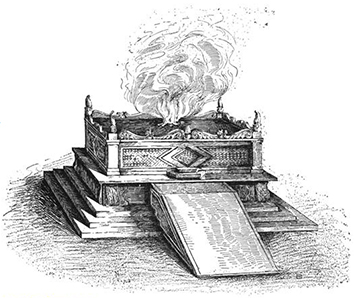
As soon as Adonijah heard this, he realized that he had made an enormous tactical error. A mistake that would likely cost him his life. So he ran to the altar of God — the place of sacrifice — and held on for dear life.

Bronze Altar of the Temple (courtesy of JewishEncyclopedia.com)

Bronze Altar of the Temple (courtesy of JewishEncyclopedia.com)

One commentary, written in 1871, explains why Adonijah would do this strange thing: “The horns or projections at the four corners of the altar… were symbols of grace and salvation to the sinner… The altar was regarded as a sanctuary. … Adonijah, having acted in opposition to the will of the reigning king, was guilty of rebellion, and stood self-condemned.”*

So Adonijah, recognizing his guilt, sought refuge. He sought shelter. He sought safety and forgiveness. He sought grace at the altar of God.

And he received it. King Solomon forgave Adonijah and told him just to “go home.” His life was spared.

Each of us makes mistakes, some of them more serious than others. Each of us sins, each of us misses the mark. But each of us has access to the forgiveness and grace of God. All of us have the ability to flee to the altar of God, holding on with everything in us to the promise given to us in Jesus Christ for refuge and shelter. Hebrews 9:24 and 26 tell us: “For Christ did not enter into a holy place made with human hands, which was only a copy of the true one in heaven. He entered into heaven itself to appear before God on our behalf. … Now, once for all time, he has appeared at the end of the age to remove sin by his own death as a sacrifice.”

Question:
What does it mean to you that sacrifice has already been made (past tense, permanent, and completed) for your sins? How do you understand what Jesus has done for you?

* Jamieson, Fausset, and Brown, The Commentary Critical and Explanatory on the Whole Bible.

Posted in Pondering Scripture | Leave a comment

Passing the Torch

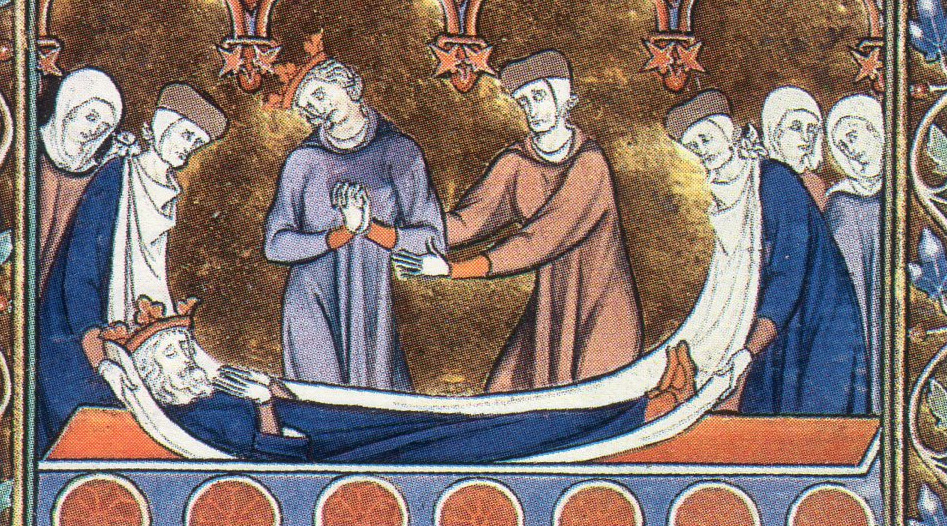
King David funeral from wikipedia

The funeral of King David, while his son Solomon watches (from a medieval manuscript)

1 Chronicles 29:23-28 (New American Standard Bible)
Then Solomon sat on the throne of the Lord as king instead of David his father; and he prospered, and all Israel obeyed him. All the officials, the mighty men, and also all the sons of King David pledged allegiance to King Solomon. The Lord highly exalted Solomon in the sight of all Israel, and bestowed on him royal majesty which had not been on any king before him in Israel. Now David the son of Jesse reigned over all Israel. The period which he reigned over Israel was forty years; he reigned in Hebron seven years and in Jerusalem thirty-three years.

David knew he would not live much longer, and so he established his son Solomon as the next king of Israel. David didn’t wait until his death to have Solomon crowned — he himself was witness to the coronation of Solomon as co-regent. He was ready to pass the crown to his son.

David had made mistakes during his reign as king of Israel — some of which had dire consequences — but he had lived his life with one goal: serving the God who had rescued him time and time again, and who had forgiven and loved him in spite of his imperfections. As he reached the end of his life, he could look forward with hope to what God would continue to do through his people.

TorchBefore the start of the 2014 Olympics, the world watched as the Olympic torch was relayed across thousands of miles. The moment of transfer is often a bittersweet moment. Your part of the race is completed. The goal has been reached. And now it is time to allow another person to run their part. No one person can do it all — or should do it all.

The New Testament records these hopeful words from the apostle Paul to a young man he was mentoring in Ephesus: For I am already being poured out as a drink offering, and the time of my departure has come. I have fought the good fight, I have finished the course, I have kept the faith; in the future there is laid up for me the crown of righteousness, which the Lord, the righteous Judge, will award to me on that day; and not only to me, but also to all who have loved His appearing” (1 Timothy 4:6-8).

How wonderful to have that kind of assurance, not just when we reach the end of our lives, but right here in the midst of it, as well. No matter what stage we’re at in life, we all have opportunities to pass on our knowledge, wisdom, and faith to the people around us. We have chances each day to follow Jesus’ example of love, forgiveness, and grace. We can be honest about our mistakes and flaws, and seek direction and reconciliation. We can allow our words and actions to speak volumes about the healing work God has done in our lives, and the eternal hope we have in God’s gracious love.

We can run the race before us with joy and with trust in God’s guiding hand.

Question:
How do you feel about the “race” you’re running right now?

Posted in Pondering Scripture | 1 Comment

Famous Last Words

King David funeral from wikipedia

The funeral of King David, while his son Solomon watches (from a medieval manuscript)

1 Kings 2:1-4 (New Living Translation)
As the time of King David’s death approached, he gave this charge to his son Solomon: “I am going where everyone on earth must someday go. Take courage and be a man. Observe the requirements of the Lord your God, and follow all his ways. Keep the decrees, commands, regulations, and laws written in the Law of Moses so that you will be successful in all you do and wherever you go. If you do this, then the Lord will keep the promise he made to me. He told me, ‘If your descendants live as they should and follow me faithfully with all their heart and soul, one of them will always sit on the throne of Israel.’”

If you look up “last words of famous people” online, a long list of sites will pop up. Presidents, movie stars, writers, criminals, heroes. Why do last words have such power? It seems as if the final utterance of a person should recap, consolidate, or serve as a capstone for that person’s life. In a This American Life broadcast on public radio, host Ira Glass said, “This is what we want from last words: a kind of summing up of who the person is.”

Often, however, that is not the case. The last words of Bing Crosby, that great singer of the mid-20th century, were reportedly: “That was a great game of golf, fellas.” (Not exactly a summary of his life.) Or the questionably authentic final words of 19th century author Oscar Wilde: “Either that wallpaper goes, or I do.”

But, sometimes, last words do speak volumes about who a person has been. John Wesley was the pastor who started the movement that became the Methodist Church. On his deathbed, he sang this hymn: “I’ll praise my Maker while I’ve breath; and when my voice is lost in death, praise shall employ my nobler powers. My days of praise shall ne’er be past, while life, and thought, and being last, or immortality endures.”

We’re told that as King David’s life drew to an end, he gave to his son Solomon the words of comfort, guidance, and warning in today’s reading. It was the advice of a loving father, a wise man, a great king. And, most importantly for David, it was also the advice of a life-long servant of the God of Israel — a man who had made many mistakes, but who had always fallen back on the love of the God he served.

Question:
If you could choose your last words on earth, what would you like them to be?

Posted in Pondering Scripture | Leave a comment

Divided Faith

census.gov screenshot1 Chronicles 21:1-4 (New International Version)
Satan rose up against Israel and incited David to take a census of Israel. So David said to Joab and the commanders of the troops, “Go and count the Israelites from Beersheba to Dan. Then report back to me so that I may know how many there are.” But Joab replied, “May the Lord multiply his troops a hundred times over. My lord the king, are they not all my lord’s subjects? Why does my lord want to do this? Why should he bring guilt on Israel?” The king’s word, however, overruled Joab; so Joab left and went throughout Israel and then came back to Jerusalem.

In 2010 we had a census here in the United States. Our constitution mandates that we take a census every ten years. The data collected is used to calculate the distribution of seats in the House of Representatives, the allocation of federal funding, and much more. The census is just an expected part of our lives.

So it could be surprising for us to read this from 1 Chronicles 21:1: “Satan rose up against Israel and incited David to take a census of Israel.” Why would Satan be interested in encouraging David to take a census? What’s the big deal? Why would it be sinful for David to do this?

It was sinful because it showed a dependence on earthly resources, instead of divine. David was chosen by God to be the king of the Israelites, and he had learned to rely on God’s strength, not his own. The taking of a census showed an increasing reliance on the measurable, the quantifiable, the material and mortal. David’s adviser Joab knew this when he cautioned him not to take this action: “Why on earth would you do a thing like this — why risk getting Israel into trouble with God?” (The Message translation).

It must have been hard for God to see this lack of trust from David, a man who had written these bold words: “Though an army besiege me, my heart will not fear; though war break out against me, even then I will be confident” (Psalm 27:3).

And now this from David, who as a young man stood in front of the giant Goliath, armed only with a sling, a few stones, and an unshakeable faith in God’s presence.

Question:
How easy is it for you to forget that God is with you in life? How easy is it for you to put your trust in temporary, earthly things instead of God?

Posted in Pondering Scripture | Leave a comment

Walking by Faith

Feet on Path

Psalm 40:1-2 (New Living Translation)
I waited patiently for the Lord to help me, and he turned to me and heard my cry. He lifted me out of the pit of despair, out of the mud and the mire. He set my feet on solid ground and steadied me as I walked along.

I didn’t grow up singing hymns. The soundtrack of my youth wasn’t Christian music, but whatever was playing on the local rock station. The first Christian CD I ever bought was Out of the Grey’s Remember This. I purchased it for the song “Walk by Faith,” which had stuck in my head after I heard it in passing one day.

“I’m gonna walk by faith, not by sight, ’cause I can’t see straight in the broad daylight. I’m gonna walk by faith, not by fear, ’cause I believe in the One who brought me here. I’m standing on the edge of whatever — whatever he has planned for me. My next step will be measured with confidence in the unseen.”

Okay, admittedly not the most creative lyrics (and pretty atrocious grammar), but the tune was really catchy, at least by late-90s standards.

Psalm 119:105 declares: “Your word is a lamp to guide my feet and a light for my path.” In our passage for today from Psalm 40, David remembers that God has promised love, redemption, and faithful guidance. He rejoices that even when he’s not sure where to place his next step, God will be there to support and steady him, to keep him going in the right general direction.

Question:
When you’re in a tricky place in your life — faced with difficult decisions about an unclear path — how do you decide what choice to make?

Posted in Pondering Scripture | 2 Comments

Scandal

Scandal

Psalm 51:10-14 (The Message)
God, make a fresh start in me, shape a Genesis week from the chaos of my life. Don’t throw me out with the trash, or fail to breathe holiness in me. Bring me back from gray exile, put a fresh wind in my sails! Give me a job teaching rebels your ways so the lost can find their way home. Commute my death sentence, God, my salvation God, and I’ll sing anthems to your life-giving ways. Unbutton my lips, dear God; I’ll let loose with your praise.

Several of my friends in the DC metro area are addicted to the television show “Scandal.” They say they watch it for the DC scenery… but we know the real reason they watch. They’ve talked about it so much, that even though I haven’t watched an episode (yet), I feel like I know what it’s all about. I mean, it’s called Scandal, right? And every day we see in our newspapers, on the internet, on tv the seeds for potential future Scandal episodes.

Like this plotline, seemingly made for Scandal:

David Benyishay is a charismatic leader of a world power. When he first took office, it seemed that the entire world was in love with him. He could do no wrong — he was the golden boy. But he has been in leadership now for several years, and he is feeling a bit bored with it all. He has sent off his staffers to a conference on his behalf with another nation. Even though he knew it would be a tricky, dangerous negotiation, and he really should have gone with them, he decided to stay home instead. He has lost interest in it all. He has also lost interest in his politically-connected wife, the daughter of a man who held the position before David.

David is wandering around aimlessly one day, and catches a glimpse of a beautiful woman. He follows her for a bit, then strikes up a conversation with her. He quickly learns that she is the wife of one of his staffers, Yuri, who is away at the conference. The woman’s name is Beth, and David finds her deeply intriguing. They fall into easy conversation, which lasts for hours, into the night. He invites her to come back to his house for a drink. One thing leads to another, and David and Beth engage in a brief, intense affair.

The last scene of the episode is of Beth in her bathroom at home, staring blackly at herself in the mirror. Just before the screen fades to the credits, the camera pans down to the pregnancy test lying next to the bathroom sink. Positive.

Over the next few episodes, we see how David spirals out of control after Beth breaks the news to him. First he calls Yuri home from the conference, and tries to manipulate him into a position where he would claim Beth’s child as his own. Several more attempts to “fix” the situation fail, and, then, in a moment of panic, desperate to protect his political image, David has Beth’s husband killed.

A few more episodes go by, focusing on other storylines. But, then, after several weeks, we come to a scene where David’s straight-talking Chief of Staff, Nathan, comes into his office. Nathan sits down across the desk, and starts to tell David a story about a man who betrayed his position of power, hurting the very people he was charged with protecting, destroying a family, and putting his nation at risk. Eventually David recognizes that the man his trusted advisor is speaking of is him. David is finally forced to acknowledge what he has done, and to take responsibility for his actions.

A Scandal plot line, straight from the Bible. With a few minor tweaks, of course, to update the story 3,000 years. If you’d like to read the original story, it’s in 2nd Samuel, chapters 11 and 12. David, the King of Israel, called “a man after God’s own heart,” falling miserably into sin and chaos.

It’s a deeply tragic story: David and Bathsheba’s affair.

Instead of leading his army in battle, King David chose to stay behind in Jerusalem. While idly passing the time, he slept Bathsheba, who quickly becomes pregnant. Her husband Uriah was a soldier in David’s army, but following several unsuccessful tries at covering his tracks, David had loyal Uriah killed.

When confronted by the prophet Nathan, David admitted his sins, and cried out, “I have sinned against the Lord” (2 Samuel 12:13). And, indeed, he has. Sloth. Lust. Envy. Greed. Anger. Pride. (The only of the “seven deadly sins” that I can’t find a way to connect with this story is gluttony.) David threw himself on the mercy of the God who had faithfully loved him, even when David had turned his back on that love.

David still faced the consequences of his actions, but God was still there for him. As much of a scandal as David had made of his kingship, as much as he had done wrong, God still loved him. God still wanted him.

No matter what we have done, no matter where we have gone, no matter how far we have wandered, no matter what… God still loves us. God still wants us. Always.

But far too many times I’ve heard people say things like this:

“If I walked into a church, lightning would strike.”
or
“People like me make church people nervous.”
or
“God can’t possibly love me. You don’t know what I’ve done.”

Just a few pages into his book What’s So Amazing About Grace?, Philip Yancey tells a story about the reaction of a prostitute he invited to his church: “Church! Why would I ever go there? I was already feeling terrible about myself. They’d just make me feel worse.”

This always breaks my heart. God’s love is the one constant in the universe. God’s arms are the one safe place to run to with all our fears and failures and brokenness. And the church community must be a place where all people can come, knowing that they will experience love, grace, and forgiveness.

After all, that’s what we hope to find there, too.

Question:
When you are stressed or worried or afraid, where is a “safe place” for you?

Posted in Pondering Scripture | Leave a comment

Hurting Those We Should Protect

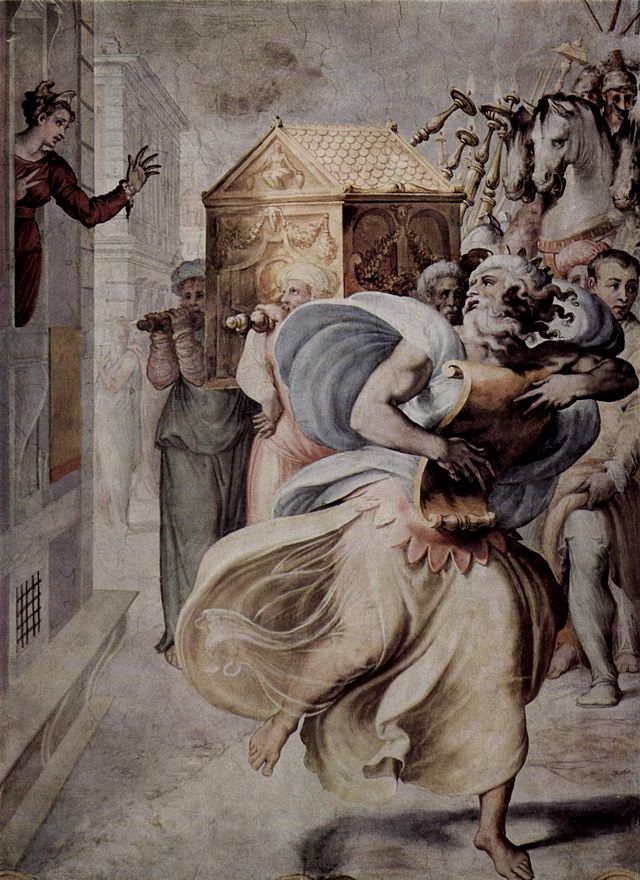
Ark of the Covenant by Gustave Doré (1865)

Ark of the Covenant by Gustave Doré (1865)

2 Samuel 6:13-16 (New Living Translation)
After the men who were carrying the Ark of the Lord had gone six steps, David sacrificed a bull and a fattened calf. And David danced before the Lord with all his might, wearing a priestly garment. So David and all the people of Israel brought up the Ark of the Lord with shouts of joy and the blowing of rams’ horns. But as the Ark of the Lord entered the City of David, Michal, the daughter of Saul, looked down from her window. When she saw King David leaping and dancing before the Lord, she was filled with contempt for him.

The moment recounted in today’s passage should have been a complete triumph for King David. He had consolidated his kingdom, and was bringing the Ark of the Lord into his new capital city, Jerusalem. It is no wonder that he was overcome with joy and danced in the processional. But the celebration was interrupted by a very personal, very painful argument between David and his wife Michal just a few verses later:

When David returned home to bless his own family, Michal, the daughter of Saul, came out to meet him. She said in disgust, “How distinguished the king of Israel looked today, shamelessly exposing himself to the servant girls like any vulgar person might do!” David retorted to Michal, “I was dancing before the Lord, who chose me above your father and all his family! He appointed me as the leader of Israel, the people of the Lord, so I celebrate before the Lord. Yes, and I am willing to look even more foolish than this, even to be humiliated in my own eyes! But those servant girls you mentioned will indeed think I am distinguished!” So Michal, the daughter of Saul, remained childless throughout her entire life.

Back in 1 Samuel 18, we were told that Saul’s daughter Michal had fallen in love with David. She was used as a bribe in an attempt to trick David into reckless action, with Saul hoping the young man would be killed in battle. When that plot failed, Michal was given to David as his prize. After the wedding, as she looked into her new husband’s eyes, she must have been so happy.

But Saul, angry with David, steals her away and gives her to yet another man, Paiti, son of Laish. This second husband appears to have had great love for her. But after David’s power grew, he demanded that Michal be given back to him. So she was, yet again, forcibly removed from another husband’s home. Paiti followed behind her and the guards, weeping, until he was compelled to return to his home alone. Years after their original marriage, she was given back to David, whose only interest in her seems to be political: she was of value to him as “King Saul’s daughter.”

According to The New Interpreter’s Bible: “As his kingdom interests bring Michal’s story to a bitter end, David is in the dangerous position of claiming to honor the Lord while completing the final humiliation of one who had once offered him love” (vol II, page 1250).

David is considered the greatest king of Israel. He is called “a man after God’s own heart” (1 Samuel 13:14). And yet is is also a flawed man, who ended up hurting a person he should have gone great lengths to protect: his wife.

Question:
How do you keep the practical demands of your life from overshadowing the personal?

Posted in Pondering Scripture | Leave a comment

Valued & Important

1 Chronicles 9:27-31 (The Message)
Being Levites, they were responsible for the security of all supplies and valuables in the house of God. They kept watch all through the night and had the key to open the doors each morning. Some were in charge of the articles used in The Temple worship — they counted them both when they brought them in and when they took them out. Others were in charge of supplies in the sanctuary — flour, wine, oil, incense, and spices. And some of the priests were assigned to mixing the oils for the perfume. The Levite Mattithiah, the firstborn son of Shallum the Korahite, was responsible for baking the bread for the services of worship. Some of the brothers, sons of the Kohathites, were assigned to preparing the bread set out on the table each Sabbath.

I love that this level of detail is included in our Bible. Even before the building of the Temple (which would happen under the reign of David’s son Solomon), its daily administration has been provided for. The duties recorded here are not glamorous, “center-stage” responsibilities, but they are very important, very necessary, very essential.

Our nephew William happily "mowing" the lawn.

Our nephew William happily “mowing” the lawn.

What would happen if those who cared for a church’s grounds suddenly decided that their gifts weren’t necessary? We’d have trouble finding the path to the church as the grass grew into a field around it. What if the folks who run the technology determined that their role was dispensable? We’d have no lights, no sound, no video. Or if the hospitality teams decided they weren’t needed? There would be no one to greet worshippers and show new people around, and we’d have no coffee (*shudder*)!

In his first letter to the church in Corinth, Paul talks about the many spiritual gifts given to the people of the church. He explains how all the gifts are important by using the metaphor of the body: “If the whole body were an eye, how would you hear? Or if your whole body were an ear, how would you smell anything? But our bodies have many parts, and God has put each part just where he wants it. How strange a body would be if it had only one part! Yes, there are many parts, but only one body. The eye can never say to the hand, ‘I don’t need you.’ The head can’t say to the feet, ‘I don’t need you'” (1 Corinthians 12:18-21).

God has given every person in the church gifts, talents, and passions. God has given you gifts! Your gifts might include compassion, serving, or faith. Or maybe teaching, giving, or leadership. Or perhaps creativity or musical ability or wisdom or communication or prophecy or administration. Or healing or preaching or… you get the point! God has provided gifts that cover every aspect of Christian community. That means every one of us has an important place in God’s kingdom.

Question:
How are your gifts and talents being used?

Posted in Pondering Scripture | Leave a comment

Music Soothes the Savage Breast

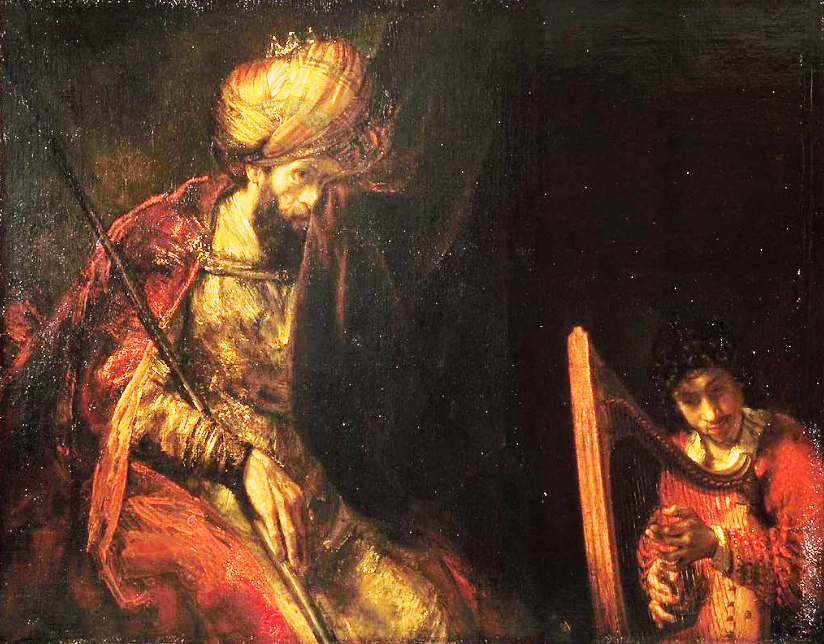
Saul and David, by Rembrandt, c. 1650

Saul and David, by Rembrandt, c. 1650

1 Chronicles 6:31-32 (New Living Translation)
David assigned the following men to lead the music at the house of the Lord after the Ark was placed there. They ministered with music at the Tabernacle until Solomon built the Temple of the Lord in Jerusalem. They carried out their work, following all the regulations handed down to them.

What a great statement: “they ministered with music.” Music has the ability to touch our spirits in ways that mere words sometimes cannot. The notes reverberate deep within us, calling us to deeper connection with God.

As a young man, David had direct experience with the power of music. When King Saul was deeply troubled, David would be called in to play his harp. The music soothed Saul and he began to feel better.

The first line of William Congreve’s play The Mourning Bride is: “Music hath charms to soothe the savage breast, to soften rocks, or bend a knotted oak.”

I always thought the line was “Music has charms to soothe the savage beast.” But the point is the same: music can have a powerful effect on us. David knew that music was a gift from God, with the potential to restore, inspire, and enliven. And so he ensured that music would be a part of worship in the Temple.

Question:
What song makes you want to get up and dance? What song makes you feel like crying? What song speaks to your soul?

Posted in Pondering Scripture | 1 Comment