Joseph – week 2, day 2

Pentecost

TODAY’S SCRIPTURE: Genesis 40:16-23 (NLT*)

When the chief baker saw that Joseph had given the first dream such a positive interpretation, he said to Joseph, “I had a dream, too. In my dream there were three baskets of white pastries stacked on my head. The top basket contained all kinds of pastries for Pharaoh, but the birds came and ate them from the basket on my head.”

“This is what the dream means,” Joseph told him. “The three baskets also represent three days. Three days from now Pharaoh will lift you up and impale your body on a pole. Then birds will come and peck away at your flesh.”

Pharaoh’s birthday came three days later, and he prepared a banquet for all his officials and staff. He summoned his chief cup-bearer and chief baker to join the other officials. He then restored the chief cup-bearer to his former position, so he could again hand Pharaoh his cup. But Pharaoh impaled the chief baker, just as Joseph had predicted when he interpreted his dream. Pharaoh’s chief cup-bearer, however, forgot all about Joseph, never giving him another thought.

AN IMAGINARY JOURNAL ARTICLE

Quote BeginWhen I heard what Joseph told the cupbearer, I couldn’t wait for him to interpret my dream. Now I wish I had never spoken to him at all. He tells the cupbearer that things are going to be all wonderful and happy for him, but me? Poor me? He tells me that I’m going to end up with my head on a pole within three days. Great. At first I thought that maybe Joseph was just a crackpot. Why listen to anything he had to say? After all, if he was such great shakes as a dream interpreter, what is he doing stuck in a prison? If he was any good, he would be in demand all around the kingdom. So, no. I’m not going to worry. By now, the Pharaoh has forgotten all about us. I’ll just bide my time here. I don’t need to go back to that messy old palace kitchen to bake bread for the royal family. I like my head just where it is, thank you very much. Not that I believe anything Joseph said about the dreams. He doesn’t know what he’s talking about! Nothing is going to happen… Oh dear… The warden just said that the cupbearer and I have been released, and Pharaoh is asking for us. Suddenly the prison isn’t looking so bad.Quote End
— Pharaoh’s Baker

THINGS TO THINK ABOUT…

  • What are the differences between the dreams of the cupbearer and the chief baker?
  • How might you have interpreted the baker’s dream?
  • How do you think Joseph might have felt delivering the interpretation?
  • Why do you think it was so easy for the cupbearer to forget his promise to Joseph?
  • Joseph remains in prison for two more years following his interaction with the cupbearer and chief baker. If you were in his situation, would the fact that your interpretations of the dreams had been correct give you comfort, even though you remained in prison?

FOLLOW-UPS

The Pharaoh in Genesis lived in a pre-gluten-free world, where “baking bread and cakes was one of the most important food-preparation activities undertaken in the household on a daily basis… Bread was literally the ‘staff of life’: along with other foods made from wheat, barley, and other grains, bread was the primary source of carbohydrate in the Iron Age diet. Several hundred types of breads and pastries have been documented in ancient Near Eastern literature.”
The New Interpreter’s Dictionary of the Bible, vol. 1 (Abingdon Press: Nashville, 2006, 382.)


Holy Bible, New Living Translation, copyright © 1996, 2004, 2015 by Tyndale House Foundation.

Posted in Pondering Scripture | Tagged , , | Leave a comment

Joseph – week 2, day 1

Pentecost

TODAY’S SCRIPTURE: Genesis 40:1-15 (NRSV*)

Some time after this, the cupbearer of the king of Egypt and his baker offended their lord the king of Egypt. Pharaoh was angry with his two officers, the chief cupbearer and the chief baker, and he put them in custody in the house of the captain of the guard, in the prison where Joseph was confined. The captain of the guard charged Joseph with them, and he waited on them; and they continued for some time in custody. One night they both dreamed—the cupbearer and the baker of the king of Egypt, who were confined in the prison—each his own dream, and each dream with its own meaning. When Joseph came to them in the morning, he saw that they were troubled. So he asked Pharaoh’s officers, who were with him in custody in his master’s house, “Why are your faces downcast today?” They said to him, “We have had dreams, and there is no one to interpret them.” And Joseph said to them, “Do not interpretations belong to God? Please tell them to me.”

So the chief cupbearer told his dream to Joseph, and said to him, “In my dream there was a vine before me, and on the vine there were three branches. As soon as it budded, its blossoms came out and the clusters ripened into grapes. Pharaoh’s cup was in my hand; and I took the grapes and pressed them into Pharaoh’s cup, and placed the cup in Pharaoh’s hand.” Then Joseph said to him, “This is its interpretation: the three branches are three days; within three days Pharaoh will lift up your head and restore you to your office; and you shall place Pharaoh’s cup in his hand, just as you used to do when you were his cupbearer. But remember me when it is well with you; please do me the kindness to make mention of me to Pharaoh, and so get me out of this place. For in fact I was stolen out of the land of the Hebrews; and here also I have done nothing that they should have put me into the dungeon.”

AN IMAGINARY JOURNAL ARTICLE

Quote BeginDreams are the strangest things. I mean, I’m a good Egyptian servant, and I know that dreams are supposed to be messages from the gods, but couldn’t the gods make their messages easier to understand? Stuck in this prison cell, I sure could use a bit of hope and guidance. But what was I supposed to make of this dream? I was complaining to my friend, the baker, about how hard it is to understand dreams, and one of the other prisoners asked me for more details. I told him about the branches, the grapes, and pouring the wine into Pharaoh’s cup, and he said that I would be free in three days, and restored to my position of honor as Pharaoh’s cupbearer! Who would have thought that I would hear a word of hope in this god-forsaken prison? I sure hope this Joseph guy is right! He asked me to remember him when I’m released, and to tell Pharaoh about his situation. No problem! If I get out, how could I forget what Joseph did for me? Oh, man, I hope he is right about that dream… I just can’t stand it in here for much longer!Quote End
— Pharaoh’s Cupbearer

THINGS TO THINK ABOUT…

  • If you heard the cupbearer’s dream, how might you have interpreted it?
  • Joseph shows a great deal of empathy in verses 6-7. For someone who had not been able to “read” his brothers’ emotions very effectively, what do you think has prompted this change in Joseph?
  • What is Joseph implying when he asks, “Do not interpretations belong to God?” (verse 8)
  • How confident does Joseph seem in his ability to interpret the dreams? What does this say about how he feels about his relationship with God at this point in his life?
  • What do you think the cupbearer’s reaction might have been to hearing his dream interpreted?

FOLLOW-UPS

According to The New Interpreter’s Dictionary of the Bible, the cupbearer was “a wine taster and trusted royal advisor in Egyptian, Israelite, Assyrian, Persian, and other Near Eastern courts.” Wikipedia (an online encyclopedia edited by its readers) states: “A cupbearer was an officer of high rank in royal courts, whose duty it was to serve the drinks at the royal table. On account of the constant fear of plots and intrigues, a person must be regarded as thoroughly trustworthy to hold this position. He must guard against poison in the king’s cup, and was sometimes required to swallow some of the wine before serving it. His confidential relations with the king often gave him a position of great influence. The position of cup bearer is greatly valued and given to only a select few throughout history.” To read the entire Wikipedia article on cupbearers, click here.


New Revised Standard Version Bible, copyright © 1989 the Division of Christian Education of the National Council of the Churches of Christ in the United States of America.

Posted in Pondering Scripture | Tagged , , , | Leave a comment

Joseph – week 1, day 6

Pentecost

TODAY’S SCRIPTURE: Genesis 39:11-23 (NLT*)

One day, however, no one else was around when he went in to do his work. She came and grabbed him by his cloak, demanding, “Come on, sleep with me!” Joseph tore himself away, but he left his cloak in her hand as he ran from the house. When she saw that she was holding his cloak and he had fled, she called out to her servants. Soon all the men came running. “Look!” she said. “My husband has brought this Hebrew slave here to make fools of us! He came into my room to rape me, but I screamed. When he heard me scream, he ran outside and got away, but he left his cloak behind with me.”She kept the cloak with her until her husband came home. Then she told him her story. “That Hebrew slave you’ve brought into our house tried to come in and fool around with me,” she said. “But when I screamed, he ran outside, leaving his cloak with me!” Potiphar was furious when he heard his wife’s story about how Joseph had treated her. So he took Joseph and threw him into the prison where the king’s prisoners were held, and there he remained. But the Lord was with Joseph in the prison and showed him his faithful love. And the Lord made Joseph a favorite with the prison warden. Before long, the warden put Joseph in charge of all the other prisoners and over everything that happened in the prison. The warden had no more worries, because Joseph took care of everything. The Lord was with him and caused everything he did to succeed.

AN IMAGINARY JOURNAL ARTICLE

Quote BeginI was just trying to make the best of a bad situation. The people who bought me from my brothers were not the nicest of individuals, and I figured that the next situation I was passed into would be just as bad. But then I was sold to Potiphar’s household. What a change! At first, I was just trying to get familiar with my new responsibilities, but they weren’t really challenging, and Potiphar kept giving me more and more to do. I had no idea that I could handle so much! My father and brothers always took care of everything for me, and I wasn’t really trusted with anything significant. Even though I was working as a slave, it was certainly much better than it could have been. And then… just as things were going well… Mrs. Potiphar. I saw her looking me up and down, and she made me very nervous. I tried to stay away from her as much as possible, but it just isn’t that big of a house. One day she cornered me. I tried to explain as best I could why this was SUCH a bad idea, but she didn’t care. I got away, but she kept trying to trap me. And she sure did trap me now! She told her husband that I tried to rape her. She had taken my coat, and used it to “prove” to Potiphar that I had been in her room. After all that I had done for Potiphar, he took her word over mine, and threw me in this prison. But even here, it has been better than I thought it would be. The warden is a nice guy, and lets me use my new-found administrative skills to help him out. I suppose it could be worse…Quote End
— Joseph

THINGS TO THINK ABOUT…

  • Do you think Potiphar’s wife was in love with Joseph?
  • When Joseph initially refused to sleep with her, why did she continue to pursue him so intently?
  • Potiphar has trusted Joseph with running his household, and he now hears that Joseph attempted to harm his wife. If you were in Potiphar’s position, how do you imagine you would react?
  • Joseph has again been betrayed, even though this time he tried to do the moral and correct thing. How do you think he felt when he entered his prison cell?
  • Joseph’s administrative skills are again put to use, this time by the warden. How do you account for this growing ability and strength in Joseph?

FOLLOW-UPS

“…prisons were known for inflicting severe hardship, especially when prisoners were chained in place or to guards. Jailers were known as men of abject cruelty. Overcrowding, darkness, psychological distress, and malnutrition characterized the incarceration experience. Most prisoners required friends or relatives to supply their food and necessities. In addition to physical and emotional distress, prison settings also brought social shame upon their inhabitants and their associates. Nevertheless, some prisoners’ conditions permitted modest freedoms, including reading, writing, and preparing defenses.”
The New Interpreter’s Dictionary of the Bible, vol. 4 (Abingdon Press: Nashville, 2009, 615.)


* Holy Bible, New Living Translation, copyright © 1996, 2004, 2015 by Tyndale House Foundation. Used by permission of Tyndale House Publishers Inc., Carol Stream, Illinois 60188. All rights reserved.

Posted in Pondering Scripture | Tagged , , | Leave a comment

Joseph – week 1, day 5

Pentecost

TODAY’S SCRIPTURE: Genesis 39:1-10 (NASB*)

Now Joseph had been taken down to Egypt; and Potiphar, an Egyptian officer of Pharaoh, the captain of the bodyguard, bought him from the Ishmaelites, who had taken him down there. The Lord was with Joseph, so he became a successful man. And he was in the house of his master, the Egyptian. Now his master saw that the Lord was with him and how the Lord caused all that he did to prosper in his hand. So Joseph found favor in his sight and became his personal servant; and he made him overseer over his house, and all that he owned he put in his charge. It came about that from the time he made him overseer in his house and over all that he owned, the Lord blessed the Egyptian’s house on account of Joseph; thus the Lord’s blessing was upon all that he owned, in the house and in the field. So he left everything he owned in Joseph’s charge; and with him there he did not concern himself with anything except the food which he ate. Now Joseph was handsome in form and appearance. It came about after these events that his master’s wife looked with desire at Joseph, and she said, “Lie with me.” But he refused and said to his master’s wife, “Behold, with me here, my master does not concern himself with anything in the house, and he has put all that he owns in my charge. There is no one greater in this house than I, and he has withheld nothing from me except you, because you are his wife. How then could I do this great evil and sin against God?” As she spoke to Joseph day after day, he did not listen to her to lie beside her or be with her.

AN IMAGINARY JOURNAL ARTICLE

Quote BeginI seriously got a bargain with this new slave. Whatever my servants paid for him from that caravan, I got a bargain! I could tell right away that this slave was special. Most of them arrive pretty beaten up and despondent, and this one was certainly not at his best, but I could see a glint of intelligence in his eyes. I put him in charge of a few small things, just feeling him out, and he did excellently at everything I gave him. Organized, thrifty, respectful. And, if he wasn’t a slave, I would even say he was wise. But he IS a slave, so let’s just say he is smart. Every new responsibility I turned over to him, he mastered right away. It is so great to have a slave I can count on. Having him here has really freed me up. I don’t need to be so worried about managing the household, and can focus on my work. Yes, I got a bargain with this slave. And, surprisingly, even my wife agrees with this. She doesn’t usually approve of anything I do, so I’m glad she gets along so well with him. What a relief… Quote End
— Potiphar

THINGS TO THINK ABOUT…

  • Joseph has been betrayed by his own family, and has been brought a long distance to be sold into slavery. As he is transferred from the Ishmaelites to the Midianites to Potiphar’s household, how do you imagine Joseph is feeling?
  • Just a few passages ago, Joseph was gloating to his brothers about his dreams of power. Do you think those dreams would sustain Joseph during this time, or haunt him?
  • In the prior chapters, Joseph hasn’t shown much leadership ability. And yet in Potiphar’s household he almost immediately becomes a trusted servant. What do you think has changed?
  • Potiphar’s wife tries to entice Joseph to sleep with her. What are Joseph’s stated reasons for refusal?
  • How would you feel if you were in Joseph’s position, with the spouse of the boss trying to seduce you, and with your job (and life) on the line?

FOLLOW-UPS

Click here to view the painting Joseph and Potiphar’s Wife by Guido Reni (1575-1642). This painting is currently on view at The Getty Center in Los Angeles.


New American Standard Bible (NASB), Copyright © 1960, 1962, 1963, 1968, 1971, 1972, 1973, 1975, 1977, 1995 by The Lockman Foundation.

Posted in Pondering Scripture | Tagged , , | Leave a comment

Joseph – week 1, day 4

Pentecost

TODAY’S SCRIPTURE: Genesis 37:29-36 (NRSV*)

When Reuben returned to the pit and saw that Joseph was not in the pit, he tore his clothes. He returned to his brothers, and said, “The boy is gone; and I, where can I turn?” Then they took Joseph’s robe, slaughtered a goat, and dipped the robe in the blood. They had the long robe with sleeves taken to their father, and they said, “This we have found; see now whether it is your son’s robe or not.” He recognized it, and said, “It is my son’s robe! A wild animal has devoured him; Joseph is without doubt torn to pieces.” Then Jacob tore his garments, and put sackcloth on his loins, and mourned for his son many days. All his sons and all his daughters sought to comfort him; but he refused to be comforted, and said, “No, I shall go down to Sheol to my son, mourning.” Thus his father bewailed him. Meanwhile the Midianites had sold him in Egypt to Potiphar, one of Pharaoh’s officials, the captain of the guard.

AN IMAGINARY JOURNAL ARTICLE

Quote BeginThere’s just something about a youngest son. The smallest of my children, my last chance to get it right. Joseph was such a bright child, full of curiosity and enthusiasm. He reminded me so much of me as a young boy. Always getting into trouble, but fearlessly exploring and stretching the boundaries of what he knew. Joseph had some difficulties with his older brothers, but that’s just a part of being in a family. After all, my older brother Esau and I used to fight constantly, and Joseph and his brothers were no different. I remember how much attention my father paid to my older brother — how he called him his favorite — and how that made me feel. I vowed never to let that happen to my youngest boy. I admit that I did occasionally go overboard with Joseph, and that didn’t make his brothers very happy. But he brought me so much joy! Oh, but now… He’s gone… I can’t believe it. My little boy, my hope and pride. Gone. His brothers brought back his torn and bloody coat— the very coat I had made for him. People are coming from all over to comfort me. But what comfort can they offer? My little boy Joseph… the comfort of my old age… is gone forever… Quote End
— Jacob

THINGS TO THINK ABOUT…

  • What do you think of Reuben’s question to his brothers: “The boy is gone, and I, where can I turn?”
  • How would you have felt if you were in Reuben’s place?
  • There is no mention of the brothers giving Reuben an explanation for Joseph’s disappearance. They are entirely silent. Why does Reuben agree to the conspiracy?
  • What is the symbolism of the brothers’ use of the coat here?
  • What did the brothers hope to gain by ridding themselves of Joseph?
  • Did their conspiracy accomplish this goal?
  • Does Jacob’s reaction to Joseph’s alleged death surprise you? How do you imagine you would have reacted upon receiving the news?

FOLLOW-UPS

As the eldest son, Reuben was responsible for his brothers’ behavior and for their safety while they were away from their father. When Reuben returns to find Joseph gone, he “tears his clothing.” In that culture, this was a sign of deep grief and despair. Click here to read an interesting (and short) article about the Jewish practice of tearing clothing as a sign of mourning. This article is from the website of a sect of Judaism, the Chabad-Lubavitch movement.


* New Revised Standard Version Bible, copyright © 1989 the Division of Christian Education of the National Council of the Churches of Christ in the United States of America. Used by permission. All rights reserved.

Posted in Pondering Scripture | Tagged , , | Leave a comment

Joseph – week 1, day 3

Pentecost

TODAY’S SCRIPTURE: Genesis 37:18-28 (NRSV*)

They saw him from a distance, and before he came near to them, they conspired to kill him. They said to one another, “Here comes this dreamer. Come now, let us kill him and throw him into one of the pits; then we shall say that a wild animal has devoured him, and we shall see what will become of his dreams.” But when Reuben heard it, he delivered him out of their hands, saying, “Let us not take his life.” Reuben said to them, “Shed no blood; throw him into this pit here in the wilderness, but lay no hand on him”—that he might rescue him out of their hand and restore him to his father. So when Joseph came to his brothers, they stripped him of his robe, the long robe with sleeves that he wore; and they took him and threw him into a pit. The pit was empty; there was no water in it.

Then they sat down to eat; and looking up they saw a caravan of Ishmaelites coming from Gilead, with their camels carrying gum, balm, and resin, on their way to carry it down to Egypt. Then Judah said to his brothers, “What profit is it if we kill our brother and conceal his blood? Come, let us sell him to the Ishmaelites, and not lay our hands on him, for he is our brother, our own flesh.” And his brothers agreed. When some Midianite traders passed by, they drew Joseph up, lifting him out of the pit, and sold him to the Ishmaelites for twenty pieces of silver. And they took Joseph to Egypt.

AN IMAGINARY JOURNAL ARTICLE

Quote BeginI had no idea that my brothers could be so bloodthirsty. Joseph is an annoying kid, no doubt about it, but as soon as we saw him coming up over the hill they started talking about killing him! I have to admit I was shocked. Big brother Reuben stepped in to the rescue, and he talked our brothers out of killing Joseph. He convinced them to just throw Joseph down the well. I thought that might even be good for the little tattle-tale! Put a little fear in him, warn him that he shouldn’t mess with his older brothers. A good lesson for him to learn. Certainly our father wasn’t going to teach him to respect us. So when Joseph showed up, we gave him a good scare, taking away that ridiculously expensive coat that our father had given him. (He never gave ME anything half so nice.) Then we gave him a shove into the well. You should have heard the whining. What a wimp. Not like there was water in the well. He wasn’t going to drown. We’re not that mean. But then… as soon as Reuben left, the talk started back up again: “Let’s kill the boy.” I started getting nervous. Even though Simeon and Levi are older than me, I knew that I had to be the voice of reason. But I’m not an authority figure like Reuben, and it’s a good thing that caravan came by when Quote Endthey did! If they hadn’t come by, I think my brothers might really have killed him…
— Judah

THINGS TO THINK ABOUT…

  • Are you surprised by the violence of the brothers’ reaction to seeing Joseph approaching?
  • Do you think the brothers really wanted to kill Joseph, or were they exaggerating out of anger?
  • What is the symbolism of the brothers taking away the coat that Jacob had given to Joseph?
  • Do you think that Reuben believed he had convinced the brothers not to kill Joseph?
  • How do you think Joseph felt when he was down in the well?
  • Do you think that Joseph believed that his brothers would do him real harm?
  • Ironically, the brothers’ selling Joseph into slavery will make it possible for his earlier dreams to eventually become reality. What do you think the brothers would have done if they understood this?
  • How do you think Joseph felt when he realized that his brothers really were betraying him, that this was not just a cruel practical joke?
  • If you were on the caravan, and you came upon this dysfunctional family, what would you have thought of their decision to sell off their youngest brother?

FOLLOW-UPS

“No individual in this story emerges innocent. Even Joseph, though certainly the primary victim, furnishes fuel for his own troubles. Everyone in his own way contributes to the mess in which the family finds itself; at the same time, to level out the sins of the characters and to make everyone equally irresponsible is to fail to consider issues of communal consequence. Or to turn God into an all-determining power undermines human responsibility for sin and encourages human passivity in the face of the power of evil.” (The New Interpreter’s Bible, vol. I, Abingdon Press: Nashville, 1994, page 601.)


* New Revised Standard Version Bible, copyright © 1989 the Division of Christian Education of the National Council of the Churches of Christ in the United States of America. Used by permission. All rights reserved.

Posted in Pondering Scripture | Tagged , , , | Leave a comment

Joseph – week 1, day 2

Pentecost

Quote BeginI didn’t want to take the sheep to the pasture near Shechem. My brothers were still so mad at me about the dreams, it just wasn’t fun being with them. They’ve been giving me dirty looks for days, and every time I try to talk to one of them, they just walk away from me without saying anything. I hoped Dad wouldn’t notice when I didn’t leave home with them and the flocks. But, of course, he did. He told me to go check on them, to make sure everything was okay. Right. Like they would talk with me anyway. They don’t want me around, that much is obvious. Don’t have to be the smartest person around to figure that out. So why would Dad do this??? I think I’m near now where the flocks should be, but I’ve stopped for a few minutes. It’s a nice sunny day, and I found a nice flat rock to sit on and write. There’s plenty of time for me to catch up with my brothers. Not like they’re waiting around for me to show up! They’re probably really happy I’m not there to bug them. It’s better hanging out here. I’m in no hurry…
— Joseph

Click here to read this section in the Bible: Genesis 37:12-17

THINGS TO THINK ABOUT…

  • Why do you think Jacob sent Joseph to the grazing land near Shechem to meet up with his brothers? What was he hoping would happen?
  • Jacob tells Joseph to go check on the “well-being” (shalom) of his other sons and the flocks. Shalom is a Hebrew word which means “welfare,” “peace,” “wholeness.” Do you think Jacob hasn’t noticed the lack of shālom in his family at this time, or is he trying to give Joseph and his brothers an opportunity to return to shalom?
  • Joseph’s last interaction with his brothers did not end on a positive note, and this time Joseph’s father is not nearby to run to for protection. If you were Joseph approaching his brothers, how do you imagine you would feel?
  • We’re told that Joseph was “found wandering about” and was given directions to where his brothers’ flocks were. Do you think this “wandering” was intentional (was he avoiding running into them) or was Joseph really lost?
Posted in Pondering Scripture | Tagged , , , | Leave a comment

Joseph – week 1, day 1

In the church I serve — Plantation United Methodist Church — we’re beginning a new sermon series, Broken Chains, based on the story of Joseph in Genesis. It’s a fascinating story of a family that lived almost 4,000 years ago, but whose issues still resonate with us today! Each day of the series, I’ll be posting here with a scripture link, an imaginary quote from one of the characters in the story, and some thoughts to ponder. I hope you’ll be a part of this exploration! Many, many blessings to you and yours!

Pentecost

Quote BeginI didn’t ask for the dreams. And, no matter what my brothers think, I didn’t make them up either. Maybe I shouldn’t have told them about the dreams, but they were just burning in my mind. I had to share them, or burst! But as soon as I started talking about the dreams, I could see my brothers’ faces getting angry. But, you know, so what? They’re always angry with me about something! They call me a tattle-tale. They order me around, telling me what to do, calling me a spoiled brat and a daddy’s-boy. I’m so tired of it. Dad used to tell me about dreams he had that came from God, so I figured these dreams came to me from God, too! And I felt so good in the dreams, so strong and powerful. It felt really good! So I just HAD to tell my brothers about them. But then they started yelling at me, saying such mean things. I ran to tell Dad on them, and I told him the dreams, too. I thought Dad would like hearing about the dreams, but he wasn’t happy about them either. But at least he didn’t yell at me like my brothers did. Dad had a funny, far-away look on his face the rest of the night, like he was thinking about something important. Anyway, I’m going to sleep now. Maybe I’ll have another good dream.
— Joseph

Click here to read this section in the Bible: Genesis 37:1-11

THINGS TO THINK ABOUT…

  • What is your initial impression of Joseph? Of the brothers? Of Jacob?
  • How did Jacob contribute to the tension between Joseph and his older brothers?
  • If you were one of the brothers, how would you feel about the relationship between Jacob and Joseph?
  • What is the symbolism of the robe Jacob makes for Joseph?
  • Why do you think Joseph shared the two dreams with his brothers?
  • We read that Jacob “kept the matter in mind.” Why do you think Jacob doesn’t just dismiss the dreams as figments of a young boy’s imagination?
  • How would you interpret the dreams?

FOLLOW-UPS

“Dreams in that world were usually understood to be externally and divinely generated, not the result of an interior psychological process. Yet the brothers interpret Joseph’s dreams as if they are the product of Joseph’s own arrogance rather than a divine word about destiny.”
The New Interpreter’s Bible, vol. I (Abingdon Press: Nashville, 1994, 600-601.)

Posted in Pondering Scripture | Tagged , , | 1 Comment

Blessed

Matthew 4:1-12 (New Revised Standard Version)
When Jesus saw the crowds, he went up the mountain; and after he sat down, his disciples came to him. Then he began to speak, and taught them, saying: “Blessed are the poor in spirit, for theirs is the kingdom of heaven. Blessed are those who mourn, for they will be comforted. Blessed are the meek, for they will inherit the earth. Blessed are those who hunger and thirst for righteousness, for they will be filled. Blessed are the merciful, for they will receive mercy. Blessed are the pure in heart, for they will see God. Blessed are the peacemakers, for they will be called children of God. Blessed are those who are persecuted for righteousness’ sake, for theirs is the kingdom of heaven. Blessed are you when people revile you and persecute you and utter all kinds of evil against you falsely on my account. Rejoice and be glad, for your reward is great in heaven, for in the same way they persecuted the prophets who were before you.

“Have a blessed day,”
says the cashier at my neighborhood grocery
and I smile at her
“You too!”

Blessed

As I walk out into the heat
of the South Florida day
I pass a fancy new car
parked next to mine
with an “I’m blessed” sticker
pressed onto the shiny bumper

Blessed

On my Facebook feed
I see posts
from friends, acquaintances, family,
excited about the blessings in their lives
new baby
new home
new job
new car

happiness
pleasure
contentment
good fortune

Blessed

Become a Better You
the book cover tells us
in the self improvement section

Your Best Life Now
we’re promised
for just $25.99

Five easy steps
to a profitable life
a prosperous life
a blessed life

And yet

Jesus stands on hill
overlooking the Sea of Galilee
he stretches out his arms
to the crowd standing below

who have come
looking for healing
searching for hope
praying for blessing

And Jesus offers them
a word
a word of blessing

Makarioi, he says
in the Greek
Blessed are…

Makarioi, he says
Fortunate are…

Makarioi, he says
To be envied are…

Makarioi, he says
Happy are…

But the words we expect to follow
makarioi
aren’t the words we hear
from Jesus’ lips

Blessed are those
whose health is secure
whose bank account is stuffed
whose marriage is solid
whose job is safe

Blessed are those
whose position is powerful
whose reputation pristine
whose appearance pretty
whose career prospering

No

Makarioi, Jesus says
Blessed are…

The poor in spirit
he says

and the people below
furrow their brows
turning to their neighbors
with a quizzical look

“Did he just say
what I think he said?”

Poor in spirit
he says
and not just poor
not just struggling,
but crouching, cowering
like a fear-filled beggar
Destitute
No resources
No prospects
No hope

Blessed?

Makarioi, he says
Blessed are…

Those who mourn
he says

and the people below
start to lean forward in disbelief
staring up at this man
who obviously
does not understand
the words he is using

The mourning
the grieving
the torn-in-pieces hearts
broken dreams
shattered lives
painfully relinquished hopes

Blessed he says
are those whose
hearts are blown open
as they grieve the loss
of someone in their life
who understood them
loved them
cared for them
supported them

Blessed?

Makarioi, he says
Blessed are…

The meek
he says
those who are mild
and gentle
and kind

And those listening below
start to laugh
“The meek!” they say
in a stage whisper
heard by all those around them

“The meek!
You mean the ones
who get walked on
the doormats
the pushovers
the spineless soft touches
who never get anywhere in this world?”

Blessed?

Makarioi, Jesus says
Blessed are…

Those who
hunger and thirst
for righteousness
he says

“Oh man,” they say,
“this guy’s off his rocker!
Hungering
and thirsting
yearning for justice?
That’s been us for years!

Trodden down
abused
oppressed
by this Roman government
that couldn’t care less about us
Are we blessed?
Is he crazy?”

Blessed?

Makarioi, he keeps saying
Digging himself even deeper
Blessed are…

The merciful
he says

People so full
of compassion and care
that they reach out in love
to those who are hurting
expecting nothing
nothing in return

This…
this gives the crowd pause
as they remember the times
they received mercy
unlooked for forgiveness
a healing word
a hand that lifted them up

And…
remembered the times
they gave mercy
and felt their own spirits
buoyed by the giving

But… blessed?

Being merciful
they think
doesn’t mean you’ll be treated
with mercy

And where
after all
is the blessing in that?

Makarioi, he continues on
Blessed are…

The pure in heart
he says
unmixed, unseparated
clean and spotless

Ah, finally, the crowd breathes out
finally, this makes sense
in a world defined by Jewish purity
a heart free from contamination of sin
that, the crowd says,
that is a blessing

But…
as these words sink into their ears
into their spirits
they become angry again.

Because
who can be that pure?
And if not that pure
then
who can be blessed?

This unattainable goal
This unachievable standard
This ridiculous, absurd, irrational
level of perfection

Blessed?

Makarioi,
he doesn’t give up
Blessed are…

The peacemakers
he says

The pacifists
the peace-lovers
those who seek harmony
who compromise
who avoid conflict
who shun battle

“The cowards”
the crowd gasps
“he calls the cowards blessed”

Then he goes even further
Makarioi, he says
Blessed are…

The persecuted
he says
Those who have been put to flight
who are being chased
hunted down
relentlessly pursued

Makarioi
he says
Blessed are those
who are disgraced
reviled
insulted
destroyed

Makarioi
he says

Blessed

“Bless you!”
we exclaim
when someone nearby sneezes

After all these years
has that blessing we’ve offered
really been a curse
all along?

Bless you!
May you be
a destitute soul
a broken heart
viewed as weak by the world
trampled by those who could care less
mocked
laughed at
as weak and spineless
and absurd

Bless you!

Blessed

In the famous words
of Inigo Montoya
“You keep using that word.
But I do not think it means
what you think it means.”

Jesus takes this word
and turns it upside down
Telling me that
sadness and weakness
and grief and insults
are a blessing

Who has the right to speak
such nonsense into my life?

Who has the right to speak
such nonsense into my life?
Such non-sense,
such anti-sense,
such gibberish
foolishness
junk

because
anyone can see that
that kind of “blessed”

it ain’t blessed

Not the way we think about
blessed

Who has the right to speak
such nonsense into my life?

Jesus stands on a hillside
overlooking the Sea of Galilee

Knowing…

Knowing
that he will soon
stand in front of

not crowds
looking for healing
searching for hope
praying for blessing

but a tribunal of judges

Knowing…

Knowing that soon he
would be lifted up on a cross

This Jesus

who left behind the glory of heaven
to become poor
with us
Living a human life
Walking our roads
Dying our death

This Jesus

who mourned our state
who cried with the bereaved
who wept over our future
even as he faced his own

This Jesus

who humbled himself
The Son of God
who became the definition
of meek
not even seeking
to save himself

This Jesus

fully divine
and fully human
who hungered and thirsted
for justice for his people
who hungered and thirsted
in his body on the cross

This Jesus

merciful and pure
who on the cross
of his agony
called out
for us to be forgiven

This Jesus

whose entire life
was one of making peace
of making wholeness
out of brokenness

This Jesus

who was reviled and pursued
betrayed and persecuted

And killed

Who has the right to speak
such nonsense into my life?

This Jesus

Makarioi
he said

Blessed

Blessed are we
when we know
that our poverty
poverty
in our wallets
poverty
in our spirits
is not the end of the story

Blessed are we
when we know
that our grief
that our losses
that our torn-apart hearts
are not the end of the story

Blessed are we
when we know
that our challenges
that our difficulties
are not the end of the story

Blessed are we
when we know
that injustice and oppression
that intolerance and persecution
are not the end of the story

Blessed are we
when we know
that our sins
that our impurity
our imperfections
are not the end of the story

Blessed are we
when we know
that we are understood
and forgiven
by the God who
is merciful
by the God who is
the peacemaker

Blessed are we
when we know
that even our death
is not the end of the story

Blessed are we
when we know
the end of the story

When we know
that God’s love
overcomes all

Because our God
gave all
to overcome
for us

Blessed are we
when that knowledge
seeps and sinks
into every part
of who we are

Blessed are we
when that knowledge
so permeates our lives

that when we walk out
into the world
where Jesus’ words sound
like nonsense

that our lives would be
a breathing testament
to the love of God

Jesus stands on hill
overlooking the Sea of Galilee
he stretches out his arms
to the crowd standing below

who
like us
have come
looking for healing
searching for hope
praying for blessing

And Jesus offers us
a word…

Blessed

Posted in Lent | Tagged , , , , , , , , , , , , , , , , , , , , , | 1 Comment

Living Water

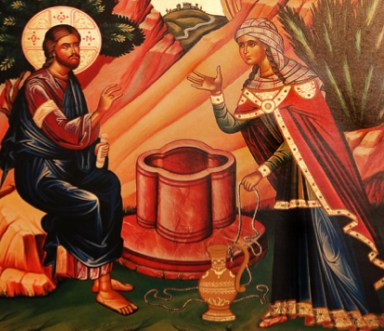
St PhotinaJohn 4:7-15 (New Revised Standard Version)
A Samaritan woman came to draw water, and Jesus said to her, “Give me a drink.” (His disciples had gone to the city to buy food.) The Samaritan woman said to him, “How is it that you, a Jew, ask a drink of me, a woman of Samaria?” (Jews do not share things in common with Samaritans.) Jesus answered her, “If you knew the gift of God, and who it is that is saying to you, ‘Give me a drink,’ you would have asked him, and he would have given you living water.” The woman said to him, “Sir, you have no bucket, and the well is deep. Where do you get that living water? Are you greater than our ancestor Jacob, who gave us the well, and with his sons and his flocks drank from it?” Jesus said to her, “Everyone who drinks of this water will be thirsty again, but those who drink of the water that I will give them will never be thirsty. The water that I will give will become in them a spring of water gushing up to eternal life.” The woman said to him, “Sir, give me this water, so that I may never be thirsty or have to keep coming here to draw water.”

Carrying a heavy, empty water jar, she came to the well alone at noontime, not expecting to encounter anyone, let alone a stranger, a tired Jewish man resting at the well. I have to wonder if there was a moment when she first saw Jesus there, and paused, unsure of whether she should approach. After all, she had no protection, no friends, no family with her to ensure her safety. Maybe she should just return home, and come back another time?

But, no, she had already walked the long, dry mile from the city of Sychar, carrying her empty jug. She needed water for cooking, for cleaning, for drinking. Her throat would already have been parched from the dust she had kicked up while walking. No, she was not going to let some Jewish stranger stop her.

Gathering her courage, she would have walked around the resting man, not making eye contact. Placing her jar on the ground, she would then drop the rope and bucket into the deep well, dug by her ancestor Jacob about 1700 years earlier.

Jacob’s Well. That’s where this interaction takes place between Jesus and an unnamed woman of Samaria.

Verses 5 and 6 of the 4th chapter of John, just before our scripture passage for today, tell us this: “So Jesus came to a Samaritan city called Sychar, near the plot of ground that Jacob had given to his son Joseph. Jacob’s well was there, and Jesus, tired out by his journey, was sitting by the well. It was about noon.”

Screen Shot 2017-03-24 at 11.40.35 AMThat ancient well still exists today. And it’s about 3700 years old! In the city of Nablus, in the West Bank, about 30 miles north of Jerusalem, you can still visit Jacob’s Well. It’s in a beautiful church there called St. Photina’s. The Eastern Orthodox Church tradition has given the Samaritan woman this lovely name: Photina, from the Greek phos, meaning light.

The well itself is located in the lower crypt of the church, down a set of stairs into a small room. In the middle of the space is a deceivingly humble looking opening, with the arch of a hefty winch over it.

Screen Shot 2017-03-24 at 11.41.17 AMThe opening to the well itself is only about 2 feet wide, just large enough for a very brave person to fit through, with arms pressed to their sides. About four feet down, though, it widens to just over 7 feet in diameter.

The Samaritan woman questioned Jesus, saying, “Sir, you have no bucket, and the well is deep.” That is an understatement! Jacob’s Well is an incredible feat of ancient engineering. When measured in 1935, it was 41 meters deep. That’s 135 feet deep.

It’s only (only!) about 65 feet deep now, thanks to decades of religious tourists curiously dropping stones in to hear the very delayed splash in the water far below.

TScreen Shot 2017-03-24 at 11.41.25 AMhe day that I visited St. Photina’s church this February, my group was the only one there, and, after receiving a donation to the church, the parish priest was happy to allow us to lower the bucket down into the water, so that we could take a drink together from Jacob’s Well.
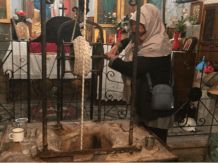
The women in my group took turns slowly lowering the bucket down the long tunnel, until finally it made contact with the water. Then, even more slowly, laboriously winching the now quite heavy bucket back up to the top.

Leaning over the well, I tried to take a picture, but even with a powerful flash, the depths would not light up. All you can see is the narrow opening, down four feet. Then, a cavernous nothing. It is a deep well, indeed.

IMG_6893Think about it! 135 feet deep. At its highest point, from the floor to the peak, the Sanctuary of my church is just 23 feet, 5 inches tall. We measured it with a laser this week. The Samaritan woman had to lower a bucket almost six times that depth… then bring that heavy, full bucket back up again. On her own. Every day.

IMG_6894From where I usually stand to preach to the glass doors of our lobby leading outside, that’s 95 feet. A rope stretched all the way back there would still have dozens of feet to go before striking water. I’m exhausted just thinking about the sheer effort that would have taken!

But water was necessary for life. This lone woman, she needed that water. She didn’t have another option. So she risked coming up to the well where a strange, Jewish man was resting.

First, he surprises her, asking for a drink of water. Then, he outright shocks her by offering her something: living water. The Greek words used here mean a water source that bubbles up, gushes up, healthy and refreshing. He tells her: “The water that I will give will become in them a spring of water gushing up to eternal life.”

How many of you know what its like to feel thirsty? I mean really, really thirsty. The thirst of a long, hot, hard-working day. So thirsty that your throat feels dry and scratchy. Thinking about it, can you remember how that felt? Now think about what it felt like to take that first cold sip of clear water. That soothing smoothness rolling down your dusty throat. A wonderful feeling!

The woman at the well that day, she knew thirst. She was more than familiar with that stretch of road between her home and this only source of water in the area. She had travelled through its hot dust every day for years. And now this strange man is offering her something absolutely amazing: fresh, bubbling, pure water that would gush up forever!

Is it any wonder she jumps at the chance?
“Sir, give me this water!” she exclaims.

But, then, verses 16-18: Jesus said to her, “Go, call your husband, and come back.” The woman answered him, “I have no husband.” Jesus said to her, “You are right in saying, ‘I have no husband’; for you have had five husbands, and the one you have now is not your husband. What you have said is true!”

She has been married five times. So, likely this is not a very young woman, as is sometimes depicted in art. She has probably lived in this village for most of her life. So why was she there, by herself, in the heat of the day? Most women would walk the road to Jacob’s well in the cool of the morning, before the sun rose high in the sky.

This woman came at noon,
at the apex of the sun’s arc,
when she knew she would be alone.

Many people have expounded on their theories about this woman over the years. General consensus seems to be that she lived a sinful life, and her alienation is her own fault.

As an example, here are two quotes from one popular preacher, from sermons written 25 years apart: In 1984, he described her as a “worldly, sensually-minded, unspiritual harlot from Samaria.” And then, in 2009, declares that “in her present condition, she doesn’t even have a living spirit. She is dead and hard and blind.”

All that judgment, when the only data we have is that she has been married five times, and is now with a man she’s not married to.

It’s actually very un-likely that she was a “harlot.” It’s not likely that she was promiscuous, adulterous, for the simple reason that if she had been, she wouldn’t have made it through five husbands! She would have been stoned to death long before. The Samaritans may have had many theological and practical differences with the Jews, but they agreed on the Torah, the first five books of the Jewish scriptures, our Old Testament: Genesis, Exodus, Leviticus, Numbers, and Deuteronomy.

And Leviticus, chapter 20, verse 10, makes the penalty for adultery quite clear: “If a man commits adultery with the wife of his neighbor, both the adulterer and the adulteress shall be put to death.”

Another possibility raised by scholars is that she was subject to the marriage rule found in Deuteronomy 25:5-6: When brothers reside together, and one of them dies and has no son, the wife of the deceased shall not be married outside the family to a stranger. Her husband’s brother shall go in to her, taking her in marriage, and performing the duty of a husband’s brother to her, and the firstborn whom she bears shall succeed to the name of the deceased brother, so that his name may not be blotted out of Israel.

This woman’s first husband may have died, and she then was required to marry his brother — she wouldn’t have had much say in this. Then that brother died, and she married the next… and so on, through five brothers, all of whom died. A seriously unlucky family!

Here’s another possibility, raised for me by the fact that she has come alone to this well, in the heat of the day when most people would avoid walking the hot, dusty roads, not in the company of other women from the city of Sychar, and, this is important, with no children of her own accompanying her to help carry the load of water. After five marriages, you would think she would have at least one child to help her on the way.

So, she may well have been infertile, unable to conceive and give birth. In that society, a woman could easily be divorced for such a reason. With each marriage, with each failed pregnancy, with each passing year of her life, with each divorce, she would have sunk deeper and deeper in the eyes of the community, and in her own. She would have carried with her, everywhere she went, a feeling of deep shame.

And, then, why is she now with a man she’s not married to? There weren’t a whole lot of options for unmarried women in those days. She couldn’t take up a trade, couldn’t get a job, other than selling her body for money. She must not have had family who could — or would — take her in. So she settles for a relationship that wasn’t acceptable to her faith or her community.

Whatever the reason, she comes to this well, about a mile outside her city, at a time of day when she was certain she would be alone.

No one to whisper rumors about her.
No one to avoid talking with her.
No one to judge her.

This poor woman. But… this on-the-periphery, outsider woman in an outsider community: she is the one chosen by Jesus to reveal himself to!

Verses 25 and 26: The woman said to him, “I know that Messiah is coming” (who is called Christ). “When he comes, he will proclaim all things to us.” Jesus said to her, “I am he, the one who is speaking to you.”

“I am he, the one who is speaking to you.” Jesus doesn’t speak in his usual metaphors here, he doesn’t beat around the bush.

“I know the Messiah is coming,” the woman says, “and when he comes, he will explain everything to us.”

Then, basically,
Jesus points to himself, and says,
“Yep! Messiah! Right here, in front of you.”

This is the first time in the Gospel of John that Jesus reveals himself. And he declares to this woman that he is the Messiah for which the people had been waiting so long!

“I am he,” Jesus proclaims, using words that would have reminded the woman about the conversation between God and Moses at the burning bush in the book of Exodus: Moses said to God, “If I come to the Israelites and say to them, ‘The God of your ancestors has sent me to you,’ and they ask me, ‘What is his name?’ what shall I say to them?” God said to Moses, “I am who I am.”

“I am he,” Jesus says to this isolated, sad woman.

Every time I read this story, I am amazed at its beauty. This woman, shunned by her community, choosing to endure the heat of the day rather than bear the scrutiny of others, comes to the well alone. For so many years she has been judged, found unworthy. She has worn a path on that road from Sychar to Jacob’s Well. And that hot noontime, she knew that her life would remain in that rut. Forever.

Then, at that place of necessity and labor and effort, she encounters Jesus. Who rebels against social convention, a Jewish man talking with a Samaritan woman. He challenges her, reaching straight into her pain. He speaks plainly to her, immediately naming her deepest wound. “You are right in saying, ‘I have no husband’; for you have had five husbands, and the one you have now is not your husband. What you have said is true!”

At first, this may seem so harsh to us. I mean, why couldn’t Jesus have eased into it? Maybe brought up some lighter, less threatening topics before launching into the very issue that has brought her such pain?

This is what I believe: God loves us too much to let us get away with surface healing. God cares too much to give us love that just glosses over the top. God is the opposite of superficial. God’s love is deep. God’s love is thorough. And so Jesus offers her healing and acceptance at the place of her deepest pain.

Hands with water splash

When you pour water, it automatically seeks the lowest point. Gravity pulls it down through any space, any crack large enough to allow a few molecules through, down and down and down, until it reaches a place where it can go no further.

Living water… it does the same… in our spirits. God’s love, it flows deeper and deeper in us, calling to our attention our wounds, our hurts. It brings to light the dark places in us that we don’t really want to see. It seeks out the lowest parts of who we are.

And that… it can be uncomfortable.
But that… is where true healing begins.

Jesus reaches out to this woman, not in judgment, but in bare honesty. He looks at her — sees her, knows her — this woman who preferred to be unseen, to be left alone.

And he gives her a priceless gift. He offers her living water. He offers her God’s love.

And she is so excited that she completely forgets the task she has come to the well for, and runs back to the city to spread the news with joy of the Messiah’s arrival to everyone she meets.

So… this day… are the dry and cracked places in your spirit crying out to be quenched? Are you yearning for God’s acceptance of you as you are, and God’s healing touch upon your hurt? Are there wounds in your soul you’re afraid to have God see?

That same offer that Jesus made
to the woman at the well
is still open to us today.

Here’s the reality: God already knows you. Really, really knows you. God knows the pieces of yourself that you show proudly to the world in the full light of the day. And God knows the pieces of yourself that you find deeply shameful, and would prefer never came to light. God knows your deepest damage, your most hidden pain, the cracks that splinter in your soul.

And God offers you living water
God’s own healing love
that can seep through every broken place
around every bend and twist of our souls
into every part of who we are
bringing grace and forgiveness and healing.

So I pray — with everything in me — that we would know that love in a real and powerful way this Lent. That we would reach out to accept the gift God offers to us. That we would allow God’s love to trickle… no… to flow, to bubble up through our spirits, cleansing us and making us whole!

And then… I pray that like that woman, we would go out into the world, overflowing with, bubbling over with God’s love, becoming God’s ambassadors of living water in a parched and thirsty world.

May it be so! I offer this to you in the name of the Father, and of the Son, and of the Holy Spirit. Amen!

_____

For a video of this message as delivered at Plantation UMC in our 11am Traditional Service, click here!


Posted in Lent | Tagged , , , , , , , , , , , , , , , , , , | 3 Comments