Incarnate

Advent Image Banner

Colossians 2:6-7 (New Revised Standard Version)
As you therefore have received Christ Jesus the Lord, continue to live your lives in him, rooted and built up in him and established in the faith, just as you were taught, abounding in thanksgiving.

Silent night, holy night. This weekend we began the season of Advent, the four weeks leading up Christmas.

Advent.
A season of grace, of joy.
A season of thanksgiving and love and peace.

But it can be hard to find, can’t it?

As the weeks toward Christmas tick down, you may be facing end-of-the-year deadlines at work. There will be more and more traffic on the roads. If you have kids, there are a million and five things for them to do before Christmas break. Stores will be filled with frantic people looking for that perfect gift, or, let’s face it, as time goes by just any gift.

Then you come home to turn on the news, only to hear about another shooting, another threat, another area of unrest and danger. Around the world, and right in your community.

I’ve talked with several people recently about how tempted they are to just “hunker down” right now. And I can certainly understand why, when the world feels so uncertain, we have this urge to close our eyes tightly and self-protect. To close out the world, and retreat to a safe place away from the chaos around us.

And this is the first time in recorded history where it is actually possible to live without having a direct, meaningful interaction with another human being.

You can order your Christmas presents from online retailers, have them wrapped and sent with a card directly to the recipient of your choice. No trudging through stores, no waiting in long post office lines, no having to stand face-to-face with that annoying relative (you know the one I’m talking about!) as you hand over a present and receive yours.

You can shop for groceries and have them left on your front porch at a scheduled time. You can consult with a physician, a tax attorney, a counselor — all from the comfort of your favorite chair. You can purchase clothing online, and, after it arrives, if it doesn’t fit or you don’t like it, just send it back, no problem.

On Facebook, Instagram, and Twitter, you can have dozens, hundreds, even thousands of friends, none of whom you actually have to interact with. You can even be “friends” with the people you see on your television or computer, or, at a minimum, you can follow their feeds online.

You can have heated political or religious debates online, without dealing with the relational repercussions. You can date online, take classes and get degrees, buy a home.

[You can, I’m sorry to admit it, even attend church online.]

I’m not the first or the last to note that this overconnected technological culture of convenience has led to a deep disconnectedness in our lives.

But, if there is anywhere in our world where that kind of disconnectedness has NO PLACE, it is the church. And that is infinitely more so at Christmastime. The community of people who follow Christ can show the world what it is means to be connected, relational, to be real.

Our Advent sermon series this year at Aldersgate is called “incarnate.”

in·car·nate
/inˈkärnət, inˈkärˌnāt/
adjective: embodied in flesh; in human form
verb: to embody or represent in human form; to make concrete an idea or abstract concept; to be the living embodiment of a quality or ideal

The story of Christmas is a story of the incarnation. It is the story of a God who loves us so much, that God made the irrevocable, game-changing decision to enter directly into creation. To live as a human being, to teach and to heal. To touch and to comfort. To explain and demonstrate God’s love and to bring hope and grace and light to a dark and fearful world.

Christianity is meant to be deeply grounded in life. It is meant to change us, to challenge us, to push us out into the world, practicing our faith in passionate, practical, meaningful ways. To teach and to heal. To touch and to comfort. To explain and demonstrate God’s love. To bring hope and grace and light to a dark and fearful world.

We are meant to be God’s love. Incarnate.

In tomorrow’s post, we’ll look at what this means!
Posted in Advent, Pondering Scripture | Tagged , , , , , , , , , , , , , | Leave a comment

Terrorism and Weltschmerz

ParisPhilippians 2:4-8, 14-15 (NRSV)
Let each of you look not to your own interests, but to the interests of others. Let the same mind be in you that was in Christ Jesus, who, though he was in the form of God, did not regard equality with God as something to be exploited, but emptied himself, taking the form of a slave, being born in human likeness. And being found in human form, he humbled himself and became obedient to the point of death — even death on a cross. … Do all things without murmuring and arguing, so that you may be blameless and innocent, children of God without blemish in the midst of a crooked and perverse generation, in which you shine like stars in the world.

Weltschmerz. It’s a German word that has made it into the English language. Weltschmerz describes what many of us are feeling this week. Welt, meaning world. Schmerz, pain. World-pain. Grief over the world. Weltschmerz is a word that has been used to describe the aching in our souls over the fact that what we see around us does not match up with what we believe our world should — and could — be. Pain in us coming from the pain in the world.

The bombing in Beirut, Lebanon on Thursday that killed over 40 people. Then Friday in Paris, a multiple-pronged attack that killed over 130. People who God loves and for whom Jesus died, doing terrible damage to other people who God loves and for whom Jesus died.

I’m not going to sit here and pretend that everything is all right. Because it’s not. It is just not.

Violence. Fear. Terrorism. Pain. Homelessness. Hungry children. Unemployment. Ennui and apathy.

I’m feeling heartbroken and just plain old tired as I write this.

Our scripture for today is from the 2nd chapter of Paul’s letter to the church in Philippi, which starts with these words: “Let each of you look not to your own interests, but to the interests of others.”

In Mark 12, Jesus tells his followers to “Love the Lord your God with all your heart, with all your soul, with all your mind, and with all your strength… And love your neighbor as yourself.” It’s that second part upon which Paul is expanding on in Philippians: “Love your neighbor as yourself.” We are called to reach out in love to people around us. Out of love, we are called to serve.

At one time or another, you’ve probably thought about volunteering to help those in need. But your calendar is jam-packed with appointments, events, meetings, and commitments. How could you possibly add one more thing in?

And you’ve probably also wondered if it was really worth it. Because, after all, you know the reality of the world:

  • For every dinner served to the hungry in our community, there are still thousands who spend the day wondering where their next meal will come from.
  • For every school built in a remote village of Guatemala, there are countless others whose lives we can’t touch.
  • For every person with whom you share God’s love, there is someone, somewhere, who is tearing the world apart with their hatred.

That is where weltschmerz turns into exhaustion, and exhaustion turns into being utterly immobilized.

How can our small acts make a difference? Why bother?

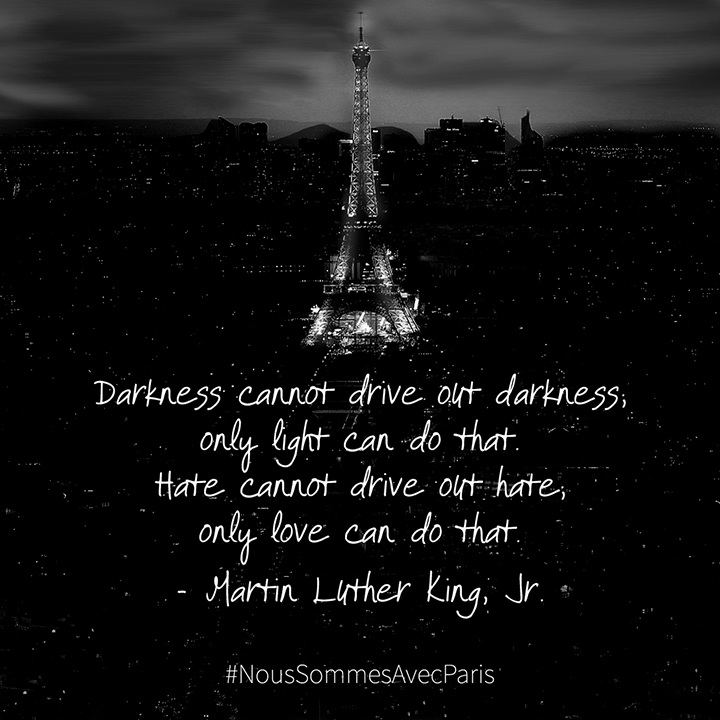
Since I turned on the news and heard about these most recent attacks, a quote from Martin Luther King, Jr. has been running through my mind:

Darkness cannot drive out darkness;
only light can do that.
Hate cannot drive out hate;
only love can do that.

Philippians 2:4 told us: “Let each of you look not to your own interests, but to the interests of others.” Paul continues: “Let the same mind be in you that was in Christ Jesus, who, though he was in the form of God, did not regard equality with God as something to be exploited, but emptied himself, taking the form of a slave, being born in human likeness. And being found in human form, he humbled himself and became obedient to the point of death — even death on a cross.”

Into a world of oppression and distrust and fear, Jesus came to show God’s love. Knowing the betrayal and pain that lay ahead of him, he still laid down his life to demonstrate God’s commitment to us.

If you’ve kind of checked out while you’ve been reading, thinking of the million and a half things you have on your schedule today, I ask you now to check back in. Just briefly. Because I really want you to hear this…

God loves you. And God knows you. Knows the pretty face you put forward to the world, pulled together and attractive. But God also knows the ugliness inside you, the things that shame and frighten you.

And God still loves you. And always will.
And that is equally true of every person who walks this globe.
God loves each and every one of us.
No exceptions.

We serve to help people know that they are fully known, cared for, that they have infinite worth.

This is what makes serving others — what makes sharing God’s love — such a powerful act of rebellion against the pain of this world.

Because by making the conscious, challenging decision to reach out in love, we are refusing to accept hatred.

We are making the courageous stand, the bold protest.
We are fighting back with joy.

We are stepping up and sticking a finger in the eye of evil.

So shake off that weltschmerz. And — please hear me — find a way:

In a world that doesn’t always care for individual people …
to say: “You matter!”

In a world where people seem kill without thought …
to bring healing and hope.

In a world there there is ample darkness …
to bring God’s light.

In a world filled with confusion and fear and hate …
to bring God’s love.

Each of us — every one of us — working together… can you imagine what we can do?

At the end of our scripture passage, Paul wrote to the Philippians that they should live as children of God and be like bright lights shining in the darkness of the world.

That is you.
That can be all of us.

Posted in Pondering Scripture | Tagged , , , , , , , , | 2 Comments

The Good Shepherd

John 10:11-13 (New Living Translation)
I am the good shepherd. The good shepherd sacrifices his life for the sheep.
A hired hand will run when he sees a wolf coming. He will abandon the sheep because they don’t belong to him and he isn’t their shepherd. And so the wolf attacks them and scatters the flock. The hired hand runs away because he’s working only for the money and doesn’t really care about the sheep.

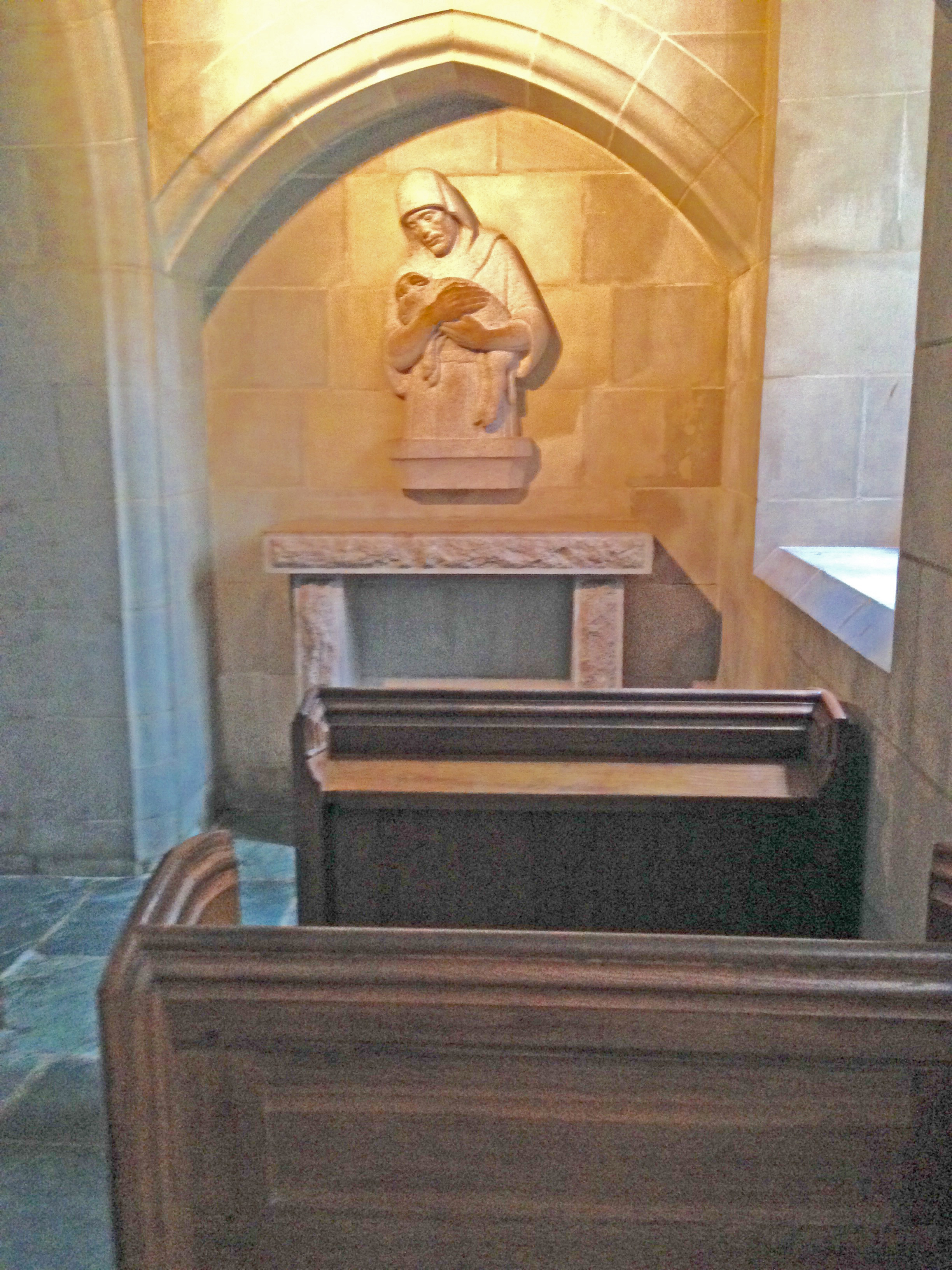
The National Cathedral in northwest Washington DC is a great place to visit. I’ve been there many times since we moved here in 2013. The Cathedral has several large, beautiful worship spaces. The towering vaulted ceilings of the ground floor nave. The magnificent stained glass windows, each with their own fascinating history. The Bethlehem Chapel, built on top of the Cathedral’s foundation stone. The Chapel of St. Joseph of Arimathea, with its vivid mural of Jesus’s burial. The Resurrection Chapel, a beautiful space with a blue and gold mosaic of a triumphant Jesus. The Children’s Chapel, with its miniaturized chairs and organ.

Good Shepherd Chapel at The National CathedralBut my favorite is a tiny chapel off the the beaten path: The Good Shepherd Chapel. It could possibly seat six people — if they didn’t mind sitting extremely close together. (Not a space for someone who suffers from claustrophobia!) Small and intimate, I find it to be the most precious room in the whole grand Cathedral. I have visited it several times: alone, with my husband, with my doctoral cohort, with friends travelling to DC.

Even in the heat of the DC summer, the chapel is always refreshing. It’s quiet, as most of the tourists are in the more spectacular areas of the Cathedral. It is calm. It is peaceful. It is lovely. The inlaid carved statue at the front is of Jesus tenderly holding a small lamb, looking down on it with compassion and care.

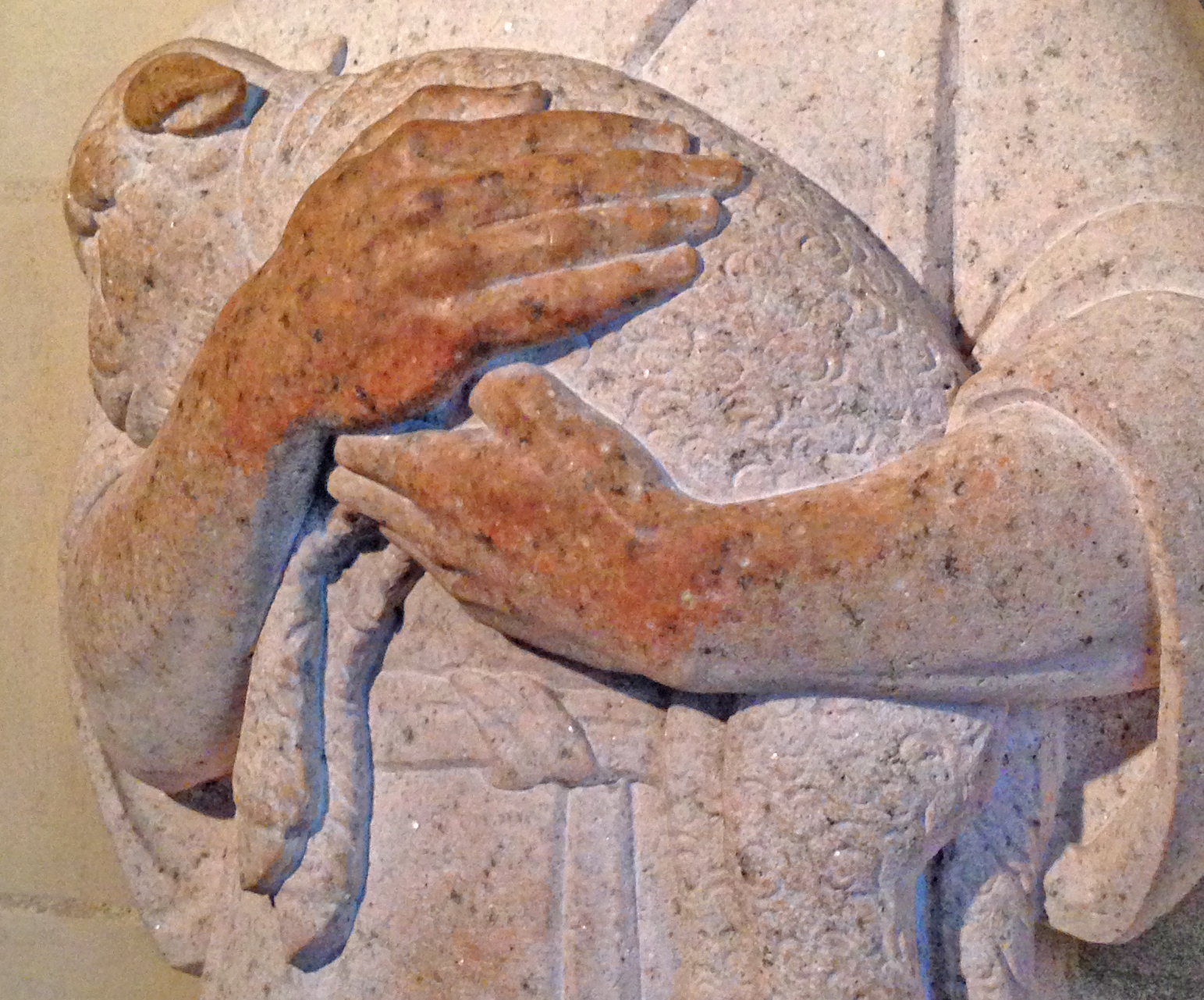
Each time I am struck by one small detail: the hands on the sculpture at the altar. Out of all the light-colored stone in that tiny room, the hands alone are a darker brown.

Lamb
Years of people coming up to the altar to place their hands on Jesus’s hands have transferred oil to the stone, polishing it, burnishing it, until the hands look almost alive.

The “Good Shepherd.” That’s what Jesus calls himself in our scripture passage for today.

I am the good shepherd.
The good shepherd sacrifices his life for the sheep.

A shepherd’s job is to care for the flock, to feed and water them, to lead and guide them. And, if they are in danger, to protect them with all the shepherd’s might. Isaiah 40:11 says this: He will feed his flock like a shepherd. He will carry the lambs in his arms, holding them close to his heart. He will gently lead the mother sheep with their young.”

Intimate. Personal. Caring. Powerful. Loving. Protective.

It is no wonder that people are drawn to this image of God, that they are compelled to reach out their hands and to touch it.

There is something — deep inside each of our spirits — that yearns to be loved like that.

Question:
How loved and protected do you feel right now in your life?

Posted in Random Thoughts | Tagged , , , , | Leave a comment

Awesome!

Yesterday I was in the sanctuary with a large group of kids from our church’s day school. I asked them if they knew what they wanted to be when they grew up. “Oh, I do! I do!” they yelled.

I want to be a firefighter!
A policeman!
I want to be in the US Army!
I’m going to be an animal doctor!
A teacher!

They were so stinking cute. And so excited! Imagine 80 preschoolers all shouting at the top of their lungs, with their little hands madly waving in the air, and you get a picture of the energy level in the room.

Then one little boy’s voice, somewhere off to my left, yelled this:

“When I grow up, I want to be AWESOME!!”

AWESOME
My first thought was: “Wow, kid, you’re already there!” My second was that I needed to find out who had yelled it, because I should slip him a $20 for providing such a perfect segue for my message that morning.

Later, though, as I laughingly shared the story, I wondered how it is that we lose that optimism as we get older. Because it seems that at least once every week I have someone in my office who is struggling with self-worth.

I just didn’t see my life going this way.
I don’t like who I am.
I’m ugly.
I’m not very smart, and I know it.
Everyone else is so successful, and I’ve got nothing.
I’m such a loser.

Have you ever felt less than “awesome” in your life?

“I am convinced that nothing can ever separate us from God’s love. Neither death nor life, neither angels nor demons, neither our fears for today nor our worries about tomorrow — not even the powers of hell can separate us from God’s love. No power in the sky above or in the earth below — indeed, nothing in all creation will ever be able to separate us from the love of God that is revealed in Christ Jesus our Lord” (Romans 8:38-39).

God loves you. Not because God isn’t aware of how you’ve screwed up, how you’ve failed, how you’ve completely fallen on your face. Not because God doesn’t know about the mistakes — both big and small — that you’ve made.

God knows all of this.

And God loves you.

Period.
End of sentence.
Done.

Because you are awesome.

Question:
How sure do you feel right now about God’s love for you?

Posted in Random Thoughts | Tagged , , , , , | 6 Comments

Wired to Lead: Serve Others (final video)

WIRED TO LEAD: RECAPTURING JOY-FILLED LEADERSHIP

Thank you so much for being a part of this Wired to Lead series! Over the next few weeks and months I’ll be madly pulling things together to create a free online group study guide with videos, based on what we’ve been exploring together here.

So now, friends…

Love God.
Understand Yourself.
Serve Others.
GO!

One of the scribes came near and heard them disputing with one another, and seeing that he answered them well, he asked him, “Which commandment is the first of all?” Jesus answered, “The first is, ‘Hear, O Israel: the Lord our God, the Lord is one; you shall love the Lord your God with all your heart, and with all your soul, and with all your mind, and with all your strength.’ The second is this, ‘You shall love your neighbor as yourself.’ There is no other commandment greater than these.” — Mark 12:28-31

Posted in Wired to Lead | Tagged , , , , , , , , , | 1 Comment

Wired to Lead: Go!

Wired To LeadWIRED TO LEAD: RECAPTURING JOY-FILLED LEADERSHIP

One of the scribes came near and heard them disputing with one another, and seeing that he answered them well, he asked him, “Which commandment is the first of all?” Jesus answered, “The first is, ‘Hear, O Israel: the Lord our God, the Lord is one; you shall love the Lord your God with all your heart, and with all your soul, and with all your mind, and with all your strength.’ The second is this, ‘You shall love your neighbor as yourself.’ There is no other commandment greater than these.” — Mark 12:28-31

Today we’re looking at the climax of Jesus’s words in Mark 12: You shall love your neighbor as yourself.”

Here Jesus uses agapeseis, the future indicative form of the verb agapaó “to love,” meaning “you shall love.” It’s the same form he used in verse 30 when he said, “You shall love the Lord your God.” It’s a funny form, indicating a fact already established in the future!

You shall love your neighbor as yourself.”

But what does that look like? To understand this, we need to look at another set of verses. The “Great Commandment” from Mark 12:28-31 that we have been using to guide our discussion over the last few weeks, and its parallel verses in Matthew 22, have a corresponding text in the “Great Commission” of Matthew 28:18-20:

All authority in heaven and on earth has been given to me. Therefore go and make disciples of all nations, baptizing them in the name of the Father and of the Son and of the Holy Spirit, and teaching them to obey everything I have commanded you. And surely I am with you always, to the very end of the age.

“Go,” Jesus tells us. The Greek here is poreuomai, which does, yes, mean “to go.” But it does not mean to simply leave. It does not mean to head out the door — et voila! — you’re all done.

Poreuomai means to travel, to journey, to conduct one’s life. All that Jesus is asking us to do here — reaching out to people, bringing them into the community of faith, teaching them, healing, showing love in ways they can understand — all that is to be a part of our everyday, our working, our living.

It is to be a part of our leading.

In their book Leadership on the Line, Ronald Heifetz and Marty Linsky write this about the importance of reaching out:

“Leadership is worth the risk because the goals extend beyond material gain or personal advancement. By making the lives of people around you better, leadership provides meaning in life. It creates purpose. We believe that every human being has something unique to offer, and that a larger sense of purpose comes from using that gift to help your organizations, families, or communities thrive. The gift might be your knowledge, your experience, your values, your presence, your heart, or your wisdom. Perhaps it’s simply your basic curiosity and your willingness to raise unsettling questions.”

Heifetz and Linsky reference parts of what we have been discussing: values, knowledge, heart, wisdom. While it sounds like something would have come from a religiously-centered text, this quote is ironically from a secular leadership book. We are not the only ones who believe that leadership is about more than getting the corner office!

But we are the ones who believe that human beings have been created in the image of God, and that our purpose is to glorify God and to demonstrate God’s love in the world.

Question:
On a scale of 1 to 10 (with 1 being low & 10 being high), what is your level of excitement right now about partnering with God in serving in the world?

Posted in Wired to Lead | Tagged , , , , , , , , , , | Leave a comment

Wired to Lead: Understand Yourself (video)

Well, we’ve finished the second part of Wired to Lead with the material for “Understand Yourself,” so here’s the accompanying video. Hope you’re enjoying the series so far!

But wait! There’s more!!
Starting tomorrow … Wired to Lead: Serve Others …

“You shall love your neighbor as yourself” (Mark 12:31).

Posted in Wired to Lead | Tagged , , , , | Leave a comment

Wired to Lead: With All Our Strength

Wired To LeadWIRED TO LEAD: RECAPTURING JOY-FILLED LEADERSHIP

“Hear, O Israel: the Lord our God, the Lord is one; you shall love the Lord your God with all your heart, and with all your soul, and with all your mind, and with all your strength.” — Mark 12:29-30

And last, but not least, today we’re looking at what it means to love God…

… with all your strength.

The Greek here is ischys. It describes the ability of a person, their strength, their might. Whatever our capabilities are, we are to use them for the glory of God. In this way, we demonstrate how we love God with all our ischys.

Ironically, this is where many leadership books begin — both secular and Christian. There are countless inventories for spiritual gifts, and a large selection of strength/weakness assessments. A person wishing to know his or her leadership ischys will have ample opportunity to do so.

But there is an excellent reason this comes after loving God with all your heart, all your soul, and all your mind. It is way too easy for us to take our strengths for granted if we did not first realize that the reason we have abilities and talents is that they are gifts from a loving God.

Tree BW BottomIf diánoia has us using our minds to deepen and strengthen our roots, then ischys is the utilization of our talents, gifts, and abilities to grow new branches and increase our fruit in the world.

“Hear, O Israel: the Lord our God, the Lord is one; you shall love the Lord your God with all your heart, and with all your soul, and with all your mind, and with all your strength.”

Jesus is our leader, our example… and this is exactly how he led.

Jesus’s kardía — his heart, his core —
was firmly rooted in the self-giving love of God.

Jesus’s psyché — his soul —
was demonstrated through his gracious words and actions every day of his life.

His diánoia — his mind —
was shown in his deep knowledge of the Hebrew scriptures,
which he both studied and taught.

And his ischys — his strength, his abilities —
were the most perfect to ever reside in a human form.

In his letter to the church in Rome, the apostle Paul wrote: “I appeal to you therefore, brothers and sisters, by the mercies of God, to present your bodies as a living sacrifice, holy and acceptable to God…” It is a phrase strange to the modern ear: “a living sacrifice.” But I believe that is exactly what Jesus is taking about in Mark 12. To lead as a living sacrifice — a breathing, walking-around-the-world sacrifice — means inviting God into all of who we are, reaching out to God with all our heart, soul, mind, and strength.

When our leadership truly reflects how we love God with who we are at our deepest core, with our words and actions, with how we use our intellect and our abilities, then, and only then, does the next thing Jesus says make sense: “You shall love your neighbor as yourself.”

And — stay tuned — that climactic commandment is up next!

Question:
What strengths, gifts, and abilities do you have? How are you using them for God in your life right now?

Posted in Wired to Lead | Tagged , , , , , , , | 2 Comments

Wired to Lead: Mind

Wired To LeadWIRED TO LEAD: RECAPTURING JOY-FILLED LEADERSHIP

“Hear, O Israel: the Lord our God, the Lord is one; you shall love the Lord your God with all your heart, and with all your soul, and with all your mind, and with all your strength.” — Mark 12:29-30

In the past few posts, we’ve been looking at Jesus’s words in Mark 12. We’ve already touched on what it means to “love the Lord with all your heart (kardía)” and “with all your soul (psyché).” Today…

love the Lord with all your mind …

Diánoia is the Greek word translated here as “mind.” This word corresponds fairly directly with the modern idea of mind: intellect, comprehension, understanding.

There are almost countless ways to love God with all our mind. Studying scripture, commentaries, history about biblical times. Delving into the millennia of Christian and Jewish theological writings, engaging in discussions with other Christians, seeking out people who have more experience or knowledge and learning from them. Taking classes. Exploring the science of nature or the human psyche, or even steeping ourselves in secular leadership tomes. We have many opportunities to deepen our understanding of God, and of ourselves.

Kenneth McFayden, author of Strategic Leadership for a Change, says this about Christ-following leaders who engage in these intellectual pursuits in a healthy way: “they believe that the behavioral sciences, leadership theories, and other secular resources contribute important perspectives for congregational leadership. Yet they assess these perspectives through the ‘eyes of faith,’ identify their contributions and limitations, and incorporate their best practices to strengthen ministry. Finally, they believe that leadership is learned. Whatever natural gifts they bring to ministry, they realize that there always is more to learn about leadership. They understand that learning to lead increases their capacity to serve.”

Tree BW TopIf kardía is the root of who we are, and psyché how the health of those roots is reflected in our interactions with the world, then diánoia is using our intellectual capacity to strengthen and push those roots ever deeper, ever broader, ever wider.

It is easy to see how these three words describing how we are to love God — kardía, psyché, and diánoia — complement and support each other. Together they create a virtuous cycle: learning more about who God is and our part in God’s creation, which in turn leads to a deeper understanding in our core of God’s love, which then results in our reaching out into the world out of the overflow of God’s love.

And that leaves us with the last of the list for tomorrow’s post: we are to love God with all our strength…

Question:
In what ways are you using your mind to love God?

Posted in Wired to Lead | Tagged , , , , , , | Leave a comment

Wired to Lead: With All Our Soul

Wired To LeadWIRED TO LEAD: RECAPTURING JOY-FILLED LEADERSHIP

“Hear, O Israel: the Lord our God, the Lord is one; you shall love the Lord your God with all your heart, and with all your soul, and with all your mind, and with all your strength.” — Mark 12:29-30

The Greek word which we translate here as “soul” is psyché. It overlaps significantly with kardía, with psyché also referencing one’s inner life. But while the English word “soul” has overtones of the ineffable and abstract, psyché has a more practical nuance. It is the “living self with all its drives, not the abstract notion,” and the “earthly existence in contrast to supernatural existence; one’s life on earth.” With this understanding, psyché is how who we are at our core is put into actual action.

Kardía is our deepest identity.
Psyché is how that identity is shown in our interactions with the world.

Tree BW BottomThis is consistent with the psychological understanding of the English word “psyche” as “the center of thought, feeling, and motivation, consciously and unconsciously directing the body’s reactions to its social and physical environment.” Kardía is the root of the tree, seen by God alone. Psyché is the branches, the leaves, the fruit available to be observed by the world.

Just as our actions unsupported by a robust love of God will not prosper for long, scripture also tells us that “Faith by itself, if it does not have works, is dead” (James 2:17). If a tree is cut down to the ground, the roots will eventually wither and die. Heart needs soul. And soul needs heart. In his book Incarnate, Michael Frost puts it this way: “An inner conviction or feeling is only worthwhile to the degree that it is embodied in action.”

Loving God with all our soul means to actively seek ways to have our leadership behaviors increasingly reflect God’s grace and love. This is not a sterile, bookish theology, but a lived one! Just as the health of a tree’s roots can be seen in the health of its trunk and branches, so the health of our love of God can be seen in our words and actions.

Question:
How well do you feel your life recently has been reflecting God’s love?

Posted in Wired to Lead | Leave a comment