Called to the Wilderness

lent

Matthew 4:1-11 (New Revised Standard Version)
Then Jesus was led up by the Spirit into the wilderness to be tempted by the devil. He fasted forty days and forty nights, and afterwards he was famished. The tempter came and said to him, “If you are the Son of God, command these stones to become loaves of bread.” But he answered, “It is written, ‘One does not live by bread alone, but by every word that comes from the mouth of God.’” Then the devil took him to the holy city and placed him on the pinnacle of the temple, saying to him, “If you are the Son of God, throw yourself down; for it is written, ‘He will command his angels concerning you,’ and ‘On their hands they will bear you up, so that you will not dash your foot against a stone.’” Jesus said to him, “Again it is written, ‘Do not put the Lord your God to the test.’” Again, the devil took him to a very high mountain and showed him all the kingdoms of the world and their splendor; and he said to him, “All these I will give you, if you will fall down and worship me.” Jesus said to him, “Away with you, Satan! for it is written, ‘Worship the Lord your God, and serve only him.’” Then the devil left him, and suddenly angels came and waited on him.

It’s hard to believe that it was only a month ago that I was in Israel. I want to thank all of you again who prayed for me and for the group as we travelled. When I returned, several people here let me know how concerned they had been — worried for me as I journeyed through such a conflicted area of our world. I received a frantic text one day while we were there, asking if we were anywhere close to where a rocket, launched from the Gaza Strip, had landed in Israel. But we didn’t even know about it! I think everyone in our group commented at some point during the trip how safe we felt. We didn’t feel anxious or worried.

Well… I say that… but there was actually one big item of anxiety weighing on my mind for the weeks leading up to the trip, and for the first week I was in Israel. Because I knew that on our first Saturday there, February 4th, our itinerary had us visiting the Jordan River. And I was nervous about it, because I was the only ordained Elder on the trip. That meant that if anyone wanted to be submerged in the Jordan River to be baptized or to remember their baptism, it was up to me. I was going to have to go into that River.

Folks, one of the reasons I was so happy to move back to South Florida is that I am a cold weather wimp! I hate being cold. And the average temperature of the Jordan River in February is… 45 degrees!!! Oh man, I knew that it was wrong — just wrong — for a pastor to be praying for people to not want to be dunked in the Jordan. So I didn’t. Not quite. But I did kind of skirt around the issue in my prayers. Which is ridiculous, because God knew what I was really asking.

So, the morning arrived, and like so many of the things that cause us anxiety, there was nothing to worry about. It was a beautiful, chilly day, and our group of 23 pilgrims clambered onto the bus for the trip from Nazareth to the Jordan. No one was interested on going in to the water.

Our tour guide Iyad didn’t take us to the familiar, very crowded tourist area, with its metal guide rails and convenient steps. Instead, our bus turned off the road, and slowly meandered our way down a bumpy dirt road.

The bus stopped at a stand of trees, through which we could see the river. Then, slowly, together we walked down a slick embankment, our feet making the first impressions of the day in the mud, and arrived at the shore of the Jordan.

img_0293

It was beautiful. Peaceful. Our group, who had been chattering away on the bus ride, was suddenly completely quiet.

As we stood there, taking it in, we read Matthew 3:13-17:
Then Jesus came from Galilee to John at the Jordan, to be baptized by him. John would have prevented him, saying, “I need to be baptized by you, and do you come to me?” But Jesus answered him, “Let it be so now; for it is proper for us in this way to fulfill all righteousness.” Then he consented. And when Jesus had been baptized, just as he came up from the water, suddenly the heavens were opened to him and he saw the Spirit of God descending like a dove and alighting on him. And a voice from heaven said, “This is my Son, the Beloved, with whom I am well pleased.”

This is my Son, the Beloved, with whom I am well pleased. “The Beloved.” Agapétos in Greek, one who is deeply cherished.

This moment is recorded in the gospels of Matthew, Mark, and Luke. And in each, it marks the beginning of Jesus’ official ministry. And, in each, immediately following his baptism, Jesus journeys alone to the “wilderness” for 40 days, where he prepares his mind and spirit for the challenging tasks that lay ahead of him, and where he is tempted by Satan.

It was another early morning when we drove the distance from Jerusalem to the Wadi Qelt and the Judean desert. Before being in Israel, I had always imagined the scene of Jesus’ temptation to be like the deserts in the American southwest: sparsely dotted with cacti, flat, stretching out to the horizon.

fullsizerender-16

It was still dark when we arrived. We carefully made our way — single-file — down a long ledge, with sharp drop-off to the left down to the dry riverbed. When we reached the end of the plateau, we stopped and watched as the sun rose over the horizon.

It was spectacular.

As the sun rose higher in the sky, we were able to start picking out more and more details of the land around us. It was both more desolate and more beautiful than I had imagined.

I stood — for what felt like hours — looking out over that vista, remembering how, fresh from his baptism, Jesus had not launched immediately, full-tilt into ministry, but how he had been drawn aside for a time of preparation.

fullsizerender-17

Matthew, Mark, and Luke all call this place erémos: an uncultivated, unpopulated, deserted, solitary place of deep quiet and loneliness. It was there, in that secluded location, that Jesus was tempted.

Verses 2 and 3 of today’s scripture: He fasted forty days and forty nights, and afterwards he was famished. The tempter came and said to him, “If you are the Son of God, command these stones to become loaves of bread.”

rocks-on-edge-of-desert

Stones. They are incredibly plentiful in the wilderness of Israel. After 40 days of fasting, Jesus was hungry. And so Satan hits him where it hurts the most at the time — his grumbling stomach. “Turn these stones, all lying here, readily available to just reach out and take. Turn them into bread, and satisfy the gnawing in your gut.”

This temptation, it’s not just about being hungry. It’s about putting our physical, temporary urges above everything else. Our culture pretty much feeds into this temptation. If we want it, we should have it. Self-denial? Makes no sense. Why would you choose to be uncomfortable?

There is a popular photography series called “Humans of New York” by a young man named Brandon Stanton. It’s pretty fascinating. He takes pictures of random people on the streets of New York City, and interviews them about their lives. One picture I ran into a while back is of a young woman in a train station.

This is what she said: “I wish I’d partied a little less. People always say, ‘be true to yourself.’ But that’s misleading, because there are two selves. There’s your short term self, and there’s your long term self. And if you’re only true to your short term self, your long term self slowly decays.”

That is exactly what this temptation of Jesus is all about. Jesus is being tempted to choose temporary comfort, and sacrifice the long-term goal.

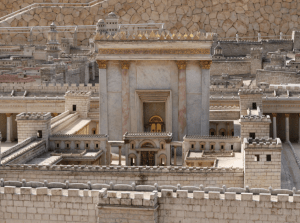
The next temptation has Jesus being torn away from the wilderness, and placed  on the highest part of the Temple in Jerusalem.
screen-shot-2017-03-04-at-10-53-44-am

The actual Temple in Jerusalem doesn’t exist any longer. It was destroyed in 70AD. At the original site there now stands an enormous Islamic shrine, called the Dome of the Rock. The picture you’re looking at is a scale model at the Israel Museum in Jerusalem.

Then the devil took him to the holy city and placed him on the pinnacle of the temple, saying to him, “If you are the Son of God, throw yourself down; for it is written, ‘He will command his angels concerning you,’ and ‘On their hands they will bear you up, so that you will not dash your foot against a stone.’”

You are the Son of God, through whom all things were created. Use your power, your influence, to ensure your perfect security. Don’t let this world harm you, Satan is saying.

Knowing what lay ahead of him, can you imagine how tempting this would have been for Jesus? Because this world? This world would harm him. This world would crush him, torture him, mock him, destroy him, murder him. At any point, he could have stopped it. He could chosen security.

But, instead, he chose to become defenseless. He chose to be vulnerable, to give of himself selflessly.

The third temptation took him even higher.

Again, the devil took him to a very high mountain and showed him all the kingdoms of the world and their splendor; and he said to him, “All these I will give you, if you will fall down and worship me.”

screen-shot-2017-03-04-at-10-53-54-am

The first full day of our time in Jerusalem, we went to the top of Mount Scopus, with a beautiful, panoramic view of the city. Jesus knew that he would be rejected, that his authority would be refused. So Satan showed Jesus the kingdoms of the world, and offers him an easy way out.

Just worship me, Satan says, and I’ll just hand all this over to you. I’ll give you the authority. I’ll give you the power. Just bow down to me, and it’ll all be so simple!

But it’s deeply ironic. Jesus is offered the kingdoms of this world. But Jesus holds within himself the Kingdom, capital T, capital K.

The Kingdom.

Jesus rejects the offer of temporary, counterfeit authority for the real, lasting authority that comes from relationship with his Father God.

Jesus rejects these temptations that appeal to his very human urges for comfort, security, and authority.

Now, please notice that each of these things are, at their core, good things. A temptation that is purely evil, just completely wrong and harmful — is pretty easy to identify and to turn away from. The ingeniousness of these temptations is that they aren’t all bad!

It is a good thing to care for your body, to eat and drink. God designed us so that we must eat and drink to live!

It is a good thing be secure, to not live in constant fear for your life.

It is a good thing to have a degree of power, to be able to make decisions and to act, to be able to make a difference in the world around us.

But… our culture teaches us to seek comfort, to seek security, to seek authority. At any cost. By following Jesus, by being Christ-followers, we are choosing to actively rebel against all that, seeking instead to follow Jesus.

Comfort. Security. Authority.

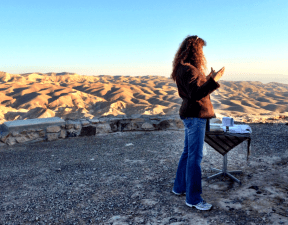
At the edge of the rugged wilderness that morning in Israel, as the sun began to warm our chilly bodies, we took Communion. It was one of the most overwhelming moments of the entire trip for me.
screen-shot-2017-03-04-at-10-54-04-am

Remembering Jesus’ bold refusal to bow to temptation. And also remembering what consequences that refusal had for him.

Jesus, who gave up comfort,
allowing himself to experience pain and to suffer.

Jesus, who gave up security,
putting himself in the hands of those
who could do him harm.

Jesus, who gave up authority,
surrendering himself
without a fight
to death on a cross.

And this is what hit me: Jesus went out into that wilderness, into his ministry, his ears and spirit still ringing with his Father God’s love as voiced at his baptism: “This is my Son, the Beloved, with whom I am well pleased.”

Agapétos, a title for Jesus, the Beloved. But, do you know… it’s also the word used for followers of Christ in the New Testament. Agapétos — we are beloved by God. And that, after all, is why Jesus came: to show us how loved we are.

We walk out into our world surrounded by the remembrance of God’s love for us.

We walk through this Lent, this season of self-denial and reflection and repentance, supported by the promise of God’s love.

We walk through our daily lives, at times sacrificing our own comfort, our own security, our own authority, to follow Jesus, because we rest in the comfort, security, and authority of God’s love for us.

And I pray as you walk out into your life today, into this world, that you would hold in your heart the knowledge of the fact that you are agapétos.

You are beloved.

Posted in Lent | Tagged , , , , , , , , , , , , , , , , | 2 Comments

A Knock at Midnight

Luke 11:5-8 (King James Version)
And he said unto them, “Which of you shall have a friend, and shall go unto him at midnight, and say unto him, ‘Friend, lend me three loaves; for a friend of mine in his journey is come to me, and I have nothing to set before him’? And he from within shall answer and say, ‘Trouble me not: the door is now shut, and my children are with me in bed; I cannot rise and give thee.’ I say unto you, though he will not rise and give him, because he is his friend, yet because of his importunity he will rise and give him as many as he needeth.”

Female hand touching knocker

It’s been a long day, and you’re soooo tired. You’ve cleaned away the dinner dishes, helped the kids with their homework, fed the dog, finished up the last bit of paperwork on your laptop, and — finally — you’ve put on your pajamas and crawled into your nice, soft, warm bed. You turn out the light, and have drifted slowly away into lovely dreams.

Then…

KNOCK! KNOCK! KNOCK!

You startle awake, not quite sure what brought you back to consciousness. Was that a knock at the door? You look at your clock. 12:00. Midnight. No, there can’t be someone at the door. Not at this time of night. No one you know would be down there. You lay your head back down on the pillow, close your eyes, and…

KNOCK! KNOCK! KNOCK!

There is someone down there! Why are they banging on the door? They’ll wake up the kids!

KNOCK! KNOCK! KNOCK!!

You run over to your window, and throw it open, looking out at the front door stoop. “Who’s there? What do you want?”

It’s a neighbor, a friend from a few houses down, and he says that he’s had a surprise visit from out-of-town friends, and his kitchen is completely bare. No food or drink to be had, and all the restaurants and grocery stores in town are closed. Would you mind going down to your kitchen and throwing together a bag of bread, cold cuts, and maybe some sodas? Nothing fancy, mind, but he’s got nothing to serve them!

You stand there, in your pajamas, in complete disbelief. It’s midnight!! And after your long hard day, this guy wants you to throw together some sandwiches for his visitors! Seriously?

You lean back into the window screen, look out again, and say in a clear, no-nonsense voice: “Umm, no. I’m not going to do that. I’m in bed. I’m tired. My kids are asleep. I was asleep until you banged on my door. Come to think of it, you should be asleep, too! Go home! Take your visitors to breakfast in a few hours. Good night.”

You shut the window, walk back to bed, and climb back under the covers, pulling them firmly under your chin. Seriously. The nerve!

KNOCK! KNOCK! KNOCK!!

No. Not possible.

KNOCK! KNOCK! KNOCK!!!

You throw your covers back, say a few choice words that you wouldn’t want your kids to ever say, angrily flick on the light, and stamp down the hallway to the kitchen.

As you turn on the kitchen light you hear: KNOCK! KNOCK! KNOCK!!

You grab a grocery bag, fling open the refrigerator door, and begin throwing random things in the bag: a package of salami, a jar of pickles, sliced cheese, a round of brie, a package of cold cuts. Next you move to the cabinet: a sleeve of crackers, a few cans of diet coke, a package of bread.

KNOCK! KNOCK!! … KNOCK!!!

Growling now, you march to the front door, and open it just as your neighbor’s fist is yet again about to make contact with the wood. He smiles at you and says, “Hi!” You thrust the bag into his outstretched hand, responding, “Good. Night!” And shut the door.

In our scripture reading for today, Jesus is teaching his followers about prayer. Like us, those hearing Jesus that day would have been able to enter into the story, identifying with the characters.

It’s important to notice that today’s passage comes right after one of the most famous prayers in scripture: Luke, chapter 11, verses 1 through 4: “One day Jesus was praying in a certain place. When he finished, one of his disciples said to him, “Lord, teach us to pray, just as John taught his disciples.” Jesus said to them, “When you pray, say: ‘Father, hallowed be your name, your kingdom come. Give us each day our daily bread. Forgive us our sins, for we also forgive everyone who sins against us. And lead us not into temptation.’”

This is the basis for “The Lord’s Prayer,” which many churches pray together each week. This beautiful pattern of prayer is followed immediately by a story of a very persistent fellow asking for bread. Jesus doesn’t do anything by accident or mistake. This story about the persistent knocker is Jesus’ direct follow-up to his explanation of HOW to pray! How are these two very different feeling passages connected?

The word describing the knocker’s behavior in Greek is anaideia, which you saw translated in the King James Version as “importunity.” Not a word we use frequently nowadays. Anaideia comes from the Greek aidós, meaning shame, and the prefix a-, which negates the noun. So anaideia means not-shame, without shame. Shameless.

So, how does a shameless, needy neighbor have anything to do with The Lord’s Prayer?

To figure this out, let’s step out of the sleepy, annoyed person’s mind, and into the person knocking at the door at midnight. Let’s consider why it is that he has taken this action.

First: he’s knocking on behalf of someone else. He didn’t come to his neighbor looking for something for himself. He is desperate to provide sustenance for others.

Second: he has nowhere else to go. That’s not stated in the text, but is an easy inference, because if there was another option, another place where he could get what was needed, he would have gone when he met with resistance! He keeps on knocking because there is no other place for him to go if this doesn’t work out.

And third: He keeps on knocking because he believes that his neighbor won’t let him down. He trusts in the relationship enough that, even when things don’t look promising, he will come through.

But there’s another interesting twist in this story. Because of the sentence structure, there is some ambiguity about who that term anaideia (shameless) refers to. Most English translations have it connected to the one doing the knocking. However, it might apply not to the knocker, but to the reluctant helper.

In the culture of Jesus’ time, it would have been unthinkable for a visitor — even an unexpected one — to not be shown generous hospitality. It would have been very troubling for a family to receive a guest without having supplies on hand to feed and care for them. Those hearing Jesus’ story would have been appalled not at the actions of the man repeatedly knocking at the door at midnight, but at the refusal of the neighbor to help out in a time of great need. Honor would have demanded that, even if it was uncomfortable and inconvenient, he would rise up from bed to help. His response of “Trouble me not” would have been seen as shameless.

So… recap so far. In the beginning of Luke, chapter 11, Jesus answers his followers’ question about how to pray by giving them the pattern of what we call The Lord’s Prayer. He then launches into a seemingly unrelated story about a man who shamelessly bangs on his friend’s door at midnight, is initially shamelessly refused assistance.

Then we read these words in verses 9-13:
“So I say to you, Ask, and it will be given you; search, and you will find; knock, and the door will be opened for you. For everyone who asks receives, and everyone who searches finds, and for everyone who knocks, the door will be opened. Is there anyone among you who, if your child asks for a fish, will give a snake instead of a fish? Or if the child asks for an egg, will give a scorpion? If you then, who are evil, know how to give good gifts to your children, how much more will the heavenly Father give the Holy Spirit to those who ask him!”

If your beloved child asked you for a fish,
would you give them a snake?
If they asked for an egg,
would you give a poisonous insect?

Obviously, Jesus meant for us to be appalled by such a thought! These ridiculously awful ideas immediately follow the story of the knocking at midnight. Jesus is telling all those who hear this story that just as a loving parent would never do something so evil as handing a child a snake or a scorpion, in the same way, God — the most loving, perfect, grace-filled parent — would never be so shameless as to turn us away in our need. When we knock, God responds.

As I drove up to and back from Lakeland on Tuesday of this week, I listened again to an audio recording I have of Rev. Dr. Martin Luther King, Jr.’s sermons. I especially listened several times through his message on our passage for today. I highly recommend listening to it yourself if you ever get the chance, or reading a transcript. It is, of course, brilliant and beautiful. One thing in particular that he said had me replaying that section many times:

“Although this parable is concerned with the power of persistent prayer, it may also serve as a basis for our thought concerning many contemporary problems and the role of the church in grappling with them. It is midnight in the parable; it is also midnight in our world, and the darkness.”

Midnight. It’s the time of night when, if you find yourself awake, you stare at the ceiling, thinking about all your worries and concerns. It’s a time when the quiet of the outside world makes our own inner chaos seem echoingly loud. It’s a time when colors are muted, when darkness drifts in the corners of our rooms and in our minds.

Midnight is a good, apt description of how many of you have recently reported feeling to me. Darkness. Uncertainty. Gloom. Fear. Anxiety. Even despair and depression.

And right now in our world, in our lives, I think we would all agree we have need. Deep, profound, soul-wrenching need.

At any time, but especially at the midnights in our lives, we step up to the door of prayer, and we start knocking.

KNOCK! KNOCK! KNOCK!!

We’re knocking because we look around our world, and we know it is not the way it should be. We see pain and sadness. We witness violence and injustice. Daily we hear stories of people God created and loves hurting and injuring and killing other people God created and loves. We’re knocking because we are desperate for a way to bring hope and peace to our families, our community, our country, our world.

KNOCK! KNOCK! KNOCK!!

We’re knocking because we have no where else to go. All of the things in which we have placed our trust have proven ineffective or insufficient in bringing healing to our world. We cannot seem to stem the rising tide of violence and fear. We are out of options, and we turn in desperation to God because there is no other viable alternative.

KNOCK! KNOCK! KNOCK!!

We keeping knocking because we believe that God loves us, and desires us to know hope even in the midst of chaos and difficulty. We know that our God will not let us down. No matter what, we can trust in our relationship with God.

And so we knock — we pray — because we know there is incredible need, because we have no where better to turn, and because we believe that God is listening and cares.

But… I’ve read and heard a large number of people recently saying that they’re sick and tired of hearing Christ-followers call for prayer after a tragedy. “Stop praying, and start actually doing something!” one person wrote. Another shared: “Prayer = how to do nothing and still think you’re helping.”

If you google “stop praying,”
hundreds of thousands of hits pop up.

And, in part, they’re right! Prayer is not the end of our partnership with God. Prayers are not the totality of our commitment to the world. But prayer is the vital beginning. It is the foundation. It is the supportive framework of all that we do. It is the filigree of precious metal that runs through the rock of our faith.

Prayer is the catalyst that changes us,
the fuel that recharges us,
the force that propels us to action.

Let’s go back to verse 9 again: Ask, and it will be given you; search, and you will find; knock, and the door will be opened for you. For everyone who asks receives, and everyone who searches finds, and for everyone who knocks, the door will be opened.

Ask, search, knock. All in the imperative tense — these are orders Jesus is giving us. You, you, you, me: ask, then search, then knock. That pattern: that’s how we can bring change and hope to our world in pain!

First, ask. We look around our lives and our world, and we see brokenness. We see injustice and cruelty and discrimination. Our hearts are powerfully moved, and we’re drawn to ask God to do something about it! When we pray, we’re coming to God as a supplicant, a petitioner. When we ask, we’re admitting that we don’t know the answer, that we need guidance, that we have reached the end of our own knowledge and wisdom, and we are opening ourselves up to hearing something new from God.

Next, seek. Search for, look for, strive for. Having asked God to guide us and show us a way forward, we use these wonderful minds that God has given us to search out new ways to reach out and to help.  We experiment, trying out ideas. Some will work, some will fail. And we’ll keep on trying, keep on moving forward, keep on seeking.

And we knock.

KNOCK!! Armed with ideas and a plan, supported by our reaching out to God in prayer, we knock on the doors of the world…

KNOCK!! challenging the status quo…

KNOCK!! standing up against injustice…

KNOCK!! pushing back against hatred…

KNOCK!! actively demonstrating love and grace and forgiveness even when everything around us seems to demonstrate the opposite…

We knock and we knock and we knock…. and we knock!

And notice what happens when we knock: For everyone who asks receives, and everyone who searches finds, and for everyone who knocks, the door will be opened.

The door will be opened.

The door will be opened because the God on the other side of that door of prayer is not a reluctant, unenthusiastic householder unwilling to give us what we need. No indeed. The door will be opened by our generous, loving parent who desires his children to know how loved they are, how cherished. A parent who wants us to live in peace, wants us to know hope.

And we, the church, can be a part of bringing that hope and knowledge that to each person we meet.

In his sermon titled A Knock at Midnight, Dr. King said this: “…if the church will free itself from the shackles of a deadening status quo and, recovering its great historic mission, will speak and act fearlessly and insistently in terms of justice and peace, it will enkindle the imagination of mankind and fire the souls of men, imbuing them with a glowing and ardent love for truth, justice, and peace. Men far and near will know the church as a great fellowship of love that provides light and bread for lonely travelers at midnight.”

May it be so!

_____

This weekend at Plantation UMC, we experimented with new video equipment. It’s still pretty rough, but if you’d like to hear & see the above message, here it is!
https://youtu.be/qlEoaWsb5uA

Posted in Pondering Scripture | Tagged , , , , , , , , , , , , , , , , , | 1 Comment

Prayer – Fort Lauderdale Shooting

Man hands holding a burning candle

By now you most likely have heard about the shooting today at the Fort Lauderdale Airport. Just last night, I was there, picking up my husband. The baggage claim area is usually a place of happy tourists and reunited families. My heart breaks this day for all those affected. We ask that you join us in prayer, wherever you are. If you are not sure what to pray, I’m attaching my prayer for this very, very, very sad day.

Take care.
With love,

Hedy

Gracious and all-loving God, we pray for all those touched by the violence of today, that they may know of love in the midst of the pain and chaos around them. Surround them with your grace. We pray for the families and friends of those who were killed or injured. We pray for all those waiting to hear news of their loved ones. We pray for the first responders who were so quickly on the scene, seeking to protect and to safeguard and to comfort. We pray for the terrified bystanders, who were not hit, but were nonetheless affected deeply by the violence. We pray for the hospital staff providing care, even at this very moment. We pray for our community, as we watch and wait and grieve. We pray for all affected — everywhere — by this terrible act of violence.

Lord, help those of us living in this in-pain, messed-up world. Give us your courage when we are afraid. Give us your wisdom when we are unsure. Give us your strength when we feel weak. Help us, God. We need you, now more than ever. Please.

We pray also for people — all around our world — who are entertaining thoughts of bloodshed. May their spirits be touched by grace so overwhelming, that whatever is broken in them would begin to mend. May people come into their lives who flood their hearts with love so strong, that the fires of violence would be quenched and not stoked.

And may we so clearly know what part we can take, that we may bring healing and hope to our communities and world. Always-loving God, help us to be carriers of your peace into the hurt. Give us your wisdom, strength, and courage as we desperately seek a way forward. We believe you desire to guide us… so we ask that you do so! Please! Amen!

Posted in Personal | Tagged , , , , , , , | 2 Comments

Welcome to 2017!

Matthew 2:1-6 (New Revised Standard Version)
In the time of King Herod, after Jesus was born in Bethlehem of Judea, wise men from the East came to Jerusalem, asking, “Where is the child who has been born king of the Jews? For we observed his star at its rising, and have come to pay him homage.” When King Herod heard this, he was frightened, and all Jerusalem with him; and calling together all the chief priests and scribes of the people, he inquired of them where the Messiah was to be born. They told him, “In Bethlehem of Judea; for so it has been written by the prophet: ‘And you, Bethlehem, in the land of Judah, are by no means least among the rulers of Judah; for from you shall come a ruler who is to shepherd my people Israel.’”

Nativity

We three kings of Orient are.
Bearing gifts, we traverse afar.
Field and fountain, moor and mountain,
following yonder star.

Over the past few weeks, we’ve looked at God’s announcement of Jesus’ coming to Mary, to Joseph, and then, at Jesus’ birth, to the shepherds going about the business of tending their flocks. We’ve remembered how Jesus was born into a humble family, poor and unworldly. We’ve celebrated how God chose to bring earthy, rough shepherds to Bethlehem to be the first visitors to the newborn Savior, born in a dirty, borrowed animal stable.

Now this simple, beautiful story collides with a very different world. Royalty, scholarship, power, intrigue. And we see the ways the world responds to the story of Jesus.

First, the “Wise Men,” who, before their story begins in Matthew 2, have likely traveled a thousand miles, following that surprising star they discovered in the heavens.

But although we sing “We three kings of Orient are,” we don’t actually know the number of men who travelled. Three is the number handed down in tradition, but all we know is that there were more than one, as the Greek word is plural: magoi, the Magi, the Wise Men. Three, or two, or twenty. We don’t know.

They also weren’t kings. They weren’t royalty. They were astrologers, scholars, interpreters of dreams, priests, teachers. They were intellectuals who passionately sought knowledge.

And these unlikely outsiders travel so very, very far to meet a king of a nation they’re not a part of.

From outside the Jewish faith tradition, God reached out to these men through the language they understood: science and astronomy. Through an astronomical, celestial event, God announced Jesus’ birth to these men from a distant, foreign land.

After long, arduous travel, they arrive in the place they deem most likely to find the child: they come to the city of Jerusalem. After all, where else would you expect to find a newborn King in Israel but in the holy capital city?

They enter Jerusalem and immediately begin to make inquiries: “Where is the newborn king of the Jews?” they ask. “We saw his star as it rose, and we have come to worship him.”

Perhaps they didn’t realize what a politically charged question this was. After all, there already was a “king of the Jews” in Jerusalem, appointed and supported by the occupying Roman government. Not surprisingly, word quickly reaches King Herod’s court about these new arrivals in the city and their surprising questions.

They are quickly summoned to the palace, where they learn that the new king is not there. They may have been quite disappointed to learn this, and to realize that their long journey wasn’t yet over.

But King Herod seems helpful, setting his own wise men, his scholars to work, digging through the scripture to locate the birthplace of the king in the line of David. Herod tells them: “Go to Bethlehem and search carefully for the child. And when you find him, come back and tell me so that I can go and worship him, too!”

This would not have seemed a terribly strange request to the Magi. After all, this was the same King Herod whose national building campaign had included a restoration and expansion of the Temple in Jerusalem, the center of worship in Israel. Of course he would wish to worship this powerful new King, sent from God!

And so, the Magi set out for Bethlehem, just a few miles south of Jerusalem, and find Jesus. And when they do, oh boy! The translation we used today (the New Revised Standard Version) says that they “were overwhelmed with joy.” Three Greek words to describe one emotional act: charan megalen sphodra.

Chara, which means grace, joy, delight.
Megas, meaning large, great, big in the widest sense.
And sphodra: exceedingly, greatly.

When they saw the star hanging over the place where they would find Jesus, they were filled with delight, with huge, enormous, soul-stretching joy! Their long journey was over. Even without a GPS, they had reached their destination. They had arrived. And now, they could finally meet and worship this King whose birth the heavens themselves had proclaimed. They have come to worship.

They are offer gifts to Jesus — deeply symbolic and powerful gifts. Gold, as a gift fitting for a king. Frankincense, incense to be used by a holy priest. And the gift of myrrh, which would be used to anoint a body for burial. In these gifts, they recognize Jesus’ authority, his purity, and his self-sacrificial love.

What a beautiful story.
But, layered behind it,
is a much, much darker one.

Back in Jerusalem, King Herod had received word of the Magi’s arrival, and had summoned them to his palace. He told them that he wanted information about this newborn king so that he, too, could go to worship him.

Herod used the same word that the Magi had for worshipping: proskuneó. From pros- (towards) and kuneo (to kiss), proskuneó means to kiss the ground by prostrating yourself in worship. It is a sign of deep, humble, submissive respect.

But we know from the scripture that where the Magi actually do worship the child, Herod has absolutely no intention of doing so. He only wants to know the whereabouts of Jesus so that he can rid the world of this perceived rival. Herod’s reaction to the news of Jesus’ birth is nothing short of fear.

The tragedy of Herod is that he utterly misunderstood the promise of Jesus. In many ways, Herod is an awful caricature of everything that is wrong with humanity: greed, lust for power, paranoia, anger, mistrust. He surrounded himself only with people who would tell him what he wanted to hear, and murdered anyone who he believed was a threat to his power.

“King Herod was deeply disturbed when he heard this.” Deeply disturbed. That’s tarassó in Greek. It means to be agitated, troubled, terrified, stirred up inside.

When he hears from the wise men about the birth of the King of the Jews, it strikes at the very core of who he believes himself to be. He fears that this child King will strip him of his power, taking his kingdom — and all that goes with it.

He’s so afraid that he will not even travel the mere six miles from his palace in Jerusalem to the town of Bethlehem, just to see for himself if there is actually anything to be afraid of.

The Wise Men and King Herod. Two incredibly different reactions to the same birth of the same child. Let’s look for a brief moment at the main contrasts.

The Wise Men are deeply curious. They see evidence of something new and amazing happening in their world, and they want to know more. They undertake a long, difficult journey, willing to go through hardship to achieve their goal of meeting this new King.

They’re open. They call Jesus the “King of the Jews.” But these non-Jewish men have come to worship this new king anyway. They know that something remarkable has occurred, and they want to be a part of it.

And they’re excited! I have to admit that I have I picture in my head of them seeing the star above the house where they will finally encounter Jesus, and giving each other jubilant high-fives as they “rejoice with exceedingly great joy”!

And then, there’s Herod. He isn’t curious. He’s afraid. He doesn’t care that a star has announced the coming of a king. All he cares about is how this new arrival will affect him. He doesn’t want to know more. He just wants it to go away.

And so, instead of being open, he rejects the opportunity to see this new thing that God is doing in the world, something so momentous that a star would herald its beginning.

And, so very, very sadly, he’s not excited that God has done something amazing, but instead is hard-hearted. He had already decided to have nothing to do with what the angels had declared “Good News for all people.” And when the Magi don’t return to Jerusalem to report back, Herod will brutally act out the violence in his heart, desperate to find a way to destroy the newborn king.

So… I have two words for you this morning: “What if?”

Herod did not have to do what he did. I very much believe that God gives us all free will. Herod allowed his fear to take ahold of him and move him to terrible, horrible action. He set something in motion, when he should’ve remained still. It didn’t have to be this way.

That Greek word for the fear that King Herod was facing — tarassó — agitated, troubled, terrified. It also means to set in motion something that should remain still. Herod could have chosen to obey those beautiful words from Psalm 46: “Be still, and know that I am God!”

What if — instead of lying to the wise men about his motives — what if Herod had actually gone to meet Jesus?

What if — instead of walling himself off in the security of his palace — had, like the wise men, bowed down in respect in front of the child?

What if he had brought gifts to honor this God-given king, this Savior of the people?

I have no doubt that if Herod had done that, his life would have been changed — not in the ways that he feared so deeply — but in ways that would have brought peace to a troubled heart. Reconciliation and forgiveness to a soul scarred by paranoia and worry.

The story could have been very different.

This new year, all of us will have choices to make. Choices about work, about family, about finances, about where we live, what we do. And we also have choices to make about our faith.

Will we choose to be curious about God:
who God is, and who God has created us to be?
Or… will we be afraid of what changes
we might have to make if we know more about God?

Will we choose to be open to learning more:
to seeking out God’s love, even if it means
temporary discomfort and a less-than-easy-road?
Or… will we reject God’s offer of relationship,
shutting ourselves away from God
in an effort to keep everything
just the way it is now in our lives?

Will we choose to be excited
about what God has in store for us this year,
whatever it might be?
Or… will we harden our hearts,
turning our backs on the adventure
and settling for something less?

Here’s what I believe — deep in my spiritual marrow: God loves you. Loves you with a love greater than any you have ever experienced in your life. And God wants you to know that love this year!

So, how will we react to the baby born in the manger? What will we decide to do with Jesus’ call on each of our lives to love as he loved, to serve as he served?

In 2017, this beautiful new year we’re entering, may we, like the wise men, welcome Jesus, cherish him, and invite him into our very hearts, minds and souls. May we allow God to work within us in ways that may not always be comfortable, but that will always be redemptive and healing. May we celebrate the love of God in our lives, rejoicing with exceedingly great joy.

This year, I pray that it would be so in your life, and in mine!

Posted in Uncategorized | Tagged , , , , , , , , | 1 Comment

Merry Christmas!

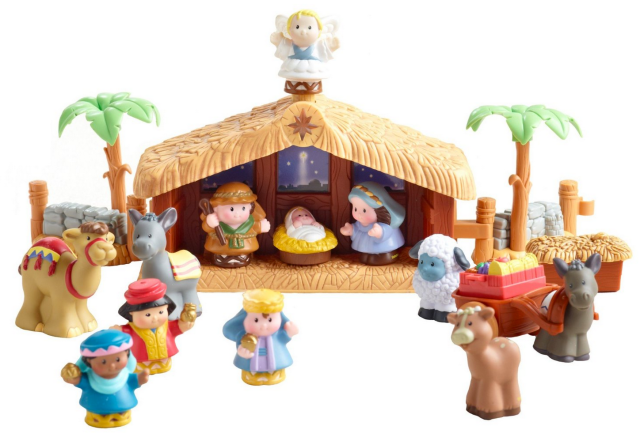
screen-shot-2016-12-23-at-5-33-37-pmA few years ago for Christmas I gave my niece Emma a Fisher Price nativity set just like this one. The cutest little roly poly Mary and Joseph you’ve ever seen, with a little baby Jesus in the straw. I FaceTime often with Emma, and by that wonderful live computer video, I get to “play” with her in my mother’s living room, 1500 miles away.
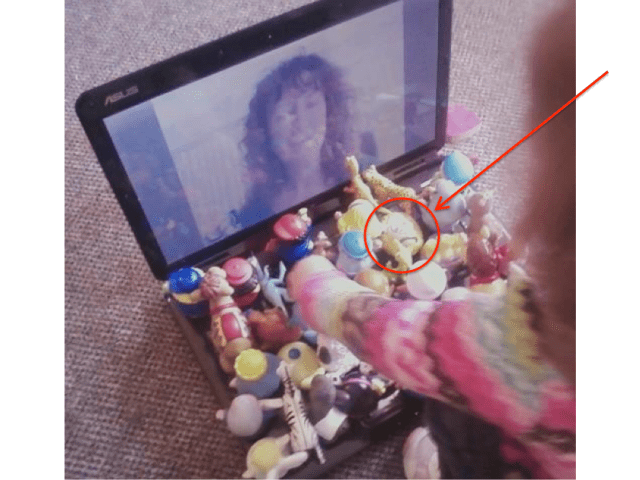
She would show me all her toys, holding each one up to the camera, tells me a story about it, then places it on the keyboard below. My mom snapped this picture of Emma and me playing one day. Me in Florida, Emma in New York.

screen-shot-2016-12-24-at-9-09-29-am

If you look closely, you can see the Baby Jesus in his straw-lined cradle up toward the top of the picture.

For Emma, that nativity set wasn’t just for Christmastime. It was for the whole year. She played with its characters almost every day. Baby Jesus, in his little straw-filled cradle, went on trips in Barbie’s little pink car. He’s been on the Fisher Price yellow school bus. He has slid down the Hot Wheels race car track. (He doesn’t do too well on the turns.)

The first year that she had the nativity set, Emma’s mom was pregnant with our nephew William, and Emma asked me a lot of questions about Baby Jesus and his mom Mary. Like:

“Was Baby Jesus in his Mommy Mary’s tummy?”
Yes, that’s right.
(Sort of, I didn’t think it was the right time to correct the biology of that question.)

“When was Baby Jesus’ birthday?”
Well, we celebrate it on December 25th.

“Did Baby Jesus cry a lot?”
We don’t know, but I would guess that he did.

“Did Baby Jesus’ Daddy have to go to work every day?”
Yep! He was a carpenter, which meant he worked with wood
to make it into chairs and tables and beds and maybe even built houses.

One day, though, she had me stumped. Holding up little Baby Jesus to the laptop camera, she said with the earnestness that only a four-year-old could muster:

“Aunt Hedy, this is baby Jesus.
He’s a little baby.
But he’s a grown-up, too, right?
He’s a baby and a grown-up?”

That question really got me thinking. Today we celebrate the birth of that baby born in a manger all those years ago. But we celebrate today because Jesus didn’t stay a baby.

In next week’s services on New Year’s Day at my church, we’ll celebrate Epiphany by exploring the visit of the Wise Men, the Magi we hear about in the 2nd chapter of Matthew’s gospel. But by the time they arrived, Jesus may have been around two years old.

And then, the following week, we’ll remember Jesus’ baptism by John, when Jesus was in his early 30s.

This week, a baby.
Next, a toddler.
And, then, suddenly,
just a week later, all grown up!

We have the benefit of having the full story laid out for us. We know the joyful, surprising beginning of Jesus’ life. We can read the biblical record of his teachings, his power, his wisdom and kindness. We know that he gave of himself so freely, so fully, going to the cross… for us. And we know that even as they lay his body down in the tomb, that this was not the end of the story, but that on Easter morning, he would rise again, bringing hope into the world.

Christmas is the world-wide celebration that it is because Baby Jesus grew up — full of grace and wisdom and truth — and gave himself for us, so that we could be saved. We celebrate Christmas because we know the whole story! Without that, celebrating Christmas doesn’t make sense!

Without the knowledge of Jesus’ life, teachings, death, and resurrection, this is just another birthday of a child — precious, but like billions of others.

But we know the story.

On that first Christmas morning, what did Mary know about what her son would offer the world? She knew from what the angel had told her that the child she had carried for nine months was to be the Messiah, the Savior. He would be the King in the line of David. He was to be the rescuer of the people.

She would know all this, and yet… she would be holding in her arms an innocent, tiny child. A child she had nurtured in her womb. An infant she had felt kick while he was growing inside her. A child who had just been born from her body, now residing in the cradle of her arms. A baby — Mary’s first baby — who was cherished and loved. She knew he would be the Messiah, but for now, in this moment, he was just Jesus, Mary’s baby boy.

Every year, we celebrate the fact that our Father God chose to send his Son to earth in the form of a child. But stop and think for a moment what that really means. The Son of God — all powerful, majestic, through whom the universe was created — was born as a helpless baby.

Our God, willing to be put in the hands of earthly parents. Willing to be raised by Mary and Joseph, poor and obscure. Willing to be born, not in the palace of a king, but in a dirty borrowed stable. Defenseless, small, completely dependent on human beings to care for him. Our God was willing to become one of us — and to put himself in our hands.

Jesus’ enters the world with very little initial fanfare. Jesus arrives surrounded not by family members, but by farm animals and dirt. He isn’t presented to the waiting community celebrating outside his home. This King, the Son of God, is welcomed simply by his mother, and cradled in her tired and adoring arms.

The second people who meet Jesus are a group of shepherds from the nearby hills. We’re so used to hearing this story, that we may not notice just how surprising this is. Shepherds were not highly regarded in those times. They spent most of their time out in the fields with their smelly animals, didn’t bathe regularly, and were a generally rough and uncultured lot. And these are the first people outside the family that God chooses to greet the newborn Savior!

An angel appears to those societal outsiders and declares: “Don’t be afraid! I bring you good news that will bring great joy to all people. The Savior — yes, the Messiah, the Lord — has been born today in Bethlehem, the city of David! And you will recognize him by this sign: You will find a baby wrapped snugly in strips of cloth, lying in a manger.”

What a gift to us, that God announces Jesus’ birth first not to the religious elite, or the earthly kings, but to a bunch of regular guys, going about their business. They are the first to hear this good news. And their reaction is so great! They rush down the hill into the town, wanting verification that what they’ve just heard is true.

And they find Mary and the baby, just as promised. They were so excited! Luke tells us that after seeing Jesus “they made known what had been told them about this child; and all who heard it were amazed at what the shepherds told them.”

Then we’re told in verse 19:“But Mary treasured all these words and pondered them in her heart.”

She “treasured” it all and “pondered” them in her heart.

To “treasure” in Greek is suntéreó. It means to preserve in memory, to carefully keep in mind, to guard, to protect. It means, in effect, to safeguard, as if locking away a precious treasure to keep from losing it or having it stolen.

And then “to ponder.” Sumballó in Greek. It means to consider, to think about seriously. But it also — and this is so important — it means to meet in battle with, to wage war with, to quarrel or dispute or fight.

There are a lot of other Greek words for thinking. Ones that mean to dispassionately process information, by logically considering all the different aspects. Ones that mean to think about something with the intent of finding a positive solution.

But these are the words chosen to describe how Mary thinks about what has happened: suntéreó and sumballó. To hold close and safe, and to battle with.

We sometimes make the mistake of believing that faith should be easy. We think that if we doubt or wonder or struggle, that our belief isn’t deep enough, isn’t real, isn’t true.

Mary, as devoted and faithful as she was, still wrestled with what it meant for her beloved child to be the Messiah. She would struggle with it as she watched him grow, as she heard his words, as she witnessed his death on the cross. She treasured in her heart the words of the angels, reinforced by the witness of the shepherds who told her what they had heard. She held that knowledge up against what she experienced. What did it mean?

What does it mean for us to believe that over two thousand years ago God entered directly into creation in the form of a tiny, vulnerable baby? What does it mean to believe that God would leave behind the glory and power of heaven, to come to earth, becoming human?

What does it mean to believe that we worship a God who calls us to be peacemakers, merciful and pure of heart?

What does it mean to believe that we worship a God who understands us — completely, fully, intimately — because that God not only created us, but has been one of us? What does it mean that we worship a God who gave sacrificially to redeem and save us?

And what does it mean to believe all that in the context of our outside-the-walls-of-this-sanctuary lives? What does it mean to believe all that in this pain-filled world?

It is all too easy to simply allow the hope and joy and the fun of this season to wash over us, giving us a temporary sense of peace and well-being. We celebrate Christmas… and then we move on.

But Christmas isn’t meant to be a brief stopping point.
It is meant to be a place of change and transformation.
Like the birth of a child, Christmas is meant to be the beginning.

This Christmas, I pray that we would — like Mary — choose to hold on tightly to the reality that God loves us. Treasure that knowledge, lock it deep in our hearts.

And then, think about it — really think about it. What does the coming of God into the world mean for our lives? Think about the tension between the promise of the gift of Jesus and the challenges of your life. Wrestle with, fight with the knowledge that God’s love exists in a world that is so often still chaotic and heartbreaking.

God is not afraid of your wonderings. God is not made angry by your questions. God loves you, knows you, cherishes you. And God wants you to know him, even better than you ever have before.

That is why Jesus came.

I wish you and yours a blessed Christmas,
and a new year filled to overflowing with God’s love!

Posted in Advent | Tagged , , , , , , , , , | Leave a comment

A Surprise Announcement

journeytobethlehem-small

Luke 2:8-12 (New Living Translation)
In that region there were shepherds living in the fields, keeping watch over their flock by night. Then an angel of the Lord stood before them, and the glory of the Lord shone around them, and they were terrified. But the angel said to them, “Do not be afraid; for see — I am bringing you good news of great joy for all the people: to you is born this day in the city of David a Savior, who is the Messiah, the Lord. This will be a sign for you: you will find a child wrapped in bands of cloth and lying in a manger.”

It was late winter in 2013, and the evenings were just starting to get warmer in Washington DC. My husband Chuck and I had met after work for dinner at one of our favorite DC restaurants. The night was perfect, clear and lovely, so after dinner we decided to take a walk before heading to catch the Metro back to Alexandria. We were still pretty new to the city, and didn’t really know our way around. We had been walking for a little while when we saw a large group of people heading down a street. And another group. Then another. We decided to follow to see what the excitement was about. We walked down, made the turn, and there, right in front of us, was the White House.

We hadn’t realized that we had wandered so close. I remember being in awe that night of the fact that I lived in a place where I could just, by turning down a random street, be faced with such a distinctive, beautiful building.

In the years we were in DC, I sometimes thought how strange it must be for the people who live in the White House. Not many of us live in a place that is photographed hundreds — perhaps thousands — of times each day. Few live in a building so famous, so historical, so public. Every entrance or exit you make scrutinized, every area of your living space guarded and watched, every visitor to your home carefully vetted and security checked. It must be incredibly surreal to live there.

But there definitely are perks. For instance, if you are a resident of the White House, you can invite just about any musical group you like to come and entertain you and your friends… and they will most likely show up. Out of curiosity this week, I googled what musicians have played at the White House during President Obama’s tenure. Here’s a partial list:

Alabama Shakes, Cyndi Lauper, Justin Timberlake, Ray Charles, Diana Krall, BB King, Mick Jagger, Los Lobos, John Legend, Sheryl Crow, Stevie Wonder, Jennifer Hudson, Joshua Bell, Esperanza Spaulding, Gloria Estefan…

Wow, right?
Can you imagine just having those folks over to your house to sing?

And that’s not even the whole list! Man, would I have loved to be there for some of those performances. And, you know, even though we lived in the DC area for a good part of Barack Obama’s time in office, he and Michelle never invited us to attend even one concert?

(What is up with that?)

If I had a time machine, there are performances I would love to go back and experience:

Mehalia Jackson singing on the steps
of the Lincoln Memorial in 1963.

Wolfgang Amadeus Mozart
performing in Salzburg in 1777.

Elvis Presley on the Ed Sullivan Show
for the first time in 1956.

(And, yes, I did just mention Mehalia, Wolfgang, and Elvis at the same time. I get to choose my dream artists. You choose your own!)

But out of all the vocalists, out of all the bands and performers and choirs in the world and throughout history, if I had just one shot at moving through time and space to be there for a musical experience, there is no question: I would go back to a starlit hillside outside of Bethlehem over two thousand years ago. When, out of pure joy, angels sang to a group of shepherds.

And there were shepherds living out in the fields nearby, keeping watch over their flocks at night. An angel of the Lord appeared to them, and the glory of the Lord shone around them, and they were terrified. But the angel said to them, “Do not be afraid. I bring you good news that will cause great joy for all the people. Today in the town of David a Savior has been born to you; he is the Messiah, the Lord. This will be a sign to you: You will find a baby wrapped in cloths and lying in a manger.” Suddenly a great company of the heavenly host appeared with the angel, praising God and saying, “Glory to God in the highest heaven, and on earth peace to those on whom his favor rests” (Luke 2:8-14, New International Version).

Try to picture that scene for a moment…

It’s dark, a clear night, with a beautiful star shining brightly overhead. The shepherds are doing what they do every night: checking on their flock as they prepare to bed down for the night. It’s a night just like any other night. Ordinary. Nothing special. They know what to expect.

Then, suddenly, an angel appears, shining with the glory of God’s power! They are — not surprisingly — completely freaked out! These are people living on the periphery of society, outsiders, outcasts, and they’ve got to be thinking that an angel appearing among them cannot possibly be good news for them!

But the angel does something remarkable, immediately offering words of comfort.

“Do not be afraid,” the angel says.  The Greek word used here for “afraid” is phobeó, together with the negative particle .

Μὴ φοβεῖσθε
Me phobeisthe
Fear not

Do not be filled with dread at my arrival, the angel says. Phobeó also means to withdraw from, to flee.  “Don’t run away!” the angel tells the shepherds, “Don’t take off!” Another translation of phobeó is “to avoid.” To the shepherds, the angel says, “Don’t avoid this!” Don’t miss it!”

“Do not be afraid. For see,” the angel says, “this is good news!”

“For see.” Idou in Greek. It’s a funny, awkward, difficult-to-translate little word. Some Bible versions render it as “Lo!” or “Behold!” Other translations choose leave it out entirely.

But it’s a really important part of what the angel says to the shepherds. Don’t be afraid, they’ve been told. Don’t run away, don’t miss this, they’ve urged. And now the angel tells them to see. Look! Pay attention! Don’t avert your eyes and walk away! Harken to what I have to tell you!

That is when they learn that they are the first to hear about the birth of the long-awaited Messiah, the Savior. Them! A bunch of shepherds hanging out with their herds on a hill!

And the child has already arrived, and is waiting in a stable in the town of Bethlehem.

While the shepherds are probably still reeling from this jaw-dropping announcement of the Messiah’s birth, the angel is suddenly joined by a “multitude” of other angels, and they burst into joyous song. Has any song like it ever been heard on earth since then?

Now, likely, our image of this moment has been formed by Christmas cards we’ve received over the years, paintings we’ve viewed. The shepherds standing in the dark on the hillside, craning their necks up to the sky, as a large number of angels break through the clouds, overwhelming but still safely removed from the men far below.

Nope! That’s not how it goes down in the scripture. The first angel, we’re told, stands before the shepherds. Close by, not at a distance. Then, after the announcement of Jesus’ birth, the other angels suddenly appear with the angel. Again, right there! And this isn’t just a few angels. It’s a stratia: Greek for an army of angels! And that word is magnified by the Greek pléthos: a great number, a multitude.

Imagine, if you will, these shepherds being completely surrounded by God’s angels — every direction they turn — all singing praises to God for the inbreaking of God’s love into the world in the form of a tiny baby.

Then… just as suddenly in our scripture, it’s all over. With the angel’s song ringing in shepherds’ ears, the night must have seemed deafeningly quiet.

They look at each other, and say, “Okay. So, let’s go — right now, this moment — to Bethlehem and see this for ourselves. C’mon! Let’s go!”  I’m paraphrasing, definitely, but it gets the mood of what they say. They are really anxious to get moving!

I have to admit that I have a rather comical image in my mind about this moment, with the shepherds falling over each other as they rush down the hillside toward Bethlehem, tripping each other up in their urgency to reach the stable first.

It’s no wonder that, following such a dramatic announcement, the shepherds are in such a hurry to get to Bethlehem. They’ve heard about the Messiah — but now they want to see him for themselves. So they take off at a run toward that manger. They rush into the village.

And it is just as the angel had promised. They find Joseph and Mary, and there, lying in Mary’s arms, a newborn baby boy.

How overwhelming it must have been for these simple, rough shepherds to see the promised Messiah not in a palace, but in the squalor of a stable. Could the message have been clearer to them? This Messiah was for them! It was for every person, no matter how high or how low. This gift of majesty, glory and honor was brought down to the level of the shepherds: humble, earthy and plain.

When the shepherds leave Bethlehem, they carry with them this truth, and they share the story with everyone they meet.

I think it’s pretty safe to say that the shepherds’ lives would never have been the same after this. How could it be? What happened to them was remarkable, beautiful, life-transforming.

It’s a simple, very short story, just 13 verses in Luke’s gospel. But what we can learn from it is so important.

Because at every turn of the story, the shepherds had choices. And they chose: (1) to listen, (2) to move, (3) and to share.

First, they listened…

They didn’t cower on the ground, curled up in fetal position, eyes tightly closed, fingers stuck deep in their ears. When the angel told them not to be afraid, they listened. They didn’t run away, didn’t avoid hearing the truth. They believed — they trusted — in the power of the angel’s message. They listened with great attentiveness.

This year, I pray that we would listen… really listen… to the beautiful message of this season. Pay attention. Don’t be afraid. Oh, please, don’t miss it!

Next, the shepherds moved…

That night, the shepherds were just living their lives, going about their business. They knew what their days, their nights would entail. They knew what to expect. That night was ordinary, nothing special.

But after they listened to the awesome news, they didn’t hesitate. “Let’s go right now down to Bethlehem,” they said. They didn’t have to do that! They could have just said, “Wow! That was pretty amazing,” and then have simply gone on with their lives. They could have tweeted about the experience, posted a picture of the angels on Instagram or Facebook.  They didn’t have to actually DO anything in response to the angel’s proclamation.

But they did. They truly listened to the message. They took it to heart. And then they took action. They wanted to see for themselves the truth of what they had heard. They wanted to test it out, to check out the facts. They moved.

I pray this year that we would not just listen to the Christmas message of grace and hope and then… move back on with our lives. Instead, may we be moved to loving action!

And, finally, they shared…

Verse 17 tells us: After seeing Jesus, the shepherds told everyone what had happened and what the angel had said to them about this child. (New Living Translation)

They were so excited, they just couldn’t keep it to themselves! They were overflowing with delight, and the news just bubbled out of them every where they went. That news — it’s the very same news we will celebrate in a just a week’s time.

It is truly good news, of great joy, that is for all people. In the town of David a Savior has been born to us; he is the Messiah, the Lord.

So, as we close, I have a few questions I’d love for you to consider this week, as we finish up our journey to Bethlehem together.

1st: LISTEN.
What part of the Christmas story is speaking to your heart this year?
What message of love and hope does God have for you?

2nd: MOVE.
What might God be calling you to do in response to God’s incredible gift of love?
How will you allow God to use you to bring healing and hope to this world in pain?

And 3rd: SHARE.
With whom in your life would you love to share the story of Jesus’ birth?
Who might you invite to come with you to a Christmas service this weekend?

I don’t have a time machine, no matter how I’ve fantasized about it. I can’t go back in history to stand with those shepherds on that hillside outside Bethlehem as the angels sang in the dark of the night.

But I can stand with you — here, now — as together we celebrate the birth of Jesus with our voices raised in joy and thanksgiving, praying for healing and peace in our world.

May God bless you as we continue to prepare for Christmas, and for the coming of the Christ child!

Posted in Uncategorized | Leave a comment

A Surprise Twist

journeytobethlehem-small

Matthew 1:18-21
This is how Jesus the Messiah was born. His mother, Mary, was engaged to be married to Joseph. But before the marriage took place, while she was still a virgin, she became pregnant through the power of the Holy Spirit. Joseph, to whom she was engaged, was a righteous man and did not want to disgrace her publicly, so he decided to break the engagement quietly. As he considered this, an angel of the Lord appeared to him in a dream. “Joseph, son of David,” the angel said, “do not be afraid to take Mary as your wife. For the child within her was conceived by the Holy Spirit. And she will have a son, and you are to name him Jesus, for he will save his people from their sins.”

Just eight verses in the Gospel of Matthew. That’s all we hear about the birth we’re about to celebrate in two weeks. Just eight verses. And all that we’ve looked at in this series so far from the Gospel of Luke — the angel’s appearance to Zechariah in the Temple, Elizabeth’s miraculous, late-in-life pregnancy, the visit of the same angel to Mary, Mary’s faith-filled acceptance of a challenging promise, 76 verses of tension and joy and drama — all of this is condensed into just one verse!

Verse 18: This is how Jesus the Messiah was born. His mother, Mary, was engaged to be married to Joseph. But before the marriage took place, while she was still a virgin, she became pregnant through the power of the Holy Spirit.

That’s it! What takes almost a full chapter in Luke’s gospel, receives just 8 lines in Matthew. And other than a few scattered verses in the gospels, this is all we hear about Joseph, the adoptive father of Jesus.

As we read today’s scripture, we know the backstory. We know about the amazing visits from the angel Gabriel, the questions asked and answered, the fulfilled promises. But Joseph… poor Joseph… he doesn’t know any of it.

All he knows is that his fiancée Mary is pregnant.
And he knows it isn’t his.

Joseph and Mary were engaged, which was a much more formal contract in those days. According to Jewish custom, Mary is legally his wife, even though they would not live together, not be intimate with each other until a full year had passed. Then Mary would move into her new home with Joseph, the community would celebrate their wedding, and they would begin officially their married life together.

But, now, all of that is over, Joseph believes. Mary has violated the terms of their marriage promise in the most egregious way possible. She has destroyed their future together.

We’re told in verse 19 that Joseph is a “righteous man.” Dikaios in Greek, meaning to live in conformity to God’s standard. The New International Version renders it “faithful to the law.”

Joseph, as a righteous man, a dikaios man, as a faithful follower of the Jewish Law, would have known the penalty Mary faced for her pregnancy. It was very clear, completely unambiguous.

Deuteronomy 22, verse 21 outlined the punishment: The woman must be taken to the door of her father’s home, and there the men of the town must stone her to death, for she has committed a disgraceful crime in Israel by being promiscuous while living in her parents’ home. In this way, you will purge this evil from among you.

The Gospel of Matthew was written for a largely Jewish audience, and they would have known what would come next in this story. Mary, pregnant by someone not her husband, would be killed in disgrace. And Joseph must be the one to accuse her.

That is what a righteous man could be expected to do.
And that was what Joseph knew those
around Mary would expect to happen.

But that is not what this righteous man, this dikaios man, chooses to do. Instead, he decides to quietly release her from their marriage. He will not accuse her publicly, will not shame her and cause her to be subject to brutal, dishonorable death. He would simply allow her to slip away, still bearing her burden of guilt, but not condemned by Joseph.

It is a remarkable, surprising twist to the story.

In 2004, I saw the movie Raising Helen. There is one scene that I kept thinking about as I thought about the surprising grace and compassion that Joseph shows to Mary. At the beginning of the movie, we meet three sisters: ultra-responsible elder sister Jenny, the wild and unpredictable youngest (the title character of Helen), and fun mom-of-three middle sister Lindsay.

When Lindsay and her husband are killed in a car crash, Jenny and Helen are shocked to learn that it is carefree Helen who is given custody of Lindsay’s three children. The rest of the movie is about the travails of Helen’s transition from cool aunt to responsible parent. And it is also about older sister Jenny’s struggles to understand why Lindsay didn’t leave the kids in her care.

Toward the end of the movie, we hear a letter being read, in Lindsay’s voice:

“Dear Jenny, If you’re reading this, you know that I’m gone. And I asked Helen to be the guardian for the kids. And you’re probably freaked about it. Yes, it’s a surprising choice, considering that you are the most incredible mother I’ve ever known. If you find this letter odd, understand that my ‘always be prepared’ [husband] Paul convinced me to write it now while our children are young. You must know from experience that when it comes to picking somebody else to raise your kids, no one seems right. No one is you. And so you choose someone who is most like you. Someone that will give the kids a taste of their real mom, the mom they lost and never really got to know. In so many ways, we are so much alike, that’s why I chose Helen.”

You must know from experience
that when it comes to picking
somebody else to raise your kids,
no one seems right.
No one is you.
And so you choose someone
who is most like you.

Joseph decides to quietly release Mary from their engagement — before he even knows the reason for the pregnancy! Joseph has every reason to believe that Mary has been deeply unfaithful to him. She has betrayed him, has broken the promise she made to him before their families and before God. She is, by law, deserving of a terrible punishment, even death.

But Joseph, out of kindness and compassion, does not act in anger, but makes the decision to show incredible, unwarranted grace by showing her forgiveness and grace.

Does that sound at all familiar?
(I sure hope so!)

The God who created the whole world, who with loving care shaped creation, who gave each and every one of us life, that God watched humanity turn away again and again… and again. We were — and are — unfaithful and fickle. We reach out to everyone and everything before we reach out to God. We break our promises.

By rights, we are subject to punishment. And, yet. Instead of punishing us, God shows us incredible, unwarranted grace. Not just by letting us go without penalty — that would have been enough. But God’s grace is so overwhelming that God comes down to us in the form of a vulnerable baby born on Christmas morning! And that child would grow to teach us about God’s love, and to show us just how far God will go to save us.

God chose Zechariah and Elizabeth to be bearers of the good news of the coming Savior because of their enduring devotion and loyalty.

God chose Mary for her faith and trust.

And I’ve come to believe that God chose Joseph because his graceful character so deeply reflected God’s own.

“You must know from experience that when it comes to picking somebody else to raise your kids, no one seems right. No one is you. And so you choose someone who is most like you.”

Now… I have to stop here and admit something to you. I’ve read today’s passage from Matthew many times. I’ve preached on it at Christmastime. I’ve read commentaries and watched dramatic reenactments. And yet, I’ve always felt that Joseph came across as a bit passionless, wishy-washy… milquetoast.

Joseph, to whom she was engaged, was a righteous man and did not want to disgrace her publicly, so he decided to break the engagement quietly. As he considered this, an angel of the Lord appeared to him in a dream.

“As he considered this.”

Really? His fiancée is pregnant after apparently cheating on him, shaming him in front of their families and community, and he is “considering” it?

How… controlled of him.

This week was the first time I have dug into the Greek word translated so boringly here as “to consider.” And, frankly, it changes everything about this story for me.

ἐνθυμέομαι
enthumeomai

It means to meditate upon, to reflect upon, to ponder. But it means to do so in a deeply passionate frame of mind. It means to think about something while agitated or moved by strong impulses to act. It is an inner, intense chewing over of the facts.

Joseph is not coolly considering his plight — and Mary’s — as he lays down to sleep. All his plans, all his hopes, all his dreams have been destroyed by Mary’s thoughtless promiscuity. He is wracked with emotional pain, deeply wounded, very angry and hurt.

Which makes what he has decided to do all the more remarkable. He has not yet been visited by the angel. He doesn’t yet know that Mary is innocent, that her child is God’s own child, conceived by the Holy Spirit.

And, yet, in anger, in pain, Joseph still decides to compassionately release her and let her go unpunished. He refuses to destroy her future, and that of the child she carries.

Compassionate.
Full of grace.
Faithful…
even when faced with faithlessness.

“You must know from experience that when it comes to picking somebody else to raise your kids, no one seems right. No one is you. And so you choose someone who is most like you.”

Slipping into sleep, Joseph knows that his dreams will likely be full of trouble.

But… then… another wonderful, surprise twist to the story!

An angel appears to him in a dream, and everything that Joseph has feared is turned completely on its head.

“Joseph, son of David,” the angel said, “do not be afraid to take Mary as your wife. For the child within her was conceived by the Holy Spirit. And she will have a son, and you are to name him Jesus, for he will save his people from their sins.” All of this occurred to fulfill the Lord’s message through his prophet: “Look! The virgin will conceive a child! She will give birth to a son, and they will call him Immanuel, which means ‘God is with us.’”

The angel tells Joseph to name the child “Jesus,” which means “God saves.” In that culture, it was the father’s right to give the child a name, and, by doing so, to officially claim the child as his own. By naming the child Jesus, God has laid claim to the unborn baby. Joseph will raise this child with Mary, but it is clear from the very beginning whose this child truly is. This baby, to be born in Bethlehem at the end of a long journey, is the child of the most High God.

Joseph now knows that Mary hasn’t been unfaithful to him. No, indeed! She has been chosen by God to bear the Savior, to be the mother of a child promised long ago. All Joseph’s pain evaporated, all his wounds gone, healed. He knows that this child will be God with us on earth. And that he, by marrying Mary, will become Jesus’ legal father.

Can you imagine the joy with which Joseph awoke that morning? He had gone to sleep filled with such anxiety, such torment. Now those storms are past, and he knows the truth of Mary’s worth, and of God’s beautiful faithfulness to the world.

Joseph immediately obeys the angel’s command, taking Mary home with him as his wife. Regardless of what the people around him might say, no matter the gossip, despite the social consequences, he does what he now knows is right. This righteous man, this dikaios man, he does the perfect, God-honoring thing.

But… let’s stop and think about what this really means for Joseph. Joseph was no fool. He knew quite well that the society in which he lived was based on honor and shame. And so, even as Joseph takes Mary for his bride immediately after the dream, he knows that when the baby arrives, people will be able to do the math. At this point, Mary is at least three months pregnant, and when a full-term, healthy-sized baby is born less than six months after the official marriage, the community around them will know full well that conception happened before the wedding.

Shame. In their culture that would bring shame on Mary, on Joseph, on their families. Deep shame. Because it would mean that they either had defied the Law and been intimate before it was legal to do so, or that Mary had cheated on Joseph.

And so even though he knew the truth about Mary’s condition, Joseph was still incredibly brave and faithful in taking her as his wife. But he knew — he knew — that this child about whom rumors would spread throughout their small community — this child was more than he appeared.

This child was a gift beyond price.
This child had come to save the world.

What was it like, in the mess and noise of that stable in Bethlehem, for Joseph to hold for the first time the small child entrusted to his care by the Creator of the universe? What was it like for him to cradle in his arms the one who would be called Emmanuel, God with us? As he rocked the child to sleep, what were his thoughts?

We’re not the first people to wonder about this, of course. On their 2005 album The Christmas Sessions, the band Mercy Me released a song called “Joseph’s Lullaby.”

Go to sleep my Son
This manger for your bed
You have a long road before You
Rest Your little head

Can You feel the weight of Your glory?
Do You understand the price?
Or does the Father guard Your heart for now
So You can sleep tonight?

Go to sleep my Son
Go and chase Your dreams
This world can wait for one more moment
Go and sleep in peace

I believe the glory of Heaven
Is lying in my arms tonight
But Lord, I ask that He for just this moment
Simply be my child

Go to sleep my son
Baby close your eyes
Soon enough you’ll save the day
but for now, dear child of mine
Oh, my Jesus sleep tight.

Our scripture reading for today continues with these words:  All of this occurred to fulfill the Lord’s message through his prophet: “Look! The virgin will conceive a child! She will give birth to a son, and they will call him Immanuel, which means ‘God is with us.’”

Amen! And hallelujah!

Posted in Advent | Tagged , , , , , , , , , , , , , , , | Leave a comment

A Surprising Faith

journeytobethlehem-small

Luke 1:13-17
The angel said to her, “Do not be afraid, Mary, for you have found favor with God. And now, you will conceive in your womb and bear a son, and you will name him Jesus. He will be great, and will be called the Son of the Most High, and the Lord God will give to him the throne of his ancestor David. He will reign over the house of Jacob forever, and of his kingdom there will be no end.” Mary said to the angel, “How can this be, since I am a virgin?” The angel said to her, “The Holy Spirit will come upon you, and the power of the Most High will overshadow you; therefore the child to be born will be holy; he will be called Son of God. And now, your relative Elizabeth in her old age has also conceived a son; and this is the sixth month for her who was said to be barren. For nothing will be impossible with God.” Then Mary said, “Here am I, the servant of the Lord; let it be with me according to your word.” Then the angel departed from her.

Chuck and I started watching our collection of Christmas movies this weekend. We started with the classic Christmas in Connecticut with Barbara Stanwick. Coming up over the next few weeks we have the more modern The Nativity Story, released in 2006. Bing Crosby’s White Christmas, which you can’t just watch — you must sing along! Loretta Young and Cary Grant in The Bishop’s Wife. The more obscure The Man Who Came to Dinner with Monty Wooley, and Donovan’s Reef with John Wayne. My all-time favorite It’s a Wonderful Life. And, of course, no Christmas would be complete without Charles Schultz’s A Charlie Brown Christmas.

I can’t remember a year when I didn’t watch poor Charlie Brown, so put upon and abused, as he longs for meaning in Christmas, thwarted on every side. Even his baby sister has been sucked into the commercialism of the season. She asks Charlie to write a note for her, as she dictates.

“Dear Santa Claus, How have you been? Did you have a nice summer? How is your wife? I have been extra good this year, so I have a long list of presents that I want. Please note the size and color of each item, and send as many as possible. If it seems too complicated, make it easy on yourself: just send money. How about tens and twenties?”

As Charlie walks away, disgusted, Sally laments, “All I want is what I… I have coming to me. All I want is my fair share.”

I think we all have a bit of Sally Brown in us. Most of us have things we wish we would find under the Christmas tree. And, like with Sally, there is a part of us that believes that we deserve to find those things under the tree come Christmas morning.

But as we grow older,
so many of the things we long for the most
can’t be wrapped up in pretty paper
with a tag signed “From Santa.”

If I was to ask you today what kind of things would make you feel loved, feel secure, feel cherished and safe, you might say something like these statements. I pray that my family’s relationship would be healed. I pray that my kids would be healthy. I pray that the different factions in our world and country would be able to hear each other and find a way to work together. I pray that no one would be without a place to sleep this Christmas. I pray that the violence in our world would stop, and that all people would be able to live in peace.

This is the second Sunday of Advent. Last week we lit the first candle on our Advent wreath representing hope. This week, we lit the candle of peace.

Peace.
We long for it.
We crave peace in our world,
in our country, in our communities,
in our spirits.

peace mug

Every morning when I wake up, the first thing I do is make tea. For over a decade now, I’ve been using this cup for that first sweet infusion of caffeine. It reads:

peace.
it does not mean to be in a place
where there is no noise, trouble, or hard work.
it means to be in the midst of those things
and still be calm in your heart.

I love that. And yet, truth is, peace is about so much more than just being calm in our hearts. The biblical Greek word in the New Testament for peace is eiréné. It comes from the verb eirō, which means “to join, to tie together into a whole.” Peace true, lasting, real peace — is about more than just an absence of war or conflict. Peace is completeness. It is about all the parts being joined together in a way that all have value. It is about being the same inside and out. It is about being whole.

Peace is what makes it possible for us face with confidence and hope whatever the world throws at us.

Peace — eiréné — is what makes Mary’s story possible.

Last week we looked at the story of Elizabeth and Zechariah, an aging couple who had longed for years for a child of their own. In the culture of their time, being childless was seen as a punishment from God. They prayed that their shame would be lifted, but no longer really believed it was possible. So, when Elizabeth becomes pregnant with their son John, they rejoiced, and everyone around them did, as well.

Contrast Elizabeth’s story with Mary’s. There are lots of similarities: an unexpected visit from an angel, who gives astounding news of a miraculous birth. There’s a question about how this could be possible, followed by a sign being given to the questioner. And, then, the fulfillment of the promise.

But there is where the similarities end. Elizabeth is a long-married woman who had prayed for a child. Mary is a young teenager, engaged, but not yet married. Her father would have arranged the marriage to Joseph. For a year following the engagement, Mary would continue to live with her parents, and after a year, Joseph would take her home with him, and the wedding would be celebrated.

Mary knew that she would soon be married. She may have prayed for the children she would eventually have, but she certainly wasn’t praying for a child right now.

All those around Elizabeth would have celebrated this amazing, surprise gift of a child to her and Zechariah. The people around Mary would have clucked their tongues in judgment of this unwed mom-to-be. In her culture, an unmarried pregnant woman could not just be shunned by her family and ostracized by her community, she could be stoned to death for the pregnancy.

It’s also interesting to see the differences in Mary’s and Zechariah’s reactions to the angel’s astonishing promise of a child. Zechariah immediately voiced doubt (and then had his voice taken away). Mary’s reaction is fascinating! All she says is: “How will this be, since I am a virgin?” The tense of the verb she uses is future indicative, which looks forward to an act that is sure to be completed in the future. It assumes that although it hasn’t happened yet, it definitely will happen. Mary’s question “how will this be?” isn’t one of doubt — she fully believes the angel’s words. Her question is simply one of wonder and curiosity.

How will this be?”

The angel answers: “The Holy Spirit will come upon you, and the power of the Most High will overshadow you. So the baby to be born will be holy, and he will be called the Son of God. What’s more, your relative Elizabeth has become pregnant in her old age! People used to say she was barren, but she has conceived a son and is now in her sixth month. For the word of God will never fail.”

Can you imagine the thoughts running through Mary’s head in this incredible moment?

She must have wondered what her family would say. Would they believe her when she told them that her child was divinely conceived?

What would Joseph do? Would he throw her aside? He certainly had that right! What would her life be like when the angel’s promise came true?

She must have wondered why she had been chosen, out of all the women in Israel. Mary is poor, unmarried, from an obscure village and a common lineage. Why not choose someone married? Why not someone among the religious leaders of the time? Why not someone more powerful, more wealthy, more connected? Why her?

She must have experienced some pangs of anxiety about the pregnancy itself. She was so young. Growing up in a small village, she would have seen what pregnancy does to a woman. She would have been there beside family and friends who were pregnant. This wasn’t something she expected to have to deal with at this point in her life.

And note that the angel gives Mary no assurance
that these obstacles would be swept away from her path.
Not one.

But as all of these thoughts — and surely many more — race through her head, Mary responds with the most amazing, simple statement: “I am the Lord’s servant. May everything you have said about me come true.”

Her acceptance of the angel’s promise was not a small act of faith. “Do not be afraid, Mary, for you have found favor with God,” the angel had said.

You have found favor with God. And yet Mary knows that this favor will likely result in serious difficulties in her near and distant future.

But she trusts her God. She knows that God has been faithful in the past, and will be faithful to her, as well. She knows what an honor it is to bear the child who will grow to save the world, to hold in her womb the long-awaited Messiah.

Near the end of A Charlie Brown Christmas, poor Charlie Brown has reached the end of his rope. In despair, he cries out, “Isn’t there anyone, who knows what Christmas is all about?”

And little voice answers: “Sure Charlie Brown, I can tell you what Christmas is all about.”

Charlie’s friend Linus steps up to tell the story.

And there were in the same country shepherds, abiding in the field, keeping watch over their flock by night. And, lo, the angel of the Lord came upon them, and the glory of the Lord shone round about them! And they were sore afraid. And the angel said unto them, ‘Fear not! For, behold, I bring you tidings of great joy, which shall be to all my people. For unto you is born this day in the city of David a Savior, which is Christ, the Lord. And this shall be a sign unto you: Ye shall find the babe wrapped in swaddling clothes, lying in a manger.’ And suddenly, there was with the angel a multitude of the Heavenly Host praising God, and saying, ‘Glory to God in the Highest, and on Earth peace, and good will toward men.’ … That’s what Christmas is all about, Charlie Brown.”

Isaiah 9, verse 6: “For a child has been born for us, a son given to us; authority rests upon his shoulders; and he is named Wonderful Counselor, Mighty God, Everlasting Father, Prince of Peace.”

It is God’s peace — eiréné — that makes the birth of Jesus possible.

It is God’s peace — eiréné — that makes it possible for Mary to say yes to the angel and to God’s promise. She knows at her core who she is. And she knows who her God is: a God of love and grace, a God of power and possibility, a God of endless creativity and compassion. And so she says yes.

It is God’s peace — eiréné — that comes into the world on that first Christmas morning, bringing the hope of redemption and healing.

It is God’s peace — eiréné — that makes it possible, just three decades later, for Jesus, at the end of his life, to sit with his friends around a borrowed room and to share a meal that would be a gift to them for all time. It is only because Jesus was whole, complete, divine and human joined together with perfect love — it is only because of this peace that Jesus could offer himself so fully. Like his mother Mary years before, he could face what he knew was coming and give himself over to his Father God’s will. As he prepared to give himself up for his followers, he gave them an amazing promise:

“I am leaving you with a gift — peace of mind and heart. And the peace I give is a gift the world cannot give. So don’t be troubled or afraid. Remember what I told you: I am going away, but I will come back to you again. If you really loved me, you would be happy that I am going to the Father, who is greater than I am. I have told you these things before they happen so that when they do happen, you will believe.”

May we all this Advent season, like Mary, say with God’s peace in our hearts, “I am the Lord’s servant. May everything you have said… come true.”

__________

For information about Christmas at Plantation United Methodist Church, visit http://www.christmasinplantation.org!

Posted in Advent | Tagged , , , , , | 1 Comment

A Surprise Gift

journeytobethlehem-small

Luke 1:13-17
The angel said to him, “Do not be afraid, Zechariah, for your prayer has been heard. Your wife Elizabeth will bear you a son, and you will name him John. You will have joy and gladness, and many will rejoice at his birth, for he will be great in the sight of the Lord. He must never drink wine or strong drink; even before his birth he will be filled with the Holy Spirit. He will turn many of the people of Israel to the Lord their God. With the spirit and power of Elijah he will go before him, to turn the hearts of parents to their children, and the disobedient to the wisdom of the righteous, to make ready a people prepared for the Lord.”

Two weeks ago, I flew up to central New York for a brief visit with my family. If you saw the pictures I posted on Facebook, you probably noticed that I took no pictures of the adults. That actually wasn’t on purpose. I mean, I love my parents, my brother and his wife, my in-laws. But when I’m up north, it’s all about the kids. I was able to spend time with six of our nieces and nephews, including meeting my great-nephew Beckham for the first time in person. It was awesome.

I think one of the best feelings in the world is having a little baby body nestled up to you, head resting on your shoulder. There is something about the birth of a child that reminds us of the potential and possibilities for the future. It is an affirmation that life is precious and beautiful. Children rekindle hope.

I have a favorite t-shirt — a Christmas gift from my parents a few years ago. It’s super soft and comfy, but the real reason I love it is the words printed on it: pistis, elpis, and agape. Three Greek words from 1 Corinthians 13: faith, hope, and love. We talk a lot about faith in church, and about God’s love. Today we’re going to talk about elpis, hope.

ἐλπίς

Elpis is a fascinating word. It doesn’t have the kind of anemic flavor we often attach in English to the word hope, such as in “Gosh, I sure do hope my team wins the Super Bowl.”

(They’ve actually got a chance this year, though!)

No. Elpis means confident expectation of what is sure, of what is certain. It means living your life in positive, confident knowledge that God is faithful and in anticipation of the fulfillment of God’s promises to us.

This is the first Sunday of Advent — the four weeks leading up to Christmas. In churches across the world people are lighting  the candle of hope on their Advent wreaths. And today’s scripture reading from the first chapter of Luke is all about hope.

Since I arrived back in Florida in July, I’ve spoken to dozens of people in our congregation and community who are worried. Afraid. Anxious. People who are facing health crises. People who are grieving. People who are unemployed or underemployed. People who are homeless. People who feel lost and confused and unsure of their faith. People who are terrified of the violence they see around our world, and the division in our country.

We could all do with a little more hope in our lives.

(Can I get an amen?)

In the time of Herod king of Judea there was a priest named Zechariah, who belonged to the priestly division of Abijah; his wife Elizabeth was also a descendant of Aaron. Both of them were righteous in the sight of God, observing all the Lord’s commands and decrees blamelessly. But they were childless because Elizabeth was not able to conceive, and they were both very old. (Luke 1:5-7)

It may seem a bit strange to begin our Advent season by not talking about the main characters of Christmas: Mary, Joseph, and Jesus. But we’re starting today where Luke begins: with a couple facing some serious uncertainty in their lives, people who are in a seemingly hopeless situation.

We’re told that both Zechariah and Elizabeth are righteous and blameless. In Greek, dikaios and amemptos, meaning people who closely observe God’s laws, who have lived a life that is above reproach. These are good, devoted people. They have lived faithfully, just the way they should.

And, yet, they have a deep grief at the core of their relationship. They weren’t able to have children. In the time they lived, being childless wasn’t understood as a result of physical or environmental factors. It was considered a divine punishment. They both knew that the people around them would have wondered what it is they had done to deserve to be so afflicted. And, indeed, Zechariah and Elizabeth themselves probably wondered this at times.

But regardless of their personal pain, as a descendant of Aaron, Zechariah was required to serve as a priest at the Temple in Jerusalem twice a year for one week.

Verses 8 through 10: Once when Zechariah’s division was on duty and he was serving as priest before God, he was chosen by lot, according to the custom of the priesthood, to go into the temple of the Lord and burn incense. And when the time for the burning of incense came, all the assembled worshipers were praying outside.

There were many ways for a priest to serve in the Temple, but the burning of incense to the Lord was a special, once-in-a-lifetime honor. It was randomly assigned to those serving that day. Over the years of his service, Zechariah had been carefully trained. He knew how to walk in to the sanctuary, where to stand, what actions to take, how to use the incense, what words to say and when to say them.

It was a well-known ritual, sacred, yet also routine, unchanging. He knew exactly what to expect. And so, leaving all those praying outside behind him, he walked in. Alone.

Verses 11 and 12: Then an angel of the Lord appeared to him, standing at the right side of the altar of incense. When Zechariah saw him, he was startled and was gripped with fear.

Zechariah had entered the sanctuary of his God, and yet he was completely shocked and terrified to encounter the divine! Everything he had been taught about the solemnity and ceremony of this moment is turned on its head. Because an angel is waiting there, right next to the altar where he would have placed the incense.

Then we hear the powerful first lines of dialogue in the Gospel of Luke. The angel tells Zechariah:

“Do not be afraid, Zechariah; your prayer has been heard. Your wife Elizabeth will bear you a son, and you are to call him John. He will be a joy and delight to you, and many will rejoice because of his birth…”

Can you imagine the thoughts racing through Zechariah’s head? For years and years and years he and Elizabeth had prayed for a child. Now, in this sacred space that should have been empty, he encounters an angel who gives him this joyous news!

But the angel’s not done. The amazing proclamation continues:

“He will bring back many of the people of Israel to the Lord their God. And he will go on before the Lord, in the spirit and power of Elijah, to turn the hearts of the parents to their children and the disobedient to the wisdom of the righteous — to make ready a people prepared for the Lord.”

Being promised a child at this late stage in the game would have been enough. More than enough! But now Zechariah learns that this miraculous child is to be a beacon of hope for the people of Israel, a prophet who will turn the people’s hearts back to God.

And… then… more incredible news: Zechariah is the first one to hear that the promised, long-awaited, constantly-prayed-for Savior was coming into the world! And Zechariah and Elizabeth’s son would be the one to prepare the people for the coming of the Messiah!

Now, I’m not sure when in the midst of the angel’s pronouncement that Zechariah begins to have some doubts — one big, huge doubt in particular. Zechariah can’t help himself. He can’t just say thanks and hallelujah!

Instead, he asks the angel for a sign: “How can I be sure of this? I am an old man and my wife is an old woman.”

Well, the angel gives him a sign all right. Zechariah loses the ability to speak.

Take notice, guys!

Much to the delight of women everywhere,
the angel makes sure Zechariah’s words
“my wife is an old woman”
are the last he utters
for nine whole months.

Yup!

So, Zechariah mutely finishes his duties at the Temple, then returns the 5 miles to his home with Elizabeth. She conceives, and goes on bedrest for several months.

The angel’s promise has come true: they will have a child! And in their private joy at this unlooked-for, surprise gift from God, comes the knowledge that this child will be a blessing to all their people, as well.

There are several things to note in this beautiful story, things that are important as we embark on this Journey to Bethlehem together, during a challenging time in our world.

First is that faithfulness and right living do not guarantee health and prosperity in our lives. And, conversely, when things go badly, when life seems chaotic and you feel lost, that does not mean that God is punishing you.

Instead, the circumstances in our lives are the means through which God reaches out to us in so many ways. There is nothing in your life — absolutely nothing — that God cannot use to bring healing to you and to others around you.

Second, this story is a reminder that God hears our prayers, and that we can count on God’s faithfulness when we are going through difficult times personally. God loves you, and will never, never, never desert you.

And, third, God hears our communal prayers, prayers we pray for our community and world. And we can count on God’s faithfulness when we are facing division in our world, in our country, in our community, in our church, in our families.

The birth of Zechariah and Elizabeth’s son John heralds the beginning of something new for the people. Regaining his voice after naming his newborn child, in verses 76 through 79 Zechariah offers this blessing, which, over the years, has come to be known as Zechariah’s song:

“And you, my child, will be called a prophet of the Most High; for you will go on before the Lord to prepare the way for him, to give his people the knowledge of salvation through the forgiveness of their sins, because of the tender mercy of our God, by which the rising sun will come to us from heaven to shine on those living in darkness and in the shadow of death, to guide our feet into the path of peace.”

The birth of a child — any child — is an incredible, miraculous event. In it, we see the possibilities for the future. There is something about the birth of a child that rekindles dreams in us, that is an affirmation that life is precious and beautiful.

The gift of John, a son to Zechariah and Elizabeth was a gift to the world. That tiny infant would grow to be the prophet who would announce the coming of the Messiah, the Savior of the world, whose birth we celebrate in just 27 days.

The season of Advent is a pregnant time. It is a time of development, like an embryo growing inside a mother’s body. It is a time of fullness and waiting. It is a time of reflection and anticipation and expectation. It is a time of great hope.

The closing words again of Zechariah’s song, this time from The Message translation:

“Through the heartfelt mercies of our God, God’s Sunrise will break in upon us, shining on those in the darkness, those sitting in the shadow of death, then showing us the way, one foot at a time, down the path of peace.”

There is a song that became popular during the Civil Rights Movement called We Shall Overcome, and I’ve been singing its words this past week. Not as a protest song, necessarily, but as a song of hope for the future of this world. It is a song of deep elpis, a confident expectation of God’s work in our lives!

The three verses that have been echoing through my brain are these:

We shall overcome, we shall overcome,
we shall overcome someday;
Oh, deep in my heart, I do believe,
we shall overcome someday.

We shall live in peace, we shall live in peace,
we shall live in peace someday;
Oh, deep in my heart, I do believe,
we shall live in peace someday.

The Lord will see us through, the Lord will see us through,
the Lord will see us through someday;
Oh, deep in my heart, I do believe,
the Lord will see us through someday.

The day that Zechariah went into the Temple to offer incense to God, he went in not expecting anything remarkable to happen. He certainly wasn’t expecting to meet an angel who would tell him that his world was about to change.

So… questions…

Do we really expect God to act in our world?
Do we expect to meet God in worship?
Do we expect God to move within our lives and transform us?
Do we expect God to heal and save this world?

I pray that during this season of Advent, we would be reminded of God’s promises, and rejoice that God will “show us the way, one foot at a time, down the path of peace.”

Because I believe that God is doing something in our world. God is using the circumstances in which we find ourselves to bring people closer to him. God is working in our midst. Every day, every moment, within us, God is awakening possibilities of healing and hope.

So whatever it is that you are going through right now, whatever worries you are bearing, whatever uncertainty you are facing, know that the God who loves you is at work in the midst of it all.

No matter our age — from the youngest children, just starting to understand God, to the eldest, long-faithful members — no matter how old we are: this day, this season, has been given to us by God.

Today is a day for us to remember the promises of God, the surprising grace-filled gifts from God. It is a day for us to recommit to allowing God to guide us — one foot at a time — on the path of peace, on the path of wholeness, of truth, of love.

That is the message on this week of hope.

May God bless you, this day and always!


Posted in Advent | Tagged , , , , , , , , , , , , , , , , , , , , | 3 Comments

Bearing Our Weight

Philippians FB Banner NO DATE

Philippians 3:4-11
If anyone else has reason to be confident in the flesh, I have more: circumcised on the eighth day, a member of the people of Israel, of the tribe of Benjamin, a Hebrew born of Hebrews; as to the law, a Pharisee; as to zeal, a persecutor of the church; as to righteousness under the law, blameless. Yet whatever gains I had, these I have come to regard as loss because of Christ. More than that, I regard everything as loss because of the surpassing value of knowing Christ Jesus my Lord. For his sake I have suffered the loss of all things, and I regard them as rubbish, in order that I may gain Christ and be found in him, not having a righteousness of my own that comes from the law, but one that comes through faith in Christ, the righteousness from God based on faith. I want to know Christ and the power of his resurrection and the sharing of his sufferings by becoming like him in his death, if somehow I may attain the resurrection from the dead.

We’re in the fourth week of our five-week series Finding Light in the Darkness. This weekend’s topic is confidence. The Greek for confidence in today’s scripture reading is closely related to the word for faith, pistis. Our English word confidence comes from the Latin confido, to have full trust.

What does it mean to have confidence in something?

When you came in here this morning and sat down, you demonstrated enormous confidence in something. The pews! You mostly likely sat down without ever wondering if the seats would hold you up. I didn’t see any of you kneeling down and peering beneath the pews to make sure that everything was secure under there. You had full trust that when you sat down it would not collapse underneath you, sending you to the floor amid scraps of splintered wood.

This is a chair from my office. Until this morning, I’d actually never sat in this chair before. Other people have sat in it, but not me. It looks pretty solid, no nails sticking out. It feels secure, not wobbly or loose.

But if I’m not sure of this chair, I’m not going to put my whole weight down on it. I’ll put just a little bit of my weight down, just barely sitting on it, still holding most of my weight on my legs. It’s an awkward feeling, not easy to maintain. Maybe I’ll shuffle a little bit, put a bit more pressure on the chair, but I’m ready to spring back up at any moment if it gives any sign of weakness.

If I had to hold this position for any length of time, the strain would show. It’s rather exhausting. And ridiculous looking!

We all want to have confidence — full confidence — in the things that support us. We want to know that they can bear our full weight.

It was late January 2013, a gray and snowy day. The temperature outside was hovering in the high 20s. A few moments before, the sun had broken through a hole in the clouds, and a ray of bright light was shining into our apartment window. Rolled in a blanket, I had curled up on the carpet in the resulting patch of sunshine on the floor.

And I found myself asking, “How did I get here?”

Now, I don’t mean how did I physically get there: that would have been an easy answer. I had moved from South Florida to Alexandria, Virginia, just south of Washington DC, where my husband Chuck had a wonderful new job. That’s how I found myself there on that cold winter day.

What I meant, as I lay there with my arms wrapped around my knees, was how did I get to a place I had never been before, where I felt so empty, so surrounded by darkness.

Just a few weeks before, I had been a pastor at a large, healthy church, I had been a part of an exciting ministry, with a ton going on each day. My calendar was full, and I felt I was contributing in an effective way. I had family living just a few miles away, and good friends who I saw several times each week. I knew who I was.

Then, on Sunday, January 13th, I preached my last sermon at that church, and we had my farewell gathering. Early Monday morning, I boarded a plane to meet my husband in Washington DC.

Within the span of a few days that January, I went from moving at 95 miles per hour at my job to zero miles per hour. A screeching halt. From meetings, appointments, and events that lasted right up until my last night in Florida to a suddenly, gapingly, wide-open calendar. From interacting with dozens of interesting people every day to being alone in my apartment while my husband was at work. It was jarring and unsettling.

It was as if my chair had given way beneath me, and I fell to the floor with a great crash. As I lay there in that small pool of sunshine on a cold winter day, I started asking myself: who am I? All the things I counted on, that gave me confidence in my value as a human being… they were gone.

And I wondered:
Who am I?

If I’m not a pastor, then who am I? Who am I if I’m not a leader responsible for guiding small groups, for preaching, for counseling, for teaching, for running a church? Who am I?

Who am I when I live somewhere I don’t have family, don’t have friends, don’t have another person other than my husband who knows me? Who am I when I don’t have anything that I must do, must accomplish? No list of tasks for my job, no one counting on me?

My family connections meant nothing. I had no relatives close by, no pre-made community. My former friendships in other towns meant nothing. I had no extensive circle of friends in my new city. My ordination, my calling, my work resume, meant nothing. I had no church to serve there. My education, my degrees meant nothing. I had no job. My skills, my extroversion, my abilities: nothing. I had nowhere to be, nothing to do.

I felt unmoored.
Lost.

The Apostle Paul understood losing confidence in things he once trusted deeply in.

In our reading for today, he outlines those things. Verses 4 through 6: “If anyone else has reason to be confident in the flesh, I have more: circumcised on the eighth day, a member of the people of Israel, of the tribe of Benjamin, a Hebrew born of Hebrews; as to the law, a Pharisee; as to zeal, a persecutor of the church; as to righteousness under the law, blameless.”

In the eyes of Paul’s world, he had every right to be fully confident in his worth. He had a lot to brag about. Paul starts out with a recitation of the privileges into which he was born, then moves on to those he achieved. He was born into one of the twelve tribes of Israel. He could trace his ancestry all the way back to Benjamin, the youngest, beloved son of Jacob’s favorite wife, Rachel.

He was born into a family that held firm to the Law of the Hebrews, as shown by having eight-day-old son Paul go through the circumcision rite that marked him forever as a child of Israel. He grew up to become a member of the ultra-rigorous religious group, the Pharisees, who worked hard to adhere perfectly to the Law. As a zealous member of that group, he sought to correct those who were in violation of the Law, bringing them to justice.

He had every reason to believe
that he was at the top of his game,
that he would receive honor and glory.

But his encounter on the road to Damascus
with Jesus Christ changed everything.

Paul writes in verses 7 and 8: “Yet whatever gains I had, these I have come to regard as loss because of Christ. More than that, I regard everything as loss because of the surpassing value of knowing Christ Jesus my Lord. For his sake I have suffered the loss of all things, and I regard them as rubbish…”

“Rubbish.” That just doesn’t get at how strong the word in the Greek is. It’s a gross word, a nasty one.

σκύβαλον
s
kubalon
dung, muck, filth
waste thrown to dogs

That seems pretty harsh, doesn’t it? All our hard-won accomplishments, all our hard-earned achievements, they’re all no more than a bunch of leftover dregs, refuse, garbage good for nothing but throwing out?

Ouch!

Paul is trying to make a point here, and he wants to make sure we don’t miss it. So he states it as boldly, as brashly, as baldly as he can. All that we put confidence in in this life, all we can do, all we can know, all we can be… that’s not something worth our confidence. All those things can’t support the full weight of our need.

So far in this series, we’ve talked about how we can find light in the darkness, but, as of yet, we haven’t talked about exactly what darkness is. I’m sure that as we’ve been walking through this series, each of you have had an idea in your head of what this darkness means. Maybe that idea is something vague and not specific. Or perhaps you’ve been thinking of a very particular situation in your life or in the world. But so far we haven’t defined what darkness is.

So… what exactly is this darkness in which we are to find light? What causes the darkness, the uncertainty, the pain?

This is what I would argue: part of why we experience darkness in our lives is when those things in which we have placed confidence fail us.

Often we place confidence in is our own abilities. We trust in our skills, our training, our education, our expertise, our health. But when those abilities fail us, when our abilities aren’t enough, when we fall short or fall completely on our faces, when we aren’t given the opportunity to show our abilities and we’re pushed to the back of the line, when we become sick and unable to do things we previously took for granted… we experience darkness.

We rely on our relationships. Our friends, our family, our colleagues, our spouses and loves. But people can let us down, can hurt us, can abuse and neglect us. Beloved friends and family leave us, through moves or through death. We feel alone, and we experience darkness.

We rely on our jobs, our roles. When the mother who has worked so many years to raise her children drops the last one off at college and returns home to a very quiet house — who is she now? The truck driver who turns in the keys to his rig after retirement — who is he now? The lawyer who decides to leave her law practice, the teacher who loses his position due to budget cuts, the student who graduates, the retail worker whose store closes — who are they when the change comes? When we lose our identity, we experience darkness.

We rely on our religion, trusting that the church will always be a safe place where we can experience grace and hope. But… this pains me to say… even the church can fail us. When we feel that our church has let us down, we experience darkness.

Each of us here this morning has something — or many somethings — that we rely upon. But can those things support the full weight of our need in this life?

As I lay curled up on my apartment floor, stripped bare of all the things I had had formerly had confidence in, wrapped up in that blanket in the fleeting ray of sunshine, I finally got it.

At the foundation, at the base,
at the bare underlying structure of who I was,
there was just this:

I am a child of God.

Now, you might be thinking: “C’mon! You’re a pastor! You’re supposed to know that!” But I’m living proof of how easy it is for us to get distracted and to put our trust in places it shouldn’t be. And so, God used my circumstances to remind me.

If you take away my job, my calling, I’m a child of God. If you strip me of my degrees, I’m a child of God. If my relationships are torn from me — still a child of God. If my mind is taken and worn down, I am a child of God. If I lose my home, my possessions, my security, I am a child of God. If I have nothing in this life, I am a child of God.

Your true, real, authentic identity doesn’t reside in what you do, what you know, what you’ve accomplished but in whose you are.

You belong to a God who loves you beyond any love you can imagine. You are a tiny, little creature who belongs to the Creator of the universe. Your worth, your power, your identity are grounded in that reality. Your worth is defined by your relationship with God, not by any temporary earthly thing.

That is a truth that can bear your full weight. We may have different roles throughout our lives, but, you and I, we’re children of the King!

Paul calls rubbish all we place confidence in in this life.

But here’s the irony: when we place our full confidence in the love of God, then that transforms that “rubbish” into something beautiful, simply because we’re freed from the fear of losing it. When we know that our confidence is placed in the one sure thing in this life, something that can never be taken from us — God’s love — then we can engage in our work and play here on earth with greater joy, knowing that our confidence in God’s love deepens and enriches all that we do.

When our confidence is placed in God,
our abilities and skills can be used
in constructive, positive ways.

When our confidence is placed in God,
we can find healing in our relationships.

When our confidence is placed in God,
our identities become grounded
in the One who created us.

When our confidence is placed in God,
our churches can increasingly become
places of joy and transformation.

Obviously, I didn’t stay curled up in a ball on my apartment floor. Just a few months later, I was serving in a wonderful church in my new city. But something had changed for me, in me. Emboldened by my renewed confidence in God’s love, I could serve with enormous joy and freedom.

Because I knew that no matter what — no matter what happened, no matter where life took me, no matter what I was doing or not doing — no matter what, I could have full confidence in God’s love.

My prayer this day is that you would know how loved you are by God. That you would experience the love of God in all its beauty and power and majesty. And that confidence in God’s love would free you to serve in this world with great joy!

So, go ahead.
Put your whole weight down on the love of God.

Posted in Pondering Scripture | Tagged , , , , , , | 2 Comments