Audacious

Exodus 33:18-20 (New Living Translation)
Moses responded: “Then show me your glorious presence.” The Lord replied, “I will make all my goodness pass before you, and I will call out my name, Yahweh, before you. For I will show mercy to anyone I choose, and I will show compassion to anyone I choose. But you may not look directly at my face, for no one may see me and live.

Moses asked to see God face-to-face—not in the future after his death, but right then in his present. What an audacious request! I love that Moses was so bold. Moses had witnessed incredible miracles and had spoken directly with God, but he yearned for more. Moses trusted God so much that he was able to ask God for the deepest desire of his heart. His prayer was answered a little differently than he probably hoped (apparently it’s impossible for a mere human to gaze upon unfiltered divinity and live), but God honored Moses’ prayer. Moses was given an indirect glimpse of God’s presence.

In John 1:18 we read: “No one has ever seen God. But the unique One, who is himself God, is near to the Father’s heart. He has revealed God to us.” In Jesus, we see God’s very nature revealed: compassion, wisdom, power, and grace. God loves us, and wants us to be talking with him, to be sharing with him. God wants to be in conversation with us about the deepest desires of our hearts.

That’s why the apostle Paul urged us to “pray without ceasing” (1 Thessalonians 5:17). Paul had full confidence in the goodness and mercy of God, and faith in God’s willingness to listen to and answer our prayers. Sometimes when we pray, God’s answer to our request is “yes.” Sometimes it is “no.” Sometimes it is “wait.” And, like with Moses, our prayer may not be answered in exactly the way we anticipate.

But if we don’t ask, we aren’t giving God the opportunity to show us his loving attention!

Questions
What is it that you really want to ask God right now? What bold, audacious request do you have for God?

Posted in Pondering Scripture | 3 Comments

Bread for the Day

Matthew 6:11 (New International Version)
Give us today our daily bread.

Since Chuck and I moved to the DC area, we’ve been looking for a good grocery store. In Florida we went to three different stores: Publix on Atlantic in Pompano Beach, Publix on McNab in Fort Lauderdale, and (you guessed it!) Publix on Federal in Lighthouse Point. Here we’ve been to Whole Foods, Trader Joe’s, Giant, Target, Safeway, and Wegmans. One has great frozen food, but not much of a fresh veggie selection. Another has amazing vegetables, but none of the toiletries we use. Yet another one is close by, but super expensive. Great overall selection, but too long of a drive. Good prices, but disorganized and erratic stocking. Terrific cheese display, but terrible parking. And we haven’t found anywhere yet that has really good Italian bread.

Picky, picky, picky!

While wandering the aisles recently at the “great overall selection, but too long of a drive” store, checking items off my long list, I thought about today’s section of The Lord’s Prayer. The New Living Translation renders it this way: “Give us today the food we need.”

I know it has been a while since I last posted, so here’s a review of what we’ve looked at so far in this beautiful prayer given to us by Jesus. We started by acknowledging the fact that God is Holy and deeply worthy of our respect, love, and reverence. Then we asked for God’s presence to be made fully manifest in our world. You might think that after those declarations, Jesus would move the next part of the prayer even further into the spiritual. But, instead, he addresses our very physical needs: “Give us this day our daily bread.” God’s love and provision aren’t meant only for our souls. God loves us: spirit, mind and body.

“Give us today the food we need.”

The food we need. The amount of food each of us needs to survive/thrive varies depending on age, height, gender, activity level, metabolic rate, etc., etc., etc. There are charts, diagrams, and computer programs to calculate what your intake needs to be for you to have sufficient energy to get through the day. You can figure out what you need to eat to gain or to lose weight. We do need food. And yet, for many of us, food is a joy, a struggle, a blessing, and a temptation all rolled up into one yummy package.

It’s easy for me to be annoyed that I can’t get all my groceries in one place. And yet I can get all my groceries. With just a little effort I have the ability to purchase all the food I need. I can (and do) even get plenty of stuff I don’t actually need. This short verse reminded me of the incredible gift of having food readily available, and of having the funds to pay for it.

But it also reminded me again of how many people in our world don’t have access to the food they need. And of how many men, women, and children in our own community don’t have the ability to purchase the food they need.

At my church in Virginia, we’re doing a food drive right now for a local food bank. … I’m going grocery shopping again, but not for me.

Questions
What food is currently in your kitchen or cupboard? What is in there that you don’t really need? What do you need that you don’t have? What ways are there in your community to help out people who don’t have enough food?

Posted in Random Thoughts | 1 Comment

Thy Kingdom Come

Matthew 6:10 (New Revised Standard Version)
Your kingdom come. Your will be done, on earth as it is in heaven.

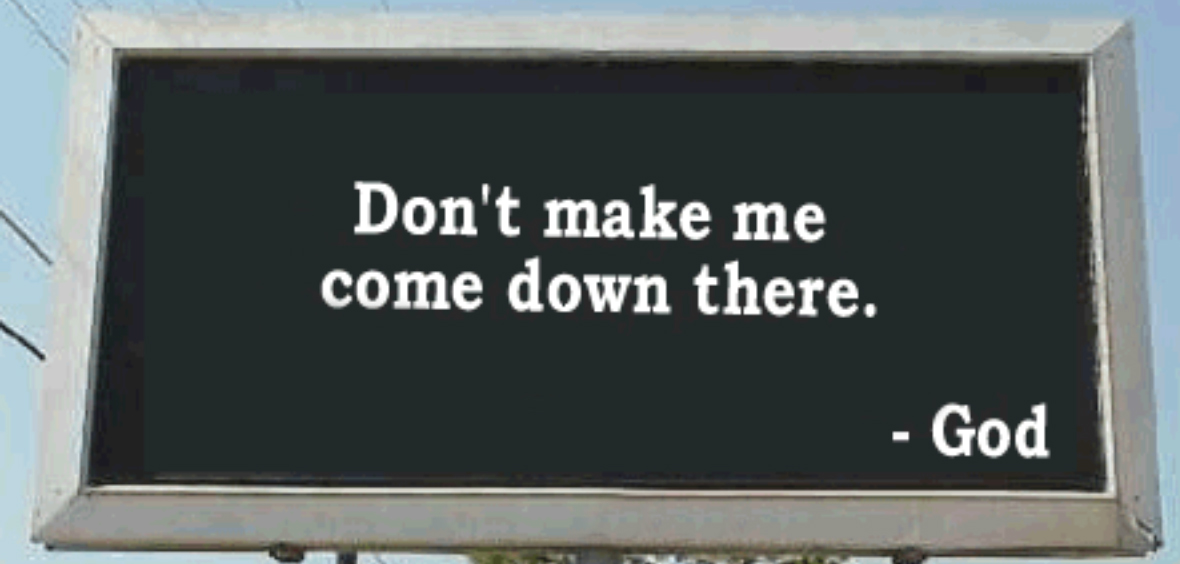
When I worked in Syracuse, New York, I would pass several billboards each day on Route 690, but there was only one for which I actually looked. It had a simple black background with white text. And it was always signed — God. Pithy little “messages” like: “That whole ‘love your neighbor thing’… I meant that.” And “Let’s meet at my house Sunday before the game.” And “Keep using my name in vain. I’ll make rush hour longer.” Some of the signs were serious, others made me laugh. You may have seen one of these signs as you drove along a major road.

One morning I saw a sign that looked like this:

DontMakeMe

I cracked up! I immediately pictured an annoyed-looking parent saying those words. My next immediate thought was, “Yes, God! Please! Come down here! We SO need you!” But not too long after that thought was: “Whoa… God coming down here. What would that be like?”

When we pray The Lord’s Prayer, the second sentence is “Thy kingdom come, thy will be done on earth as it is in heaven.” These aren’t words to say lightly. In praying that, we’re asking for a full, unfiltered, in-person, permanent encounter with the God who created the universe. We’re asking God to be as palpably and recognizably present on earth as God is already in heaven. We’re asking for God’s kingship to be realized in every aspect of our lives, in every particle of our world, in every action, every word, every thought. We’re asking for the Holy to become part of our every day experience. And we’re asking to be transformed by that holiness, to become part of God’s Kingdom.

“Thy kingdom come.” Those are powerful words!

Question
What does it mean to you for God to be “King” of your life?

Posted in Random Thoughts | 3 Comments

Hallowed Be Thy Name

1 Thessalonians 5:16-18 (New Revised Standard Version)
Rejoice always, pray without ceasing, give thanks in all circumstances; for this is the will of God in Christ Jesus for you.

Some people are able to feel constantly connected with God, with prayer seeming as natural and easy as breathing. But for many others it is more of a struggle. That’s really not surprising! After all, most human conversations are conducted with a minimum of one additional human nearby. There is an audible give-and-take with both parties speaking. Or, even if one person is monopolizing the conversation, the other person still may respond by head nodding, shoulder raising, or (if the monologue has gone on just a wee bit too long) eye rolling.

That can make prayer, admittedly, somewhat of a weird conversation. God is not visible to us, most of us don’t hear God’s voice or experience God’s physical presence. And yet we’re told over and over again throughout scripture that God wants us to talk with him. And in today’s scripture passage, Paul is very clear about how we’re supposed to pray: constantly.

Jesus knew that this would be a challenge for us. That’s why in Luke 11, when the disciples asked Jesus to teach them to pray, he gave them a simple prayer. As it’s recorded in Matthew 6, Jesus just anticipated their question about this fundamental need for communication with God, telling them this: “Pray then in this way: Our Father in heaven, hallowed be your name. Your kingdom come. Your will be done, on earth as it is in heaven. Give us this day our daily bread. And forgive us our debts, as we also have forgiven our debtors. And do not bring us to the time of trial, but rescue us from the evil one.” 

I want to walk briefly through this pithy, concise prayer that Jesus offers. It’s a prayer that I use every day, and when I do something every single day it’s super easy for it to become passionless, rote and meaningless…

ourfatherwhoartinheavenhallowedbethynamethykingdomcomethywillbedoneonearthas
itisinheavengiveusthisdayourdailybreadandforgiveusourtrespassessasweforgivethosew
hotrespassagainstusandleadusnotintotemptationbutdeliverusfromevilforthineistheking
domandthepowerandthegloryforeveramen

That is so very, very far from what God desires for us! Prayer is designed to be a dynamic conversation, a means of deepening the relationship between us and God. That’s why Jesus gave us this beautiful, powerful prayer! So, what does it tell us about our relationship with God? Over the next few days, I’d like to explore “The Lord’s Prayer.” It begins…

Our Father who art in heaven, hallowed be thy name.
“Hallowed” means to regard something as holy, as sacred. Someone told me recently about a child’s definition of love: “When someone loves you, the way they say your name is different. You just know that your name is safe in their mouth.” When we love someone, we talk about them differently, don’t we? When we’re with our friends, we tell the stories that showcase our loved one’s best qualities. We use positive descriptors for them: smart, beautiful, funny, nice, kind. One of the many (many!) things I love about my husband is that I know he speaks about me with respect— even when I’m not there to witness it. I know that my name is safe in his mouth, and he knows the same about me.

Likewise, when we love God, the way we talk about God will reflect that trust and respect. The love that God has given so freely to us should shine through our words and actions.

Question
Is God’s name safe in your mouth? What words or phrases would you use to describe God to a child? What descriptors would you use about God to a friend? What about to someone who was struggling?

Posted in Random Thoughts | Leave a comment

Thee, Thou, Thy & Thine

Matthew 6:9-13 (King James Version)
After this manner therefore pray ye: Our Father which art in heaven, hallowed be thy name. Thy kingdom come, thy will be done in earth, as it is in heaven. Give us this day our daily bread. And forgive us our debts, as we forgive our debtors. And lead us not into temptation, but deliver us from evil: for thine is the kingdom, and the power, and the glory, for ever. Amen.

When I was starting out in ministry, a wise colleague advised me, “You can mess with a lot of things, but don’t touch the 23rd Psalm or The Lord’s Prayer.” Even if you don’t know The Lord’s Prayer by heart, you probably recognized the words in today’s scripture passage. When I served as a hospice chaplain, I was amazed to see that people who hadn’t walked through the doors of a church in decades could pray the words of The Lord’s Prayer without tripping over a syllable. I saw the peace that crossed the person’s face as he or she spoke the words. These words are precious. They are beautiful. They are sacred.

Then why, I wonder, does the King James Version of it bug me?

“Our Father, which art in heaven, hallowed be thy name…” With my eyes closed, I can easily say the entire prayer in KJV cadence that is based on Jesus’ words in Matthew 6. It is very beautiful. But what does it mean? “Which art in heaven”? “Hallowed be thy name”? For most people nowadays, “art” is something you do with paint and a brush, and the only connection with “hallows” comes from the last book of Harry Potter.

Language is a funny thing. In 1382, a man named John Wycliffe translated the Bible into English, which is probably the primary language of most everyone reading this post. So, I challenge to read out loud his version of Matthew 6:9-14a:

“And thus ye schulen preye, oure fadir that art in heuenes, halewid be thi name; thi kyngdoom come to; be thi wille don `in erthe as in heuene; yyue to vs this dai oure `breed ouer othir substaunce; and foryyue to vs oure dettis, as we foryyuen to oure dettouris; and lede vs not in to temptacioun, but delyuere vs fro yuel. Amen.”*

You probably got “and” and “amen,” right?

I’m also not always a super big fan of Eugene Peterson’s paraphrase of the Bible, The Message, which you may have heard me smilingly refer to as “The Groovy Dude Bible.” But I have to admit that I really like how he renders this passage…

Our Father in heaven,
Reveal who you are.
Set the world right;
Do what’s best—
as above, so below.
Keep us alive with three square meals.
Keep us forgiven with you and forgiving others.
Keep us safe from ourselves and the Devil.
You’re in charge!
You can do anything you want!
You’re ablaze in beauty!
Yes. Yes. Yes.

It may not be tightly connected to the grammar and structure of the original Greek text, but I think it certainly gets across the intended feeling of the passage: awe, love, joy, trust, excitement, hope.

When my Gramma Marie died, my mom gave me her Bible. I love it because I loved her and because I slowly grew to love the God she had so faithfully worshipped. But still I struggled for years with reading that Bible, until I finally realized that Gram would want me to put her Bible aside and to find a translation that I would actually enjoy and really understand.

“Our Father in heaven, may your name be kept holy. May your Kingdom come soon. May your will be done on earth, as it is in heaven. Give us today the food we need, and forgive us our sins, as we have forgiven those who sin against us. And don’t let us yield to temptation, but rescue us from the evil one” (New Living Translation).

Tomorrow I will dig a little deeper into this famous prayer, but today I’m just thinking about the passage from which it springs and the language in which we read it. I firmly believe that the Bible is meant to be a gift to us. It’s meant to teach us and guide us and challenge us and call us into a deeper relationship with the God who lovingly gave it to us. What it is not meant to be is completely confusing, frustrating, discouraging, forbidding, or incomprehensible.

Our Old Testament was originally written in Hebrew, and the New Testament in Greeknot languages in which you’re expected to be proficient! but there are almost 50 English translations out there (that I know of, there are probably more). There are several online sites where you can compare and contrast different versions, such as biblegateway.com and youversion.com. If you need help choosing a Bible version that works for you, please let me know. I’ll be happy to help!

The Bible is amazing and spiritually irreplaceable. So… whether you prefer the poetry of the King James Version, the informality of The Message, the crispness of the New International Version, the familiar-sounding paraphrase of the New Living Translation, the orthographic brain-teaser of Wycliffe’s Middle English version (very sorry, but the language nerd in me just couldn’t resist!), or one of the other beautiful translations, please choose one that speaks to you!

Question
What is the Bible translation that you first read? What is the translation you currently have on hand? Does it work for you?

* Thanks to the Wesley Center Online for this version of Wycliffe’s translation.

Posted in Random Thoughts | 1 Comment

Hands, foreheads, doorposts & gates

Deuteronomy 6:4-9 (New Living Translation)
Listen, O Israel! The Lord is our God, the Lord alone. And you must love the Lord your God with all your heart, all your soul, and all your strength. And you must commit yourselves wholeheartedly to these commands that I am giving you today. Repeat them again and again to your children. Talk about them when you are at home and when you are on the road, when you are going to bed and when you are getting up. Tie them to your hands and wear them on your forehead as reminders. Write them on the doorposts of your house and on your gates.

Last week my husband and I were on the Metro coming back from seeing a play at the Kennedy Center. As usual on a Friday night after 10, the train was jam-packed. I took an open seat on the aisle, and Chuck stood next to me. About two stops in, the lady at the window told me that she was getting off at the next stop. I leaned down to grab my purse, snagged my long necklace on the armrest, and heard the *snap* as the chain broke. As people filed in and out of the open train door, I searched between the trampling feet for the prayer box that had been at the end of the chain.

My mom gave me that small silver prayer box many, many years ago. For a long time I would write prayers on tiny scraps of paper, roll them up tight, and place them in the box. Eventually I found a long chain and attached the box. If you’ve known me for any length of time, you’ve probably seen me wearing it– it’s one of my favorite pieces of jewelry. About two years ago I had opened and closed that box so many times that the clasp fell off, and I had to superglue it closed. But that meant committing to a permanent prayer, one that would stand as a guide to my life. What would I choose? What short message would stay with me through the years to come? It may seem like a silly, inconsequential decision– and really it was– but I felt as if I was choosing what was to be engraved on my tombstone.

I chose a quote from Henri Nouwen, one of my favorite theologians: “When we live in the world with knowledge of God’s love, we cannot do other than bring healing, reconciliation, new life, and hope wherever we go.”

I’ve been wearing that necklace for years, and I have to admit that sometimes I didn’t think about that quote/prayer when I wore it. And I haven’t always done a great job living it out, either. As I searched for the prayer box in the crowded train, I remembered the commitment I had made as I sealed the box. I prayed that my life would exemplify God’s healing, reconciliation, new life, and hope. That Friday night on the train, as my fingers touched the cool metal box wedged in between the seat cushion and armrest, I smiled and recommitted myself to that promise.

Question
What scripture verse, word, phrase, or quote comes to your mind when you think about a guide for your life?

Posted in Random Thoughts | 3 Comments

Skipped Over

Genesis 48:17-20 (New Living Translation)
But Joseph was upset when he saw that his father placed his right hand on Ephraim’s head. So Joseph lifted it to move it from Ephraim’s head to Manasseh’s head. “No, my father,” he said. “This one is the firstborn. Put your right hand on his head.” But his father refused. “I know, my son; I know,” he replied. “Manasseh will also become a great people, but his younger brother will become even greater. And his descendants will become a multitude of nations.” So Jacob blessed the boys that day with this blessing: “The people of Israel will use your names when they give a blessing. They will say, ‘May God make you as prosperous as Ephraim and Manasseh.'” In this way, Jacob put Ephraim ahead of Manasseh.

Growing up in a patriarchal society like Egypt, Joseph’s eldest son Manasseh must have felt quite confident in his birthright. In the usual pattern of inheritance, the blessing would inevitably go to the eldest son.

But when Jacob and the whole extended family arrived to live with Joseph, Manasseh would no doubt have begun to worry. Because Jacob and his sons would have shared stories with Manasseh and Ephraim about Jacob’s childhood with his older brother Esau. Stories about Jacob’s mother Rebekah showing him how to trick his father Isaac into giving him the blessing due to Esau. Jacob himself may have talked about how afraid he was of Esau after that, and how he ran away and met Rachel and her sister Leah. He would have told the boys about their great-grandfather Isaac, who was also a younger son. Isaac, who also received his father’s blessing, and the eldest son, Ishmael, who did not.

Our reading today shows how confident even Joseph was that Jacob’s blessing was destined for the oldest son Manasseh. And here was the moment of truth. Joseph placed Manasseh at his grandfather’s right hand, and Manasseh bent his head to receive the blessing. But then Jacob crossed his arms– which must have been an awkward position to hold for an elderly man– and placed his right hand on Ephraim’s head instead. Joseph tried to correct his father, who he knew didn’t see well. He assumed that Jacob was making a mistake, and wanted to correct the error before the elderly man was embarrassed. But Jacob knew what he was doing. It was Ephraim, the younger son, who would receive the blessing, not Manasseh. Then Jacob said, “The people of Israel will use your names to make blessings: May God make you like Ephraim and Manasseh.” Ephraim’s name first. Manasseh’s second. That was very clear, indeed.

Question
When have you been disappointed not to receive something that you had expected? What was that experience like for you? How did you deal with it? What happened as a result?

Posted in Pondering Scripture | Leave a comment

Stop!

This past Friday evening, my husband and I met at Union Station and headed out to dinner. We had a lovely walk that took us right by the White House, followed by a leisurely meal at a restaurant that has been in business since 1856. A nice way to start the weekend! Feeling happily sluggish from all the yummy food we’d consumed, we decided to pick up the Metro at the closest stop. Apparently half of DC had decided to do the same thing, as we stood with hundreds of people in the dimly lit station.

In the middle of the platform, bridging the east-bound and west-bound sides of the station, was a trio of men singing their hearts out. Now I’ve heard lots of subway performers, and they usually range from pretty darned awful to moderately okay. I do not exaggerate when I say that the voices of these three men were absolutely extraordinary. They sang a cappella, no musical accompaniment. But not once did someone hit a wrong note. The music they sang was recognizable– probably songs that you’ve whistled as you walked along– but the arrangements were complex, with their voices blending perfectly as each man’s notes swirled around, under, over the others’.

I was entranced. One train passed us by as we enjoyed their talent. I put money in the hat on the floor in front of the center man, and he grinned and nodded, never missing a beat. As I looked around, I noticed that most of the people near us were completely focused on their phones or tablets, shoulders rounded forward, cutting themselves off from the people around them, their backs to the trio. Others stood with arms crossed, staring into space. One small child danced to the beat, but his parents didn’t smile or even look in the direction of the singers. It was like they weren’t aware of the gift the men were offering.

How often does this happen to us each day? It is easy to be drawn so deeply into ourselves that we can miss the grandeur and beauty of the world outside of us. We can be so captivated by the difficulties and struggles of our lives, that we end up robbing ourselves of the gifts of healing and love that God offers to us.

Don’t let that happen to you this week! Instead, give yourself permission to experience the joy of your day. This is especially important if you’re having a tough time right now. Enjoy a conversation with a friend, or with a complete stranger. Savor a cup of coffee, truly tasting the drink instead of downing it as quickly as possible. Take a walk and look at the budding trees and flowers peeking up out of the ground. Listen to your favorite song, one that inspires you, that lifts you up. Dance with a child– or if there isn’t a child handy, just dance like a child. Read a chapter of a new book, write a poem, share a laugh. Watch the stars come out tonight, wake up for the sunrise tomorrow.

Life can be busy. Life can be difficult. But it is also so very, very beautiful. And it is always a gift. So… stop! And enjoy it.

Question
What activities bring you joy in your life? How can you make those activities a regular part of your week?

Posted in Random Thoughts | 3 Comments

The Benefits of Downtime

Until recently, the longest “downtime” trip I had ever taken was in the summer of 1998. My husband Chuck was in the PhD program at Syracuse University, and took an internship at Credit Suisse in London, England. We rented a room from a fabulous family in Kelfield Gardens. Ian and Bunty had several children who had grown up and moved out, and they didn’t like empty rooms. So they opened up their home to students from the SU internship program. That summer, we were the lucky recipients of their hospitality.

While Chuck was working hard each day, I was free to explore the city– anywhere I wanted to go, no tour guide. Just me, curiosity, and very comfortable shoes. Every evening I would come back to the Ross household give my report on the day’s activities. The youngest daughter, Liberty, would ask me, “So, now… what did we do today?” I swear half the fun of that trip was relating my adventures to the family over dinner. No matter what I had done– a trip to Madame Tussaud’s, viewing the crown jewels, checking out the construction of the Millennium Dome, catching a play at Shakespeare’s Globe– Liberty would proclaim it “Aaaaaa-maaaay-zing!” And it was!

I was thinking about our summertime England trip when Chuck moved to DC in December and I followed in January. He would be immediately launching into a more-than-full-time job, and it would likely be several months before I was employed again. I looked forward to taking long, leisurely walks exploring the nation’s wonderful capitol city.

Unanticipated challenge #1: Culture Shock. Within the span of a few days in January, I went from moving at 95 miles per hour at my job at Christ Church to *bam* zero mph. From meetings, appointments, and events that lasted right up until my last night in Fort Lauderdale to a suddenly, gapingly, wide-open calendar. From interacting with dozens of interesting people every day to being alone in my apartment. It was jarring and unsettling.

Unanticipated challenge #2: The Cold. Oh my goodness! I had forgotten how bone-chilling 20-degree weather affects my body. Somehow I had blocked the knowledge of how those dainty inner-nose hairs could freeze if I breathed quickly through my nose, and how my lungs crackled when I sucked in that icy air. And the wind? Even with my voluminous puffy coat, tendrils of cold worked their way down my neck and seeped through my insufficiently insulated shoes. There were weeks when the furthest I ventured on foot was the Whole Foods two blocks away from our apartment.

Unanticipated challenge #3: The Colds. In the first three months of my DC life, I came down with three sinus infections. (To that, all I can say is… blaaaaaahhhhh.)

I wouldn’t blame you for thinking right now, “Wait! I thought this ‘Random Thoughts’ posting was supposed to be about the benefits of downtime?”

Yep. I’m getting to that…

When I was packing up our house during my last weeks in Florida, I had a firm plan for the year 2013. But none of it went the way I expected. And, as it turns out, that is actually a good thing! I didn’t realize it until recently, but the forced downtime has been an incredible boon in my life.

Unanticipated blessing #1: Redefinition. I started asking myself: who am I if I’m not “pastor”? Who am I if I’m not responsible for guiding small groups, for preaching, for counseling, for teaching, for running a church? It’s so very, very easy for us to become defined by what we do. Most of our waking hours are spent working, so it’s totally understandable that our identities would become entwined with our professions. But what happens when what we “do” is taken away from us? When the mother who has worked so many years to raise her children drops the last one off at college and returns home to a very quiet house– who is she now? The truck driver who turns in the keys to his rig after retirement– who is he now? The lawyer who decides to leave her law practice, the teacher who loses his position due to budget cuts, the student who graduates, the retail worker whose store closes– who are they when the change comes?

It may sound ironic to read these words coming from a pastor, but here goes… I discovered that I’m a child of God. Now, yes, I knew that before. (Don’t worry!) But I needed a fresh reminder that my true, real, authentic identity doesn’t reside in what I do, but in whose I am. I belong to a God who loves me beyond any love I can imagine. I am a tiny, little creature who belongs to the Creator of the universe. My worth, my power, my identity are grounded in that reality. We may have different roles throughout our lives, but, you and I, we’re children of the King! I’ll be a pastor again someday (hopefully soon!) but I’ll go into it remembering the joy of being defined by my relationship with God, not by any temporary earthly thing.

Unanticipated blessing #2: Boredom. I don’t get bored easily. I can usually find lots to do. I’m a deeply curious person who loves to learn– there are always new books to read, new educational videos to watch, new classes to take, new ideas to learn. But there are also a lot of hours in a day, in a week, in a month when you’re in a new city and stuck in the apartment.

I think now that God arranged for my hunkered-down, going-nowhere winter months in DC in order to help me reach the end of how I could fill my hours. I don’t need to tell you that we live in a world where it’s super easy to be constantly connected. We have our desktop computers, laptops, tablets, smart phones. We get home from a busy day and flip on the TV, download a video, check our personal email, skype with a friend, post to a blog, send a text, an email, a picture message. God needed me to get to a point where I was tired of it all. I didn’t want to read another book. I didn’t want to do another online class. God wanted me to be quiet.

“Shhhhhhhhh, Hedy,” God whispered to me, “Will you just chill out and be quiet? Spend a little time with me. Not reading about me or studying about me or writing about me. Spend time just being with me.”

Oh! Okay! I was spending so much time filling my time that I was neglecting the very one who gave me the gift of time. But it took me pushing through the boredom to make that realization. You know, it’s amazing to me that God has such patience– sometimes I can be so remarkably thick.

Unanticipated blessing #3: Uncertainty. I’ve always had a very clear idea of where I was going next. Chuck and I call them our “Five Year Plans.” We’ve tried to hold loosely to those plans, knowing that God could have something different in mind, but we still made them. My plans were thrown out the window when the DC opportunity arose for Chuck. I found myself in an unfamiliar condition: essentially plan-less. I needed to start from scratch. And that “scratch” was based in completely trusting God– it had to be!

Well, now it’s finally springtime in DC, and the days are beautiful. Sunshine, not too warm. Nice breezes and flowers popping up all over. I love taking walks down to the riverfront in Old Town Alexandria. I enjoy taking the Metro into the city to walk by the White House and the Capitol Building. I get a kick out of the Smithsonian, especially the Air & Space Museum. I’m looking forward to starting my doctoral classes at Wesley in a little over a week. I’ve met wonderful people here– people who are creative and energized and excited to serve God. I have fun, fabulous ministry ideas percolating in my head that I would probably never have had in my old context. I can’t wait to see what God has in mind for me in the church here in my new home.

But I am so very, very, very glad that God gave me this forced downtime. It was painful at times, and definitely uncomfortable. And yet it has been rich beyond anything I could have arranged for myself.

God is so smart.

Questions
How do you currently define yourself? When do you have “alone time” with God? How do you deal with uncertainty in your life?

Posted in Random Thoughts | 1 Comment

Bless You!

Genesis 47:7-10 (The Message)
Next Joseph brought his father Jacob in and introduced him to Pharaoh. Jacob blessed Pharaoh. Pharaoh asked Jacob, “How old are you?” Jacob answered Pharaoh, “The years of my sojourning are 130– a short and hard life and not nearly as long as my ancestors were given.” Then Jacob blessed Pharaoh and left.

Joseph’s father, Jacob, and his entire family have now moved to Egypt to live under Joseph’s protection. Eleven brothers, their wives, children, servants, extended families. So many people relying on the Pharaoh’s generosity and good-will. All dependent on Joseph and his knowledge of the court of Pharaoh. Joseph had worked many years for the ruler of Egypt, and he knew how to talk with him. Joseph first brought five of his brothers to offer obeisance to Pharaoh. Before entering his presence, Joseph tells them exactly what to say. They repeated Joseph’s words verbatim, and Pharaoh granted them prime land for their flocks. Everything in this interview went exactly according to plan.

Then Joseph brought his father to meet Pharaoh. The man who gave him life to see the man who gave him back his life. The man who named him Joseph to stand in front of the name who re-named him Zaphenath-paneah.

No doubt Pharaoh was curious to meet the father of a man as extraordinary as Joseph. As the father of a deeply valued servant, Jacob might have expected to somehow be honored by Pharaoh. In truth, simply by allowing this elderly man to be near him, Pharaoh was conveying his appreciation for Jacob’s son. But then something truly unusual happened. Jacob stepped boldly up to Pharaoh and gave him a blessing. An old Hebrew man, a shepherd, straight out of the wilderness… this man dared to bless the Pharaoh of Egypt! This prompted Pharaoh to ask what we might consider a rather rude question: “How old are you?” That always brings up a smile for me. I wonder if Pharaoh was thinking that perhaps this man was senile. Obviously Jacob did not realize in whose presence he stood. Surely Pharaoh would not have felt that he was in need of a blessing– he was the most powerful man in the land, considered a god by his people, with hundreds of people at his immediate command, an army of servants dedicated to his comfort and safety, and an actual army ready to fight to the death at a word. And yet, somehow, Pharaoh recognized that something important was happening there. He wordlessly accepted Jacob’s blessing, not once, but twice.

I love today’s passage– it’s one of my favorites.

It tells me that God’s blessing doesn’t always come the way we expect. We don’t always receive it from the anticipated sources. Last week I was walking back to my apartment from the train, and a man stopped me on the sidewalk, asking for help. We talked for a few minutes, and I told him I was going to go to the grocery store around the corner to pick up some food for him. A few minutes later I came back to the bench where he was sitting. He was visibly surprised that I had returned– apparently he thought “I’m going to the grocery store” meant “I’m out of here.” We spoke for a few more minutes, and just as I was about to pray for him, he put his hand on my shoulder and prayed for me. It was an unexpected moment, a beautiful, thoughtful prayer. I was blessed.

This passage also reminds me that God’s blessing does not necessarily guarantee smooth sailing, easy paths, straight roads. Jacob had been the recipient of God’s blessing, but when Pharaoh asks about his age, he replies: “a short and hard life.” (How many of us would count 130 as short? But that’s beside the point here.) God’s blessing doesn’t mean that we’ll always be healthy and prosperous. But it does mean that we are loved with an infinite, undying love, and that God will never abandon us.

And, finally, it is a lovely reminder that God’s blessing is intended to be shared with the people around us. There is not one person in this world who is too powerful or too lowly to be in need of God’s grace. I need it. You need it. Every person you see today needs it. Through our words, but, even more importantly, through our actions, we get to be the conduit of that blessing today!

Question
When was the last time you “blessed” someone? What does it mean to bless a person? What does it look like? How could you bless someone today?

Posted in Pondering Scripture | 1 Comment