peace.

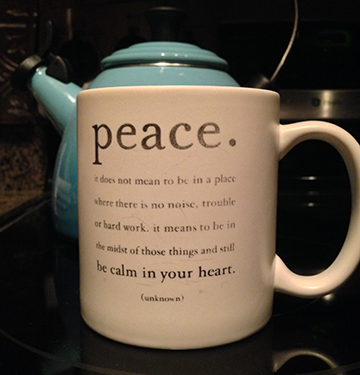
peace mug

1 Thessalonians 1:4-6 (New Living Translation)
We know, dear brothers and sisters, that God loves you and has chosen you to be his own people. For when we brought you the Good News, it was not only with words but also with power, for the Holy Spirit gave you full assurance that what we said was true. And you know of our concern for you from the way we lived when we were with you. So you received the message with joy from the Holy Spirit in spite of the severe suffering it brought you. In this way, you imitated both us and the Lord.

When I wake up in the morning, the first thing I do is make some tea. The day is just not right without that caffeinated ritual. And although I have an army’s worth of serviceable mugs in my kitchen, there is one that’s my favorite. The cup has become even more of a favorite as it faded through repeated washings, chipped against the sink wall, and was generally beaten up by the dishwasher. It’s the perfect size to hold my steaming brew, but that’s not really why it’s my go-to cup. I like what is written on it:

Peace. It does not mean to be in a place where there is no noise, trouble, or hard work. It means to be in the midst of those things and still be calm in your heart.

What great words to ponder first thing in the morning. But how do we actually get that kind of peace? How do we find a peace that carries us through our lives, regardless of the circumstances or challenges?

In today’s reading, the word translated in verse 5 as “full assurance” is plerophoria in Greek. Strong’s Concordance defines it as: “full conviction, firm persuasion, certainty.” Paul celebrates that the people of the Thessalonian church were given “full assurance that what we said was true.” This “full assurance” gave them the strength to endure “severe suffering” with peace and calm in their hearts.

Again, how do we get that kind of peace?

In the 1700s, John Wesley started a Christian movement in England that eventually became The United Methodist Church. He had grown up in a devout family and had been trained to be a preacher. And yet he still felt that something was missing. In May 1738, he went to a meeting on Aldersgate Street in London. In his journal, he wrote about what became a surprisingly life-changing moment: “About a quarter to nine, while [the speaker] was describing the change which God works in the heart through faith in Christ, I felt my heart strangely warmed. I felt I did trust in Christ, Christ alone for salvation, and an assurance was given me that he had taken away my sins, even mine, and saved me from the law of sin and death.”

The answer to “how do we get that kind of faith?” is simply: we don’t.

It’s not something we can get. We can’t earn it or acquire it or make it or force it. But it is something God wants to give us. We can choose to trust in it and to accept the gift. In a later letter to the church in Philippi, Paul will write: “Don’t worry about anything; instead, pray about everything. Tell God what you need, and thank him for all he has done. Then you will experience God’s peace, which exceeds anything we can understand. His peace will guard your hearts and minds as you live in Christ Jesus” (Philippians 4:6-7).

Questions:
What keeps you from trusting in Jesus and in God’s love for you?

Posted in Pondering Scripture | 2 Comments

Loyal, Unfailing Love

Psalm 136:1-3, 23-26 (English Standard Version)
Give thanks to the Lord, for he is good, for his steadfast love endures forever. Give thanks to the God of gods, for his steadfast love endures forever. Give thanks to the Lord of lords, for his steadfast love endures forever. … It is he who remembered us in our low estate, for his steadfast love endures forever; and rescued us from our foes, for his steadfast love endures forever; he who gives food to all flesh, for his steadfast love endures forever. Give thanks to the God of heaven, for his steadfast love endures forever.

I heard someone say — I can’t remember who — that if you memorized the 31 chapters of the book of Proverbs, you would have the equivalent of degrees in business, psychology, and theology. That’s certainly overstating the case quite a bit, but there is no doubt that Proverbs is filled with wonderful, wise advice. Our lives would be vastly improved if we could live consistently with such counsel.

But there, of course, is the sticking point. Proverbs is a book to be acted upon, not just to be read. And we’re not always so great on putting good theory into real action. God knows this about us. God knows us.

One day some Pharisees — the snobby religious elite of Jesus’ time — saw Jesus sharing a meal with people they considered to be disreputable. They asked Jesus’ disciples to explain the bizarre behavior of a man who was supposed to be so holy. Jesus answered them directly: “Those who are well have no need of a physician, but those who are sick. Go and learn what this means: ‘I desire mercy, not sacrifice.’ For I came not to call the righteous, but sinners” (Matthew 9:12-13).

Jesus came for imperfect, flawed, messy people. He came for you and for me.

The Hebrew word in Psalm 136 translated above as “steadfast love” is ḥesed, and it appears over and over again in the Bible when talking about God. It’s one of my favorite Hebrew words. Ḥesed. It means kindness, mercy, steadfast love, loyalty, goodness, unfailing love. Each of the 26 verses of Psalm 136 end with the phrase: His steadfast love endures forever.

According to The New Interpreter’s Bible, “There can be no more profoundly good news than this — that God’s attitude toward the world and God’s motivation for action are summarized by steadfast love… Psalm 136 ultimately affirms that the origin, continuity, and destiny of the cosmos are dependent upon the grace of God” (vol. iv, page 1225).

We may never be able to perfectly live out the wisdom found in the book of Proverbs. We will probably not make it through even this day without slipping up somehow, and doing or saying something that isn’t in line with God’s will for us. After all, we’re flawed human beings. But… we have hope in our God who is infinitely caring and faithfully loving. A God who knows us intimately, who never gives up on us, who helps us to grow and to mature, and whose steadfast love for us endures forever.

Questions:
What do you think it would be like to consciously spend just one day looking at the people around you from the perspective of God’s compassionate, merciful, steadfast love? How might your conversations and interactions be different on that day?

Posted in Pondering Scripture | Leave a comment

Discipline? (Ugh!)

FB Thumbs Down

Proverbs 22:6; 29:17; 19:18 (New Living Translation)
Direct your children onto the right path, and when they are older, they will not leave it. … Discipline your children, and they will give you peace of mind and will make your heart glad. … Discipline your children while there is hope. Otherwise you will ruin their lives.

Discipline. That’s a word that sends shivers down many people’s spines. It conjures up images of long walks down the hallway to the Principal’s office. Memories of stern talks from parents, or of being grounded. So, when we read today’s selections from Proverbs, they may have provoked a not-altogether-pleasant reaction from us.

The Hebrew word used for “discipline” in today’s proverbs is yasar, which means to chasten or admonish for the purpose of instruction. If you’re a parent, you know that there are times when it is necessary to firmly and lovingly correct your child, teaching him or her important lessons about how to live. I’m guessing it’s fairly safe to say that when the child receives this discipline, it’s not always with immediately overwhelming happiness or gratitude: “Woohoo! Thanks for the reprimand, Mom! I’ve got it now!”

(If your child is the exception to this, then, congratulations! You hit the genetic jackpot with that kid.)

We don’t really grow fonder of discipline as we get older, do we? Receiving correction and critique is not usually our favorite activity. But it is just as necessary for us as adults as it was when we were little. Because we get off the path God has laid out for us. We stray from a God-honoring life. We engage in unhealthy behavior. And so we depend upon God’s guidance. We require God’s discipline.

How can we be more willing to accept God’s discipline? By remembering that — just like a perfectly loving parent — God disciplines us to lead us back to a healthier path. And by remembering what the author of the letter to the Hebrews wrote: “No discipline is enjoyable while it is happening — it’s painful! But afterward there will be a peaceful harvest of right living for those who are trained in the way” (12:11).

Questions:
How well do usually accept criticism? The last time you received some “discipline” or “instruction” in your life, how did you react?

Posted in Pondering Scripture | 1 Comment

True Friend

Proverbs 18:24; 17:17; 17:9; 27:17 (New Living Translation)
There are “friends” who destroy each other, but a real friend sticks closer than a brother. … A friend is always loyal, and a brother is born to help in time of need. … Love prospers when a fault is forgiven, but dwelling on it separates close friends. … As iron sharpens iron, so a friend sharpens a friend.

When I was in college, I had a poster with snippets from Robert Fulghum’s All I Really Need to Know I Learned in Kindergarten. I have no idea where that poster has gone (those college years have quickly receded into the distant past), but the gist of it has stuck with me.

“Share everything. Play fair. Don’t hit people. Put things back where you found them. Clean up your mess. Don’t take things that aren’t yours. Say you’re sorry when you hurt somebody. Avoid negative people.”

Those words from Fulghum are all proverbs: “a pithy saying, especially one condensing the wisdom of experience” (Webster’s Dictionary). The scriptures we’ve been looking at over the last few days from the biblical book of Proverbs are just that: pithy, short-sweet-and-to-the-point bits of wise advice.

Today’s string of proverbs is about friendship. In Genesis 1:26, we’re told that we were formed in the image of God. Community an intrinsic part of God’s nature: Father, Son, and Holy Spirit. Because we are made in God’s image, we naturally long for authentic relationships in our lives. The proverbs for today remind us that choosing our closest friends is an important decision. A true friend is someone who will stick by you, even when — and especially when — times are tough. Someone who will tell you the truth with compassion, who will forgive you when you inevitably mess up, and who will consistently encourage you to grow and improve.

When you find that friend, hold on. And be a true friend to that person, as well.

Questions:
Who is the friend you know you can count on — no matter what is going on in your life?

Posted in Pondering Scripture | Leave a comment

Your Money or Your Life

Jack Benny Cast

Proverbs 11:24-26 (New Living Translation)
Give freely and become more wealthy; be stingy and lose everything. The generous will prosper; those who refresh others will themselves be refreshed. People curse those who hoard their grain, but they bless the one who sells in time of need.

Jack Benny was a comedian in the heyday of radio and in the early days of television. The character he played on his show was notoriously stingy and penny-pinching. In one of Benny’s most famous skits, he is innocently walking along the street when he’s held up at gunpoint. The robber tells Benny: “This is a stick-up. Now c’mon! Your money or your life!”

There is a long, dramatic pause, and then the robber repeats the demand: “Look, bud, I said: your money or your life!” Which causes Benny to yell back in an annoyed voice, “I’m thinking it over!!!”*

Our scripture today would sound totally counterintuitive to the Jack Bennys of the world. After all, if you give away your resources, if you are generous with your money, then you’d have nothing left for yourself, right? This is what financial guru Dave Ramsey calls “The Great Misunderstanding.” In the last session of his Financial Peace University class, Ramsey says, “The paradox is the mistaken belief that the way to have more is to hold on tightly.”

Money is a wonderful tool, no doubt about it. It enables us to purchase what we need, to assist others, and to enjoy ourselves. Other verses in Proverbs teach us about the proper usage of money, such as: “The wise man saves for the future but the foolish man spends whatever he gets” (21:20) and “Good planning and hard work lead to prosperity, but hasty shortcuts lead to poverty” (21:5). Financial resources, utilized wisely, are a good gift from God.

But our focus is out of order when we view accrual of money as the goal instead of the means. That’s when that good gift from God becomes distorted and damaged… and dangerous. Paul cautioned his young protégé Timothy about this: “For the love of money is the root of all kinds of evil. And some people, craving money, have wandered from the true faith and pierced themselves with many sorrows” (1 Timothy 6:10).

Ironically, in real life Jack Benny was very generous. He gave quietly to charities and took care of his friends. When he received a lucrative offer from a new radio station, before he accepted for himself he first used his influence to negotiate contracts for his entire cast. Totally unheard of at that time.

Questions:
When you have used your resources to help someone else, how did that feel?

* To hear the Jack Benny “Your Money or Your Life” skit, click here. It’s less than a minute long.

Posted in Pondering Scripture | Leave a comment

What You Oughta Do

Arm Around Shoulder

Proverbs 21:23; 12:18; 15:1; 10:19; 17:9 (The Message)
Watch your words and hold your tongue; you’ll save yourself a lot of grief… Rash language cuts and maims, but there is healing in the words of the wise… A gentle response defuses anger, but a sharp tongue kinds a temper-fire… The more talk, the less truth; the wise measure their words… Overlook an offense and bond a friendship; fasten on to a slight and — good-bye friend!

My husband’s grandfather, Morris Acker, was an incredibly wise man. More times than I could count he started a sentence with these words: “What you oughta do is…” And, invariably, whatever followed that dot-dot-dot was completely on target and correct. Were there times when we disregarded Grampa Morris’ advice? Sure! And we always regretted it. Every time, it turned out that his advice was exactly what we oughta have done.

The Book of Proverbs is full of “what you oughta do” statements. Today we’re looking at a compilation of verses about what comes out of our mouths. (Remember yesterday’s children’s song: “Oh, be careful little mouths what you say!”) Language is immensely powerful. With our words, we can build people up or tear them down. We can encourage, or we can destroy.

Decades ago now, someone suggested to me that, in every conversation, I should imagine Jesus standing next to the person with whom I’m talking. I’ll tell you, that simple advice transformed the way I think about those moments.

Do I get it perfect every day? Sadly, no I don’t. (I so wish that I did.) But verses like today’s powerfully remind me of the importance of speaking — always — thoughtfully, and out of God’s love.

Questions:
How much attention do you pay to the words you use in conversation? How might your conversations change if you could see Jesus standing there, listening to every word you said?

Posted in Pondering Scripture | 1 Comment

The Choices We Make

Proverbs 6:16-19 (New Living Translation)
There are six things that the Lord hates — no, seven things he detests: haughty eyes, a lying tongue, hands that kill the innocent, a heart that plots evil, feet that race to do wrong, a false witness who pours out lies, a person who sows discord in a family.

There’s a children’s song that, once I hear it, is stuck in my head for hours. There are about eight verses, all along along these lines:

Oh, be careful little eyes what you see. Oh, be careful little eyes what you see. For the Father up above is looking down with love. So, be careful little eyes what you see.

Oh, be careful little hands what you do. Oh, be careful little hands what you do. For the Father up above is looking down with love. So, be careful little hands what you do.

Oh, be careful little mouth what you say. Oh, be careful little mouth what you say. For the Father up above is looking down with love. So, be careful little mouth what you say.

(And little feet… little ears… little minds… and on and on and on…)

Our scripture passage for today from Proverbs is about eyes that look disdainfully at those around us, mouths that speak words they shouldn’t, hands that do what they ought not, feet that take us in unhealthy directions, hearts and minds that focus on the wrong things. Each of these are actions that involve decisions and choices.

Be careful, God tells us. Because these things matter.

Consider an alternative to our cautionary scripture: eyes that look with compassion at the world and its peoples, mouths that speak words of healing, hands that reach out to the lost and hurting, feet that take us into the world with love, and hearts and minds focused on God.

Oh, be careful little hearts who you trust. Oh, be careful little hearts who you trust. For the Father up above is looking down with love. So, be careful little hearts who you trust.

“Oh Lord, you alone are my hope. I’ve trusted you, O Lord, from childhood” (Psalm 71:5).

Questions:
What song do you remember singing in childhood that has stuck with you over the years?

* If you would like to see a cute version of this song online, click here. Warning, though: you won’t be able to get it out of your head all day!

Posted in Pondering Scripture | 2 Comments

Seek, Find & Cherish

Proverbs 2:1-5 (New International Version)
My child, if you accept my words and store up my commands within you, turning your ear to wisdom and applying your heart to understanding — indeed, if you call out for insight and cry aloud for understanding, and if you look for it as for silver and search for it as for hidden treasure, then you will understand the fear of the Lord and find the knowledge of God.

This is my favorite run-on sentence in the Bible. (And I’m not generally a fan of run-ons.) I like it so much, that, years ago now, I wrote it down on a nice piece of paper and put it in a fancy frame on my desk at home. It forms part of my personal “purpose statement.”

“If you accept my words and store up my commands within you…”

Accept and store up. That sounds kind of mild-mannered and tame, doesn’t it? The original Hebrew is actually stronger. The word translated as accept (lāqaḥ) means to take, seize, lay hold of, acquire. And store up (ṣāpan) means to treasure, to hide away. We could think of it as grabbing hold of God’s truth and embracing it lovingly. That’s why, as much as I love the New International Version translation of today’s passage, I also love The Message version of verse 1: “Good friend, take to heart what I’m telling you; collect my counsels and guard them with your life.”

And what a promise we’re given in verse 5! We’re told that if we do these things — if we seek after God wholeheartedly, if we bend our minds to learning more about our Creator, if we boldly ask questions and cherish the insights we receive, if we consider that pursuit to be life’s most valuable activity — then we will receive a priceless gift: an understanding of the majesty, power, and wisdom of God.

Questions:
What are you most interested in learning about God right now?

Posted in Pondering Scripture | Leave a comment

Purpose Statement

Proverbs 1:1-7 (New Living Translation)
These are the proverbs of Solomon, David’s son, king of Israel. Their purpose is to teach people wisdom and discipline, to help them understand the insights of the wise. Their purpose is to teach people to live disciplined and successful lives, to help them do what is right, just, and fair. These proverbs will give insight to the simple, knowledge and discernment to the young. Let the wise listen to these proverbs and become even wiser. Let those with understanding receive guidance by exploring the meaning in these proverbs and parables, the words of the wise and their riddles. Fear of the Lord is the foundation of true knowledge, but fools despise wisdom and discipline.

Have you ever made a decision that you later regretted? Have you ever done something you wish you hadn’t? Or not done something that you wish you had? Said something that should never have been said? Have you ever thoroughly messed up? Have you ever looked back and shook your head in dismay at your own actions?

(Uh oh. Am I alone in this?)

In our faith history there was a king named Solomon, who had a remarkably acute ability to look at a situation, to comprehend the available options, and to choose the best path. Earlier in his life, God had come to this king in a dream, offering to give him whatever he wished. Solomon asked this of God: “Give me an understanding heart so that I can govern your people well and know the difference between right and wrong” (1 Kings 3:9).

Ah! Wisdom from God! How wonderful! If only we had a record of Solomon’s collected sayings to help guide us…

Oh… wait! Actually, we do have access to many of Solomon’s “words of wisdom.” The book of Proverbs is filled with insights that can be directly applied to our lives, many of which are from King Solomon. So, we’re going to spend a few days exploring this wonderful book that is almost at the center of our Bible.

In today’s reading, Proverbs opens with its “purpose statement.” Purpose statements are all the rage right now, with companies and individuals working hard to condense into one declarative sentence their focus and goals.

This is the way The Message paraphrase explains why Proverbs was written: “so we’ll know how to live well and right, to understand what life means and where it’s going; a manual for living, for learning what’s right and just and fair; to teach the inexperienced the ropes and give our young people a grasp on reality” (Proverbs 1:2-4).

Sounds like a pretty good purpose, doesn’t it?

Questions:
If you were to write a one sentence “purpose statement” for your life, what would it be?

Posted in Pondering Scripture | 1 Comment

Indescribable Joy

Footsteps of Jesus

John 20:14-16 (New Living Translation)
She turned to leave and saw someone standing there. It was Jesus, but she didn’t recognize him. “Dear woman, why are you crying?” Jesus asked her. “Who are you looking for?” She thought he was the gardener. “Sir,” she said, “if you have taken him away, tell me where you have put him, and I will go and get him.” Jesus said, “Mary!” Jesus said. She turned to him and cried out, “Rabboni!” (which is Hebrew for “Teacher”).

How much I would love to go back in time and be present at this moment! Mary has come to the tomb to honor Jesus one last time by caring for his dead body. When she sees that the body is missing, not for an instant does she imagine the truth of what has happened. Her fear and sadness only deepen with the loss of even the small act of respect she was prepared to offer that morning.

But then, with one word — her own name on Jesus’ lips — Mary moves from complete despair and misery to indescribable joy!

HAPPY EASTER!!!

Questions:
How will you allow yourself to be changed by this Lenten journey? How can you increasingly live your life inspired by the joy offered through Jesus?

Posted in Lent | 1 Comment