Wrong Direction

The biblical story of Jonah is very well known, especially the part about his being swallowed by a whale. But one of the problems with feeling familiar with a story is that we can gloss over the details and miss the message God has for us today. So… for the next few weeks, I’ll be revisiting a study guide I wrote on this “children’s story” and diving into its lessons for us grown-ups. This week… “It Seemed Like a Good Idea at the Time.”

It Seemed Like a Good Idea at the TimeJonah 1:3 (The Message)
But Jonah got up and went the other direction to Tarshish, running away from God. He went down to the port of Joppa and found a ship headed for Tarshish. He paid the fare and went on board, joining those going to Tarshish — as far away from God as he could get.

This verse starts out so promising: “Jonah got up…” This is the same Hebrew verb used by God in verse 2: qum. It appears that Jonah is immediately obeying God’s command to get up and go.

Then, quickly, it all falls apart. Jonah does get up, but starts moving in the wrong direction. The verb barah used here means to “flee, run away, hurry away.” It refers to flight from an enemy.

A prophet of God, running away from God as if fleeing from an enemy! We have many examples in the Bible of prophets who were reluctant to accept God’s call, including heroes of the faith like Moses and Jeremiah. But while they questioned God’s choice, they also ultimately agreed to take up the call, trusting in God to give them the strength they needed.

If it’s true that “actions speak louder than words,” then Jonah’s actions aren’t just speaking — they’re yelling! He arrives in the port city of Joppa and finds a ship with space available. He has enough money on hand to pay for the passage. He boards the ship, and then, no doubt, relaxes.

Question:
When have you done the opposite of what you knew God wanted you to do?

Extra:
Read again Jonah 1:1-3, then read Exodus 3:10-4:17 and Jeremiah 1:1-19. What similarities and differences do you see between the three call stories?

Posted in Jonah, Pondering Scripture | Leave a comment

Get Up! Go!

The biblical story of Jonah is very well known, especially the part about his being swallowed by a whale. But one of the problems with feeling familiar with a story is that we can gloss over the details and miss the message God has for us today. So… for the next few weeks, I’ll be revisiting a study guide I wrote on this “children’s story” and diving into its lessons for us grown-ups. I hope you enjoy the daily devotionals, and the graphics I created to go along with each week. First up… “It Seemed Like a Good Idea at the Time.”

It Seemed Like a Good Idea at the Time
Jonah 1:1-2 (New International Version)
The word of the Lord came to Jonah son of Amittai: “Go to the great city of Nineveh and preach against it, because its wickedness has come up before me.”

This is the beginning of the famous story of Jonah. It isn’t the first time Jonah appears in our Bible. Back in 2 Kings 14:25, Jonah son of Amittai was called “the prophet from Gath-hepher.” As a prophet, Jonah had been known to speak God’s word to the people. In our opening verses of the book of Jonah, the voice of God speaks very clearly to this prophet. The three verbs used are in the imperative: Get up! Walk to! Proclaim! This is not a request from God or a suggestion. It is a command: “Get right up, walk to the great city of Nineveh, and proclaim against it.” Knowing Jonah’s history as a prophet, we would certainly expect immediate obedience to such an unambiguous call to action.

But… that is not what is about to happen. We have a subtle clue to this in Jonah’s name, which comes from the Hebrew yona, meaning dove or pigeon. In Hosea 7:11, the Israelites were called “silly, witless doves,” as they vacillated back and forth, flitting this way and that, not following God’s guidance for their lives. Likewise, Jonah will not follow the direct path outlined by the God he served. No, Jonah’s path will be much more circuitous and complicated. And painful.

Question:
When has a person who you thought you knew well acted in a way that took you completely by surprise?

Posted in Jonah, Pondering Scripture | Leave a comment

Easier Than We Think

JordanRiver

2 Kings 5:9-12 (The Message)
So Naaman with his horses and chariots arrived in style and stopped at Elisha’s door. Elisha sent out a servant to meet him with this message: “Go to the River Jordan and immerse yourself seven times. Your skin will be healed and you’ll be as good as new.” Naaman lost his temper. He turned on his heel saying, “I thought he’d personally come out and meet me, call on the name of God, wave his hand over the diseased spot, and get rid of the disease. The Damascus rivers, Abana and Pharpar, are cleaner by far than any of the rivers in Israel. Why not bathe in them? I’d at least get clean.” He stomped off, mad as a hornet.

Naaman was a general for the king of Aram. You might think that a high-ranking military officer would have a life blessed with not just wealth and power, but also strength and health. But Naaman was afflicted with leprosy, a terrible disease which affects the nervous system. There is no doubt that he suffered greatly. Desperate, Naaman lowered himself to listen to the advice of a lowly maid, who told him that there was a prophet in her homeland who could heal his disease. Equipped with a letter of introduction from the king of Aram and an impressive array of gifts, he journeyed to Israel and approached Elijah’s successor, Elisha.

No matter the level of his desperation, Naaman still expected a certain amount of deference due to his status. But Elisha, who learned at the feet of Elijah, knew that true status comes from God. So, instead of meeting Naaman with gratitude and awe, Elisha sent a servant to deliver his message: “Go to the River Jordan, dip yourself in it seven times, and you’ll be healed.”

What? No magic incantations? Just go to the river and dunk down seven times? That’s it?

Naaman was not amused. He thundered off, angry and incredulous that a mere prophet would give a mighty general such a simple solution to a very difficult situation.

Sadly, like Naaman, we tend to make things needlessly complicated. God freely offers us his love — without strings. Simple, sincere, uncomplicated. Entirely, lovingly.

But we look for something more complex. We approach God with all the mistakes that we’ve made in life. In our prayers, we bring to God’s altar all our doubts, our worries, our uncertainties and fears. And God answers back: “I know. It’s all right. I love you. I forgive you. Now, come to me.” And we think, “No, it can’t possibly be that easy!” We walk away, angry and disappointed. We don’t think it’s possible that it could really be that simple. Surely, salvation must demand more than that.

But here’s the truth. God loves us, and wants to heal us. Wants to forgive us, make us clean, bring us back to the way we were originally intended to be. “For God so loved the world that he gave his one and only Son, that whoever believes in him shall not perish but have eternal life” (John 3:16).

That’s it. No complications. Just pure, undiluted grace.

Question:
What does it mean to you that God wants to heal you of your deepest hurt, and to free you from all that holds you back from being the person God intended you to be: whole, conscious of God’s love, and full of joy?

Posted in Pondering Scripture | Tagged , , , , , , , , , , , , , | Leave a comment

Bittersweet Goodbyes

2 Kings 2:1-2 (New Living Translation)
When the Lord was about to take Elijah up to heaven in a whirlwind, Elijah and Elisha were traveling from Gilgal. And Elijah said to Elisha, “Stay here, for the Lord has told me to go to Bethel.” But Elisha replied, “As surely as the Lord lives and you yourself live, I will never leave you!” So they went down together to Bethel. The group of prophets from Bethel came to Elisha and asked him, “Did you know that the Lord is going to take your master away from you today?” Elisha answered, “Of course I know. But be quiet about it.”

The prophet Elijah was a wonderful mentor to Elisha. Elijah taught Elisha, preparing him to be his successor. Now Elijah’s ministry was reaching its end, and Elisha was ready to take over. Or was he? In those last moments, we see some hesitancy on Elisha’s part. He knows that Elijah is about to be taken away from him, so he refuses to leave his master’s side. Several times Elijah urges Elisha to stay behind, but Elisha is having none of it.

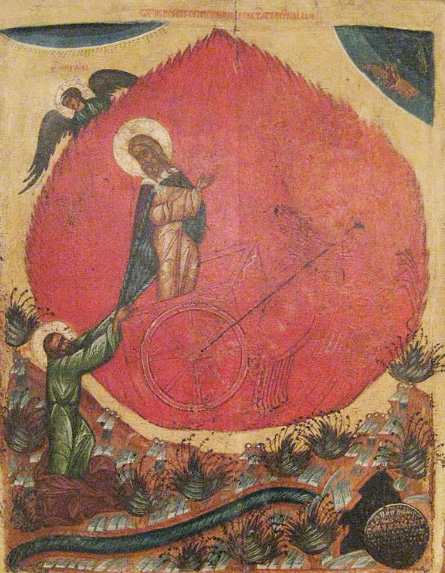
Icon Elijah ascending to heaven

Icon of Elijah’s ascent into heaven (Pskov Museum, Russia)

That’s why I find this icon of Elijah’s ascension so wonderful. Elijah is already on board the chariot, ready for his next adventure. But Elisha is holding tightly on to him with a look of determination and desperation. He is not ready to have his mentor and friend leave him behind.

I especially enjoy the way the angel is peering over the top of the flaming chariot: “Hey! You there! What are you doing, man? Let go!”

We don’t like important relationships in our lives to end. And can you blame us? After all, we’re wired by God to love! We were created to want meaningful connections — relationships that teach us, encourage us, stretch us, inspire us, comfort us. But the truth is that people come in and out of our lives. It’s a natural part of living. People move away. People die. People change and relationships change along with them.

A very wise pastor named Eugene Zimmerman wrote this when a good friend passed away: “Everything I call ‘mine’ isn’t mine in the sense that I possess it. So many things, including my life and the people I  love, are not mine to keep. They are given for a while, and then I shall have to give them up. I could be bitter about it and curse the giver for taking them back. Or, I could rejoice and thank him for the privilege of allowing me to share in his wonderful creation, which is marvelous and mysterious at the same time.”

Because of his relationship with Elijah — arguably the greatest prophet in history — Elisha was able to confidently begin his ministry, and to change the lives of so many people he would meet.

In the same way, we are enriched by our relationships. So, let us rejoice and thank God for the privilege of sharing in deep, meaningful ways with the people in our lives.

Question:
What relationship has made a positive, lasting impact on your life — an impact that endured beyond the end of the actual relationship?

Posted in Pondering Scripture | Leave a comment

Magic 8 Ball

2 Kings 1:1-2 (Today’s New International Version)
After King Ahab’s death, Moab rebelled against Israel. Now King Ahaziah [Ahab’s son] had fallen through the lattice of his upper room in Samaria and injured himself. So he sent messengers, saying to them, “Go and consult Baal-Zebub, the god of Ekron, to see if I will recover from this injury.”

Magic 8 BallWhen I was a kid, I had a Magic 8 Ball. A plastic sphere with a small window, it was filled with liquid, with a 20-sided die inside. You would “ask” it a yes/no question, give it a good shake, then wait for one side of the die to float up to the window. It gave answers such as: “outlook not so good, ask again later,” “you may rely on it,” “maybe,” “my sources say no,” “concentrate and ask again,” “outlook good,” “signs point to yes,” or “no way!”

I remember picking up the little sphere, looking for answers to vitally important queries like, “Will I pass my math test tomorrow?” (reply hazy, try again) or “Should I wear my pink dress today?” (yes, definitely).

Silly, of course. I have no idea what happened to that toy. It probably was put on the 50-cent table at a garage sale when I was a teenager.

But it’s amazing how many places we’ll go, even as rational adults, to get answers to life’s most important questions before we head to the One with the plan. Like King Ahaziah in today’s reading, we forget the power and promises of the God of the universe.

Abraham Lincoln reportedly once said, “I have been driven many times to my knees by the overwhelming thought that I had nowhere else to go.” It is such a blessing to have access to the God who promised us, “I know the plans I have for you, plans to prosper you and not to harm you, plans to give you hope and a future” (Jeremiah 29:11). What better place to go with our questions? Because even when the answer to our prayers is not the one we may have chosen, God promises us that we will never be alone, never abandoned, and that we will be loved — forever.

Question:
Last time you faced a big decision in your life, where did you turn for guidance?

Posted in Pondering Scripture | Leave a comment

Who Is Blessed?

Communion1 Kings 17:13-16 (New Living Translation)
Elijah said to her, “Don’t be afraid! Go ahead and do just what you’ve said, but make a little bread for me first. Then use what’s left to prepare a meal for yourself and your son. For this is what the Lord, the God of Israel, says: There will always be flour and olive oil left in your containers until the time when the Lord sends rain and the crops grow again!” So she did as Elijah said, and she and Elijah and her family continued to eat for many days. There was always enough flour and olive oil left in the containers, just as the Lord had promised through Elijah.

This is such a wonderful story. God tells Elijah to seek out a widow in the city of Zarephath and to ask her to share her food with him. When Elijah arrives, he immediately encounters the widow and learns that her food supplies are almost depleted. She is understandably concerned by his request for food, but decides to trust in the promise that God will provide for her because of her kindness to Elijah and her generosity with her own limited resources. God honors that promise, caring for the widow and her family throughout a prolonged drought.

When I graduated seminary, I was on staff at a church in South Florida. My first office window faced a courtyard where volunteers from the church food pantry would meet with the pantry guests. In the early days of that ministry, there were many times when the pantry shelves were pretty close to empty. But the volunteers never hoarded their dwindling supplies. They joyful gave away whatever they had, not holding anything back.

I would often watch people arrive at the pantry, tired and dragging. By the slump of their shoulders you could just see how beaten down they felt. Then they would be greeted with enthusiasm by the volunteers, treated with respect and love. They would be talked with and prayed for. Almost every time, the person would leave the courtyard with much more than a simple bag of food — they would leave with a smile and with a head held much higher.

And the smiles on the pantry volunteers — those were also amazing. Their joy was almost palpable. They were given the incomparable gift of showing God’s love in a real and practical way with the men, women, and children who visited the pantry.

When we lovingly and freely give of ourselves, we find that we are blessed in return.

Question:
How have you experienced blessing as a result of giving selflessly of yourself or your resources?

Posted in Pondering Scripture | Leave a comment

Relying on God’s Strength

1 Kings 17:1 (New Living Translation)
Now Elijah, who was from Tishbe in Gilead, told King Ahab, “As surely as the Lord, the God of Israel, lives — the God I serve — there will be no dew or rain during the next few years until I give the word!”

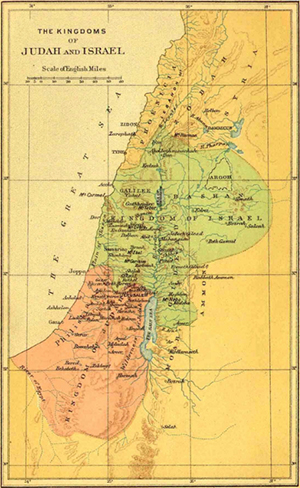
Judah Israel MapIt was during the reign of Solomon’s son Rehoboam that Israel split into two separate kingdoms. While Rehoboam remained the king of Judah in the south, Jeroboam became king of Israel in the north. 1 Kings 13:33 tells us that Jeroboam’s way were evil. After his death, Jeroboam’s son Nadab became king, and “he did evil in the eyes of the Lord” (1 Kings 15:26). Nadab was assassinated by Baasha, who killed all of Jeroboam’s descendants and who — yet again — “did evil in the eyes of the Lord” (15:34). Baasha’s son Elah reigned until he was assassinated by Zimri. Zimri’s reign lasted a whopping seven days, in which he killed all of Baasha’s family. Zimri died in a fire during an attack by the next king, Omri, who “did what was evil in the Lord’s sight, even more than any of the kings before him” (16:25).

Anyone else depressed yet?

But, alas, we’re not done. After Omri’s death, his son Ahab took the throne of Israel. He was even worse than his predecessors: “He did what was evil in the Lord’s sight, even more than any of the kings before him” (16:30). And, as if that wasn’t bad enough, he also brought with him to the leadership of the kingdom one of the most reviled women in scripture: Jezebel.

It is into these desolate circumstances that a surprising character enters: the prophet Elijah. After a long, detailed genealogical list of kings, Elijah appears with no fanfare. He’s just there. But this unknown, obscure man boldly confronts the most fearsome couple of his time.

How does he manage to do this? This prophet from an unheard-of town in Gilead, without a pedigree of tribe or ancestors — how does he dare speak words of censure to a ruthless, powerful king and his influential wife?

It’s in his name that we have a great clue to the source of his courage. In Hebrew, Elijah means “the Lord is my God.” Elijah faces down Ahab and Jezebel, not on his own strength, but filled with the strength of God.

Question:
What have you faced in your life that you cannot imagine having faced without God’s support and strength?

Posted in Pondering Scripture | 1 Comment

Ignoring Good Advice

Rehoboam by Hans Holbein the Younger (c. 1530)

Rehoboam by Hans Holbein the Younger (c. 1530)

2 Chronicles 9:29-31 (New Living Translation)
The rest of the events of Solomon’s reign, from beginning to end, are recorded in The Record of Nathan the Prophet, and The Prophecy of Ahijah from Shiloh, and also in The Visions of Iddo the Seer, concerning Jeroboam son of Nebat. Solomon ruled in Jerusalem over all Israel for forty years. When he died, he was buried in the City of David, named for his father. Then his son Rehoboam became the next king.

Through David and Solomon’s reigns, Israel had grown and prospered. Rehoboam would have learned at the feet of his grandfather and father, and we could assume that he would be even greater. After all, could a future king ask for better mentors?

And yet… Rehoboam’s time as king begins with an unqualified failure. He travels to Shechem for his coronation, and is confronted by a group of Israelites, who ask their new king to lighten the demands for conscripted labor and heavy taxes.

At first it seems that Rehoboam is taking wise action: he immediately seeks out his father’s advisors, and asks them how he should proceed. They tell him, “If you are good to these people and do your best to please them and give them a favorable answer, they will always be your loyal subjects” (10:9).

Rehoboam is not happy with this answer, and so he heads instead to consult with his friends, who counsel him to ignore the crowd’s pleas and to make their lives even more difficult: “This is what you should tell those complainers who want a lighter burden: ‘My little finger is thicker than my father’s waist! Yes, my father laid heavy burdens on you, but I’m going to make them even heavier!'” Rehoboam told the crowd exactly what his friends suggested.

This — shockingly enough — did not go over well.

When the people hear Rehoboam’s declaration, they respond angrily: “‘Down with the dynasty of David! We have no interest in the son of Jesse. Back to your homes, O Israel! Look out for your own house, O David!’ So all the people of Israel returned home. But Rehoboam continued to rule over the Israelites who lived in the towns of Judah. King Rehoboam sent Adoniram, who was in charge of forced labor, to restore order, but the people of Israel stoned him to death. When this news reached King Rehoboam, he quickly jumped into his chariot and fled to Jerusalem. And to this day the northern tribes of Israel have refused to be ruled by a descendant of David” (16-19).

Not a great start.

Question:
When have you ignored good advice?

* Painting of Rehoboam from a fragment of the wall painting originally in the Great Council Chamber of Basel Town Hall, Switzerland, but now kept at the Kunstmuseum Basel. Licensed under public domain via Wikimedia Commons.

Posted in Pondering Scripture | Leave a comment

Yearning for Wisdom

Solomon and the Queen of Sheba

Solomon and the Queen of Sheba (by Lorenzo Ghiberti, 1452)

2 Chronicles 9:5-8 (The Message)
She said to the king, “It’s all true! Your reputation for accomplishment and wisdom that reached all the way to my country is confirmed. I wouldn’t have believed it if I hadn’t seen it for myself; they didn’t exaggerate! Such wisdom and elegance — far more than I could ever have imagined. Lucky the men and women who work for you, getting to be around you every day and hear your wise words firsthand! And blessed be your God who has taken such a liking to you, making you king. Clearly, God’s love for Israel is behind this, making you king to keep a just order and nurture a God-pleasing people.”

The Queen of Sheba has come to Jerusalem to pay her respects to King Solomon. We’re told that she also came to “test him with hard questions” (9:1). How much I would have loved to hear their conversation! I imagine that she began with some fairly simple questions, but then, as he answered with wisdom and knowledge, she kept upping the ante. Tougher and tougher and tougher questions, until she finally ran out of queries and exclaimed, “It’s all true!”

The prophet Micah wrote about a future king from Bethlehem — a descendant of David of of Solomon — who would rule the world with his wisdom and authority: “He will stand tall in his shepherd-rule by God’s strength, centered in the majesty of God-Revealed. And the people will have a good and safe home, for the whole world will hold him in respect — Peacemaker of the world!” (5:4).

When Jesus was twelve, his parents took him to Jerusalem. They lost track of him, and spent undoubtedly panicked hours looking for him. In Luke 2:46-47 we read: “The next day they found him in the Temple seated among the teachers, listening to them and asking questions. The teachers were all quite taken with him, impressed with the sharpness of is answers.” The teachers were amazed by Jesus’ wisdom, his knowledge.

Solomon was no ordinary, run-of-the-mill king, as the Queen of Sheba found out. And Jesus was no normal, typical, pre-teen boy. I can’t help but apply the queen’s words to Jesus: “Lucky the men and women who work for you, getting to be around you every day and hear your wise words.” 

Isn’t that just the truth!

Question:
How has your life been changed so far by reading the wisdom in the Bible?

* Detail from the Gate of Paradise, a renaissance relief of Solomon meeting the Queen of Sheba by Lorenzo Ghiberti, 1452, from the door of the Florence Baptistery.

Posted in Pondering Scripture | Leave a comment

Waiting, Waiting, Waiting…

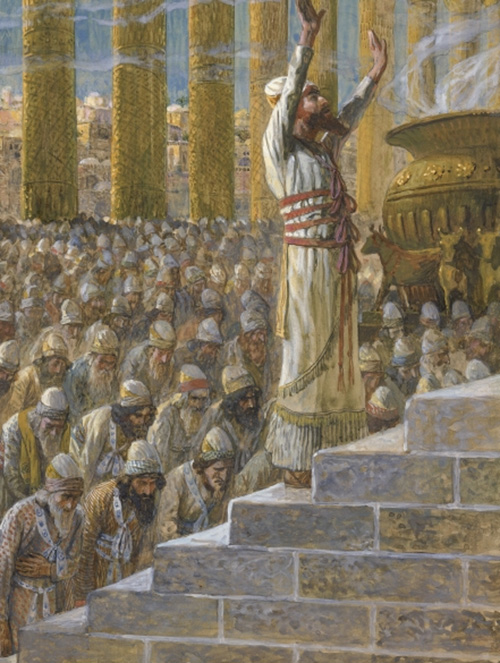
Solomon Dedicates the Temple2 Chronicles 6:7-9 (New International Version)
“My father David had it in his heart to build a temple for the Name of the Lord, the God of Israel. But the Lord said to my father David, ‘You did well to have it in your heart to build a temple for my Name. Nevertheless, you are not the one to build the temple, but your son, your own flesh and blood — he is the one who will build the temple for my Name.'”

Back on July 10th, we looked at the day when Solomon’s father David brought the Ark of the Lord into Jerusalem. In the years since its arrival, as the city of Jerusalem grew up around it, the Ark stayed under the Tabernacle tent: a portable structure. The Temple has now been built as a permanent place of worship, to contain the chest with the tablets that Moses had received from God.

A long time ago someone told me that God really only gives three answers to our prayers: yes, no, or not yet. I think God responds to our prayers in significantly more complicated ways than that, but it’s a way to understand that an immediate “yes!” is not always the best answer — no matter how much we might like it to be. In today’s scripture reading, we are reminded that David, beloved as he was, still received an unequivocal no from God. He would not be allowed to build the Temple. But, interestingly, that “no” to the yearning of David’s heart also contained a “yes” and a “not yet.” The Temple would be built (that’s the “yes” part) eventually by David’s son Solomon (the “not yet”).

And here, after so many years, so much labor and prayer and effort, the Temple is ready, and King Solomon dedicates it to God: “My father David had it in his heart to built a temple for the Name of the Lord,” Solomon says. And now it has been accomplished.

Question:
For what yearning of your heart have you had to wait?

* Painting “Solomon Dedicates the Temple at Jerusalem” by James Tissot [Public domain], via Wikimedia Commons

Posted in Pondering Scripture | Leave a comment