
Working Out Our Faith

Philippians FB Banner NO DATE

[Transcript of a sermon delivered August 21, 2016, at Plantation United Methodist Church]

Philippians 2:12-18
Therefore, my beloved, just as you have always obeyed me, not only in my presence, but much more now in my absence, work out your own salvation with fear and trembling; for it is God who is at work in you, enabling you both to will and to work for his good pleasure. Do all things without murmuring and arguing, so that you may be blameless and innocent, children of God without blemish in the midst of a crooked and perverse generation, in which you shine like stars in the world. It is by your holding fast to the word of life that I can boast on the day of Christ that I did not run in vain or labor in vain. But even if I am being poured out as a libation over the sacrifice and the offering of your faith, I am glad and rejoice with all of you — and in the same way you also must be glad and rejoice with me.

I saw this video a few weeks ago, and was mesmerized. It’s not often you see an 86-year-old nun in a Nike ad! I have zero-point-zero interest in joining a convent or competing in an Ironman Race, but I still want to be like Sister Madonna Buder when I grow up. Don’t you? 86 years young, and with a zest for life that eclipses what people half her age have.

And she didn’t start running until she was 48 years old. A Catholic priest at a retreat suggested that Sister Madonna begin physical training as a discipline for body, mind, and spirit. So she did, that very day. And that is where it began.

In her book The Grace to Race, Sister Madonna writes about her first race. She ran that race as an intercessory prayer for her brother, who was struggling in his life and marriage.

Four years later she tackled her first triathlon: swimming, biking, and running. Then her first Ironman at 55. Swimming 2.4 miles, biking 112 miles, and then running a full marathon, 26.2 miles. At the age of 86, she has completed over 340 triathlons, including 45 Ironman races around the world.

Aren’t you exhausted just thinking about it?
‘Cause I sure am!

The sheer amount of energy, time, effort, discomfort, and discipline that goes into an undertaking like that: it’s an amazing feat! And a phenomenal commitment.

We’re in the third week of our Finding Light in the Darkness series, as we explore Paul’s beautiful letter to the church in Philippi. In our scripture for today, Paul likens his work with the Philippian church to running a race, saying in verse 16, “It is by your holding fast to the word of life that I can boast on the day of Christ that I did not run in vain or labor in vain.”

Running a race, with its long-term, up-front preparation and investment.

But… then there’s this phrase, which has been troubling to generations of Christians trying to figure out exactly how this whole “salvation” thing functions:

Philippians 2:12-13: “Work out your own salvation with fear and trembling; for it is God who is at work in you, enabling you both to will and to work for his good pleasure.”

κατεργάζομαι

The Greek word we translate as “work out” is katergázomai. From two words: katá, “down, exactly to,” and ergázomai, “to work, to accomplish.” So this word means:

to work
down
to a conclusion

Paul is not telling us here in these verses that we need to work really, really, really hard to earn our salvation, to win God’s forgiveness and approval and love. There is no need! God has already offered all that to us, no strings attached.

What Paul is saying is that we are to take what we have been given in that relationship with God and work at deepening it, strengthening it, working down to that conclusion of perfect connection.

Let’s look at verse 12 in another version, the New Living Translation:

“Work hard to show the results of your salvation,
obeying God with deep reverence and fear.”

While that is not a word-for-word, direct translation of the Greek, I think it is very close to Paul’s original intention. Work hard — not to earn your salvation, because you already have it as a free gift from God — but work hard to demonstrate what that salvation means in your life.

What Paul, in essence, is talking about here is what John Wesley would eventually call “sanctifying grace.”

Wesley was the minister in England who began the Christian movement which eventually became The United Methodist Church. When he considered how God’s love works in our lives, he spoke of three types of grace: prevenient, justifying, and sanctifying.

Prevenient grace is God’s love at work in our lives before we even know of our need for God. It’s those small nudges we receive, those feelings that something is missing, that there must be something more to life. It’s God drawing us closer.

Justifying grace is our acceptance of God’s love and forgiveness. It’s a grace that changes the trajectory of our lives and our eternity.

Then there’s sanctifying grace. When we’ve accepted God’s love and have decided to follow Christ’s path, we’re not automatically *snap!* made perfect. (Or maybe you were, but I sure wasn’t.) As our relationship with God matures and deepens, we learn more and more to live as Jesus lived.

Growing into our faith is a process.
A long one.
It’s a slogging along,
gutting it out
marathon to beat all marathons.
It is our life-long Ironman Race.

Sounds exhausting, doesn’t it? So why do it? If God already has forgiven us, already loves us, why do all that hard work?

When I was 18, I had the opportunity to visit Vatican City in Rome, Italy with my classmates. At that age, I definitely didn’t have the full appreciation for the tour that I would now, but I was still pretty amazed by the art in the Sistine Chapel. I was especially taken with the panel of God and Adam, close to the center of the ceiling.

In the left half of that section, we see Adam lounging on a hillside, legs sprawled in front of him, leaning rather lazily back, with his arm loosely resting on his knee.

The other half of the painting depicts God, whose whole body is straining toward Adam, with his hand reaching out to touch his creation.

This is what kills me about the picture. If you zoom in on Adam and God’s hands, you can see that God is reaching out, and all Adam has to do to be in direct contact with God is to lift his finger. Literally. Look at the space between the fingertips here. If he would just lift his finger.

Screen Shot 2016-10-04 at 10.54.55 PM.png

Make a little effort. Seriously Adam! We human beings, we tend to be path-of-least-resistance kind of people. We like to take the easy way, avoiding the tough paths that require extra effort from us. But this relationship with God, it’s a partnership. God offers us freedom and power and hope, but it’s up to us to take it and run with it. It’s up to us to do the work involved in making it an intrinsic part of our lives.

That is what katergázomai is all about: “working down to a conclusion.” We are called to work out our salvation with awe of and respect for God, as we internalize God’s love and grace and principles until we come to the point where God’s love and grace and principles are ours.

We are called to lift our finger, our hands. We’re called to reach out with everything that is in us — heart and soul and mind and strength — reaching out to the God who is already reaching out to us.

That is the great work of our lives!

So, how exactly do we do this? How do we run this race, how do we stretch our faith muscles, preparing ourselves for the marathon of life with God?

Just like Sister Madonna training for a race, we train ourselves spiritually. By worshipping together! By sharing our faith with each other, by wrestling together with tough questions that don’t have easy answers. By reading scripture and discussing it with our friends and fellow church members. By taking Communion together and remembering both God’s past acts and future promises. By serving people in need, stepping away from our own needs and focusing on others.

Philippians 2:17-18: “But even if I am being poured out like a drink offering on the sacrifice and service coming from your faith, I am glad and rejoice with all of you. So you too should be glad and rejoice with me.”

Right there is why all we’ve talked about this morning so far matters. It’s what makes the work of living out our faith worth it. All of this is what makes praise possible, even in midst of difficult times. That training, that preparatory discipline is what helps us to find light in the darkness.

Paul, writing to the Philippians from that uncomfortable jail cell, knows that one possible outcome of his trial will be execution. He’s facing death. And yet he rejoices!

“But even if I am being poured out like a drink offering on the sacrifice and service coming from your faith, I am glad and rejoice with all of you. So you too should be glad and rejoice with me.”

C’mon.
That is a seriously weird thing to say.

Even if I am killed, it has been worth it because of your faith. I am rejoicing, and you should be, too!

That kind of hope is only possible when we’ve already developed our faith muscles through long-time training and preparation.

I’ve been blessed to work with many fabulous, brilliant people in my life. One of these people is my friend Jason Micheli. He and I served together as pastors in my church in the DC area. An incredible, cutting wit. He’s one of the most well-read, thoughtful theologians I’ve ever encountered. He was famous all throughout that community as the pastor who ran many, many miles each week in way-too-tiny running shorts.

In mid-February 2015, Jason, our senior pastor Dennis, and I were talking about our upcoming sermon series, when Jason announced that he had a doctor’s appointment later that day. He’d been experiencing some discomfort, and just wanted to get it checked out.

Over the next few days, we learned that Jason had a late-stage, extremely aggressive blood cancer. So aggressive, in fact, that he was immediately taken out of work and put into an equally aggressive regimen of cancer treatment.

That next year of his life was hellish. No other way to describe it. Although he did describe it — in detail — in his blog, TamedCynic. Whenever he felt well enough, he would post a message with bone-jarringly blunt words about what was happening to him, and what the experience was doing to his faith.*

Now, his is not a blog for which I would give a blanket, everyone-should-read-this recommendation, as his writing is, frankly, difficult for many to read. If you’re offended by language that sometimes sounds like it would be at home in a truck stop, TamedCynic probably isn’t for you!

But it amazed me to watch how the faith he had worked so hard to understand and flesh out over the years had prepared him to face this horrible situation with both deep grace and brutal honesty.

Jason, now, one year later, back working at the church, writes: “Tears, and the suffering that provokes them, can in fact bring us closer to God by leaving us no other options but turning to God. But tears and suffering cannot fetter us to God. Only joy can bind us fully to the God who is most infallibly Joy.”

When we — like Sister Madonna, like Jason, like so many Christians before us — when we invest in the most important preparation of our lives, then we can find joy and gratitude and praise, even in the most difficult of circumstances.

Then we will be able, as Paul says in Philippians 2:15: “to shine like stars in the world.”

When together we engage in the challenging, but beautiful, life-transforming work of deepening our faith, then we can sing out praises to God.

Then we will find light in the darkness.
_______________________________

* Jason’s blog is TamedCynic. He also has a book coming out in a few months about his experience. It’s available now on amazon for pre-order: Cancer Is Funny: Keeping Faith in Stage-Serious Cancer
Posted in Pondering Scripture | Tagged , , , , , , , , , , , , , , | 2 Comments

A Matter of Gratitude

Philippians FB Banner NO DATE

[Transcript of a Communion meditation delivered August 7, 2016, at Plantation United Methodist Church]

Philippians 1:1-11 (New Revised Standard Version)
Paul and Timothy, servants of Christ Jesus, to all the saints in Christ Jesus who are in Philippi, with the bishops and deacons: Grace to you and peace from God our Father and the Lord Jesus Christ. I thank my God every time I remember you, constantly praying with joy in every one of my prayers for all of you, because of your sharing in the gospel from the first day until now. I am confident of this, that the one who began a good work among you will bring it to completion by the day of Jesus Christ. It is right for me to think this way about all of you, because you hold me in your heart, for all of you share in God’s grace with me, both in my imprisonment and in the defense and confirmation of the gospel. For God is my witness, how I long for all of you with the compassion of Christ Jesus. And this is my prayer, that your love may overflow more and more with knowledge and full insight to help you to determine what is best, so that in the day of Christ you may be pure and blameless, having produced the harvest of righteousness that comes through Jesus Christ for the glory and praise of God.

In a dark, dank, stone-walled room, away from friends, torn from the work he loved, Paul sat alone. He had been imprisoned for doing nothing more than sharing the story of Jesus with the people he met. That message — and most likely the bold way he had delivered it — had offended some powerful people in the towns he traveled. It had angered and frightened them, and Paul finds himself in jail.

He would have been entirely dependent on the goodwill of others. In jails at that time, there wouldn’t have been a state-provided meal for breakfast, lunch, and dinner. Meals, clothing, water, writing materials — all that would have to be provided by friends from the outside.  No breaks in the open with other inmates for exercise and fresh air. Just the room.

Every day, those stone walls.
Every night, that same ceiling.
Every hour, that damp, mildewed, confining air.

Awful. And… yet… it is in this context that Paul writes one of his most beautiful, affecting, hope-filled letters, our scripture reading for today. In just the 11 verses we’ve read we find these words: grace, peace, thanks, confidence, love, confirmation, compassion, insight, pure, blameless, righteousness, glory, praise.

So, how does he do it? In the midst of such difficulty, such discomfort, such darkness, how does he grab ahold of and hold on to the light?

In the search for an answer, I’d like to take you this morning on a bit of a whirlwind tour through some fascinating words in the Greek of our passage today. Are you sufficiently caffeinated to handle that? Ready? Okay, let’s go!

ἅγιος

Our first word this morning is hagios. We usually translate this word as saints, or holy. “Paul and Timothy, servants of Christ Jesus, to all the saints in Christ Jesus who are in Philippi.”

I’ve struggled a bit with that word over the years: saint. I’ve known a lot of wonderful people in my life, full of hospitality and joy and wisdom. But I have yet to see a halo hovering above any of their heads. And I know there isn’t one above mine. And I would hazard a confident guess that there weren’t any be-haloed visions of saintlike perfection in the Philippians church, either.

And yet, Paul calls them hagios.

The core of hagios is of contrast. Hagios is something that is different than what is around it. A church building can be called hagios, because it is different from the other buildings around it. It has a different structure, and a different purpose. A church is a building that has been “set apart” for a very specific use: the worship of God.

Calling people hagios is saying that there is something different about them. But how different? It’s the next words that fill in an important blank:

ἁγίοις ἐν Χριστῷ Ἰησοῦ
hagiois en Christo Iesou
.

The people are hagios in Jesus. And that little word we translate as “in” (ἐν) has so many different meanings, such as…

It can be a physical place, as in “I live in Plantation, Florida.” Hagios people live our lives located in Jesus’ life and love.

It can mean “for,” as in we live our lives for Jesus, motivated by Jesus.

It can mean “by.” We are able to live a hagios life by the means of having the love of Jesus at our core.

Subtle differences in meaning, but important. And I don’t think we have to choose just one. Because they’re all true, and all important. The people of Philippi were hagios — we are hagios — not because we have reached saintly perfection, but because of the relationship we have in Jesus Christ.

Next up, verse 2. Grace to you and peace from God our Father and the Lord Jesus Christ.”

χάρις

That word “grace” is charis. It is a word that absolutely pervades Philippians, appearing over and over again in many forms. It is the central theme of the letter. Sometimes we translate it as “joy.”

Charis, though, is more than an emotion. It is not just being happy. It is a mindset, a core characteristic of a person that allows him or her to look beyond their circumstances to the promise of God’s love. Charis is what allows Paul to be thankful in jail.

“Grace to you and peace…”

εἰρήνη

Eiréné is the word we translate as peace. When we use the word “peace” in English, we’re usually talking about one of two things: (1) a state of well-being inside a person, or (2) an absence of conflict between persons or groups. Eiréné doesn’t speak so much to that intrapersonal, subjective feeling of internal peace, but instead a unity between people. Eiréné is peace in relationship.

εὐχαριστέω

Our next Greek word is one of my favorites: eucharisteó. It comes from two lovely words: eu (good) and charis (grace), which we looked at a moment ago. Eucharisteó: to give thanks, to be grateful. I thank my God every time I remember you,” Paul writes. I eucharisto my God.

μνεία

And then there’s the next word. “I thank my God every time I remember you.” Remembrance is mneia in Greek.

It comes from the verb mnáomai, to actively, consciously bring into our mind a person or something that has happened in the past. It is a recollection, a mention, a commemoration.

κοινωνία

And then, finally our last Greek word for the day, from verse 5, koinónia. Often translated as fellowship, it means an active partnership. “I thank my God in all my remembrance of you, always in every prayer of mine for you all making my prayer with joy, because of your partnership in the gospel from the first day until now.” Paul is able to give thanks because of the koinónia of his brothers and sisters in Philippians.

How you hanging in there? Hagios, charis, eiréné, eucharisteó, mneia, and koinonia. That’s a lot to take in for one post!

So… after all that… let’s put it all together.

Because of his connection (koinonia)
with the people of Philippi
who were living life (hagios) in Christ,
Paul is able, in the midst of a difficult situation,
to remember (mneia) God’s promises with a joy
that rises above his circumstances (charis)
and to rejoice in the peace
of relationship with God (eiréné)
with thanksgiving (eucharisteó).

Communion

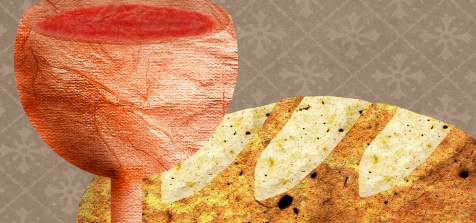
When we come to the Communion table, that is exactly what we are doing. In spite of our circumstances, we come to celebrate the relationship we have been offered with God and with each other. We come to remember. We come to celebrate. We come to give thanks.

Eucharisteó. Good grace, to give thanks. The “Eucharist” is one of the words we use to describe The Lord’s Supper, Holy Communion, where we gather to celebrate the self-giving love of Jesus Christ. We come together in gratitude. And we remember.

Jesus took some bread and gave thanks to God for it. Then he broke it in pieces and gave it to the disciples, saying, “This is my body, which is given for you. Do this in remembrance of me.” After supper he took another cup of wine and said, “This cup is the new covenant between God and God’s people — an agreement confirmed with my blood, which is poured out as a sacrifice for you” (Luke 22:19-20).

The words we’ve looked at today as we open our Philippians study are all at the core of who we are as Christ-followers.

And at the core of the core… is thanksgiving.
Eucharisteó.
The Eucharist.

Screen Shot 2016-08-06 at 4.33.58 PM

I came to faith in a lovely church in upstate New York, Clinton United Methodist Church. And although I don’t remember the exact date, I do remember the exact circumstances.

I had recently made the intellectual decision to become a Christian. Meaning: I had weighed the evidence, and concluded that this religion made sense, and I made the analytical determination that I would follow Jesus.

But it hadn’t yet reached my heart.

Soon after I started attending worship services in Clinton, I heard that there was a class on healing prayer being offered. Taking classes is right up my alley, so I signed up. It was great, I really enjoyed it.

Screen Shot 2016-08-08 at 3.20.00 PMOn the final night of the class, the visiting pastor who was teaching, Rev. Madeline McDonald, was offering a Communion service. As we were all walking into the sanctuary, Rev. McDonald came up to me and said, “I feel strongly that you are supposed to hold the cup during Communion.”

I was stunned. I told her that I was still very new at this whole Christian thing, and I didn’t think it was a good idea for me to be a part of the service. I would be happy to be a participant, but not actually involved.

She shook her head, and said again, “No. I really think you are supposed to do this.” She seemed so certain. And so serious. So I — very reluctantly — agreed.

At the conclusion of the short service, I stood up when she asked for the Communion servers to come forward. I took Communion from quickly, and with not a lot of thought, feeling a bit nervous about the whole thing. Then turned to face the congregation gathered. As each came forward to receive, I held out the cup and said the words that Rev. MacDonald had taught me, over and over again.

This is the blood of Christ, shed for you.

I don’t know how many times I intoned those words before it finally hit me.

This was the blood of Christ, shed for you… and for me, as well. It wasn’t an intellectual idea about grace. It wasn’t a lovely story of hope and promise. This ritual, this rite, was an active remembrance of an actual act in human history, when God became flesh and bone, and gave that flesh and bone up for us — so that we would be hagios, the ones who are called to live a life that is different, that is full of peace and joy and love.

That is the hope in which we stand,
in which Paul stood,
and which can transform our lives…
and our world.

We are stronger because of our connection with one other (koinonia), a community of people striving to live every part of our lives in Christ (hagiois en Christo Iesou).

Whatever is happening in our lives, we can choose to remember (mneia) God’s promises with a joy (charis) that can lift us from our circumstances into the peace of deep, abiding relationship with God (eiréné) with eucharisteó, deep, profound gratitude.

May it be so in your life this day, and all your days!

__________________________________________

Greek translations courtesy of BibleWorks 6.0, the Analytical Lexicon of the Greek New Testament, the Greek-Engish Lexicon of the New Testament, and Thayer’s Greek-English Lexicon of the New Testament.

Posted in Pondering Scripture | Tagged , , , , , , , , , , , , , , , | Leave a comment

Prayer for those considering violence

Pentecost

Praying this morning for people around our world who are entertaining thoughts of bloodshed.

May their spirits be touched by grace so overwhelming, that whatever is broken in them would begin to mend. May people come into their lives who flood their hearts with love so strong, that the fires of violence would be quenched and not stoked. And may we so clearly know what part we can take, that we may bring healing and hope to our communities and world. Gracious and ever-loving God, help us to be carriers of your peace into the hurt. Give us your wisdom, strength, and courage as we desperately seek a way forward. We believe you desire to guide us… so we ask that you do so! Amen!

Posted in Random Thoughts | Tagged , , , , , , , , , , | Leave a comment

Boldly Go

Philippians FB Banner NO DATE

Philippians 1:12-14 (New Living Translation)
And I want you to know, my dear brothers and sisters, that everything that has happened to me here has helped to spread the Good News.
For everyone here, including the whole palace guard, knows that I am in chains because of Christ. And because of my imprisonment, most of the believers here have gained confidence and boldly speak God’s message without fear.

Paul of Tarsus is writing this letter to the church in Philippi from the not-so-comfortable environs of a prison. It’s not a place you would naturally expect to find inspiration or illumination. And yet Paul has seen that God is able to use even his time of confinement to produce amazing results. He has shared God’s message of love and grace with his fellow inmates and his jailers, and, in turn, now those who believe are enthusiastically sharing their faith. They are boldly speaking God’s message without fear.

There are two Greek words that I find interesting in that last line: tolmaó and aphobós.

First, the verb tolmaó. It means to be bold in the face of danger, and in spite of your very understandable fear. Couple that with the adverb aphobós and things get interesting. The prefix a- negates what comes after it, and the Greek word phobos means fear. Aphobós means “not-fear,” and can be translated as fearlessly or boldly.

And because of my imprisonment,
most of the believers here have gained confidence
and boldly speak God’s message without fear.

Because of his imprisonment. Because of his example. Because of his willingness to be used by God even in difficult circumstances.

It could have been different.

Seriously, would we blame Paul for taking a bit of time off? If I were in his situation, I’d probably be feeling pretty miserable. Stuck in a prison, away from the people and the work that I love, I can see myself sulking in the corner, arms crossed around my knees, lamenting my position and the events that brought me there. I’d be praying to be released… so that I could get back to the ministry to which I’m called.

But the truth that Paul knew is this:

God wants us all to bring God’s love to the world.

Wherever you are. Whatever your job is. Whatever you perceive your abilities to be. Whatever your personality. Whatever you have. Whatever you don’t have. However busy you are, or how young you are, or how old you are, or how eloquent or tongue-tied, or how educated or inexperienced. No matter our circumstances…

God wants us all to bring God’s love to the world.

With every person you meet. No matter who they are. No matter how like you they are. No matter how different from you they are.

God wants us all to bring God’s love to the world.
Boldly speaking God’s message without fear.

Questions:
How could God use your current circumstances to bring you closer to God? How can you share God’s love with the people you encounter today? How can God work through you today?

Posted in Pondering Scripture | Tagged , , , , , , , , | 1 Comment

Parting Words

Philippians FB Banner NO DATE

[This post is a transcript of my final sermon at Aldersgate UMC, delivered June 4/5, 2016.]

Philippians 2:5-8 (New International Version)
In your relationships with one another, have the same mindset as Christ Jesus: Who, being in very nature God, did not consider equality with God something to be used to his own advantage; rather, he made himself nothing by taking the very nature of a servant, being made in human likeness. And being found in appearance as a human, he humbled himself by becoming obedient to death — even death on a cross!

Over the past month, Chuck and I have been going through our “DC bucket list.” Things we’ve meant to do, but had put off, thinking we’d be here longer than three years. And a lot of things that we’ve done before, but loved so much we wanted to do it one last time.

This past Friday night, we made reservations at one of our favorite DC restaurants. Chuck would take the Metro Red Line from Union Station, I’d take the Yellow up from King Street, and we would meet at the restaurant.

I had just gotten off at Gallery Place, and it had started raining. I crossed 7th, and was waiting for the crosswalk to change for F Street. The little red hand changed over to the white walk sign, and the 61 second countdown began. But, before stepping off the curb, I looked both ways — just like my Mama taught me.

I halfway across the first lane, and was thinking about the sushi Chuck and I were about to enjoy, when I heard someone scream behind me. I lifted my umbrella and turned to the left, where I saw, just inches away from my left shoulder, the large, metallic grill of a hotel shuttle bus. I looked up, through the windshield, and saw the driver, ashy pale and, frankly, looking even more terrified than I was.

As I lay in bed Friday night, I thought back about what had happened with amazingly vivid detail. The rain dripping off of my tilted umbrella. The short, spiky hair of the bus driver. The cluster of tourists on the sidewalk ahead with their mouths hanging open. Six more inches and that bus would have hit me. Twelve more and I would have been thrown. Eighteen and I might not be here.

I kept thinking, “What a stupid way to end my time in Alexandria!” Because I would forever be known as the pastor who was hit by a bus before she could give her final sermon.

D’oh. Not the legacy I wanted to leave.

But it was a great reminder to me of how fragile this life is. From one moment to the next, things can change. Sometimes drastically. By freak accident, by illness, by changes in our lives that take us from one place to another.

Truth is, we don’t really know what tomorrow holds for us. That’s why what we do and say every single day is so important. That’s why we desperately want our words and actions to make a difference.

Especially when we know that it could be our last words to people we love.

Our scripture for today comes from a letter that the apostle Paul wrote to the church in Philippi in Greece. Throughout the letter he encourages them and sends his love. And he also tries to impart a condensed form of his accumulated wisdom.

Because he is not sure if this will be his last chance to do so. Paul is writing this letter from the confines of a prison, not the most comfortable to be. And he doesn’t know for certain what the outcome will be for him. In the first part of the letter, he tells the church that whether he lives or dies, he is content in Christ.

This beautiful letter is full of what Paul knows could be his last words to these people he loves. He starts out with this greeting:

Grace to you and peace from God our Father and the Lord Jesus Christ. I thank my God every time I remember you, constantly praying with joy in every one of my prayers for all of you, because of your sharing in the gospel from the first day until now. I am confident of this, that the one who began a good work among you will bring it to completion by the day of Jesus Christ.

Unlike many of Paul’s letters, he is not writing to correct any particular misbehavior or dangerous theology. He’s writing because… catch this!… he’s proud of them.

I think, in many ways, Paul feels about the people of Philippi the same way I feel about you here at Aldersgate. It has been a joy and an honor to be one of your pastors. I love the heart that you have for people in need in our community and world. I love the care you give to each other, and to complete strangers. I love your thirst and hunger for God, and your desire to learn more. In short, I love you.

And this, today, is my last chance to pass on to you something I think is important. Not because I was almost hit by the proverbial bus on Friday, but because today is my last day as a pastor of this wonderful community.

So I’d like to take a moment to look at Paul’s words in Philippians, chapter 2, verse 5. The New International Version reads, “have the same mindset as Christ Jesus.” The New Revised Standard Version renders that verse like this: “Let the same mind be in you that was in Christ Jesus.”

“Mind.” You knew I couldn’t leave here without teaching you one more Greek word, right? That word we translate as “mind” is phroneó. And it means much more than just intellect, just thinking.

Paul is not telling the people of Philippi that they all need to think exactly the same, that they can never have differing opinions or ideas. That’s not what phroneó means.

Phroneó comes from the noun phrén, meaning the mid-section of the body. Phroneó means to take what we know to be true — deep in our gut — and to put it into action. It means to take our most deeply held perspective and demonstrate it through our outward behavior. Phroneó is belief fleshing itself out in deeds.

That’s why phroneó is so hard to translate into English. We just don’t have a word that is both visceral and cognitive. So translators have to make a choice, and most have chosen “mind.”

But what Paul is telling the people is this: “Those beliefs and actions and attitudes you saw embodied in Jesus Christ? Let that be who you are, too.”

What you believe at your core,
let that be reflected in your acts in the world.

If you’ve been around when I’ve led worship, that may sound slightly familiar to you. Because just about every service I end with these words:

Now, what we’ve said with our lips,
let us believe in our hearts.
And what we believe in our hearts,
let us practice in our lives.

I love those words because they are a wonderful summary of what the life of faith is supposed to look like.

Not just an intellectual faith, one whose words we can say, whose language we understand.

Not just a faith of feeling, one that makes us feel good and comforted and challenged … personally.

It is both of those, but it is also — very much! —  a faith of action. Taking what we understand, what we believe and feel, and walking it out into the world. Every day. Everywhere we go. With everyone we meet.

Because that is exactly what Jesus did.

“Those beliefs and actions and attitudes you saw embodied in Jesus Christ? Let that be who you are, too.”

And what beliefs and actions and attitudes did we see embodied in Jesus? The next verses flesh that out. (Pun fully intended!) Starting with verse 6:

Jesus, being in very nature God, did not consider equality with God something to be used to his own advantage; rather, he made himself nothing by taking the very nature of a servant, being made in human likeness. And being found in appearance as a man, he humbled himself by becoming obedient to death — even death on a cross!

“Jesus, being in very nature God…”

Jesus did not stop being the “very nature of God”
when he left behind the glory of heaven to come to earth.

Jesus did not stop being the “very nature of God”
when he reached out in love to the hurting and despised and lost.

Jesus did not stop being the “very nature of God”
when he washed the feet of his own disciples.

Jesus did not stop being the “very nature of God”
when he went without a fight to the cross.

In Jesus’ self-emptying love,
self-giving love,
we have seen the very nature of God.

In Jesus’ life, actions, words, we see the nature of the God who loves us.

That, I pray, is something that you will know in the core of who you are. And I pray that what you know in your core will be seen in your life. Every day. Everywhere you go. With everyone you meet.

Because I have absolutely no doubt that God has amazing things in store for you.

And, I can say along with Paul: “I am confident of this, that the one who began a good work among you will bring it to completion by the day of Jesus Christ.”

Questions:
In your words and actions today, how can you demonstrate God’s love? Thinking back over your actions and words this week, what would an observer assume to be your most deeply held beliefs?

Posted in Pondering Scripture | Tagged , , , , , , , , , , , , | 7 Comments

Tested by Sunlight

Philippians FB Banner NO DATE

Philippians 1:9-11 (New International Version)
And this is my prayer: that your love may abound more and more in knowledge and depth of insight, so that you may be able to discern what is best and may be pure and blameless for the day of Christ, filled with the fruit of righteousness that comes through Jesus Christ — to the glory and praise of God.

I love this passage! Love. Knowledge. Insight. Discernment. Pure. Blameless. Righteousness. Glory. Praise.

And this is my prayer: that your love may abound more and more…

The Greek mallon kai mallon (μᾶλλον καὶ μᾶλλον) is translated as “more and more.” Mallon is a comparative adverb, referring to an increase from what existed before or what exists now.

More and more knowledge. More and more insight.
That sounds mighty good to me! How about you?

But here’s the word that is fascinating me in our passage this morning: εἰλικρινής. Eilikrines is often translated as “pure” in Philippians 1:10. It means uncontaminated, sincere, spotless. It means “tested by sunlight.”

Tested by sunlight.

I was at a goodbye party in a friend’s backyard the other night. The sun had set, it was gorgeously warm, and we all stood in the glow of firelight and torches. A bunch of us were talking about how great we look by candlelight. The years drop away in the soft flickers. Wrinkles soften, blemishes fade. Gray hairs become happy sparks, highlighting the corona of hair around our heads.

If only we could carry that kind glow with us everywhere in life.

But, alas, reality intervenes. And although I love bright sunshine, it definitely does show the fact that I’m not 18 anymore. Or 28. Or  38.

As fabulously yummy as sunshine feels on my skin, it certainly does not soften my flaws.

In his sermon “The Scripture Way of Salvation,” John Wesley wrote about the first flush of confidence and excitement when a person becomes a Christ-follower. He said that in the moment of acceptance and surrendering, “there is a real as well as a relative change.” Something happens within us, moving us closer to God. And we feel that it will always be that way — we will be constantly in God’s loving presence, never faltering, never wavering, continuously drawing nearer and nearer to God, experiencing within our bodies and spirits God’s peace and love and forgiveness and grace.

Mallon kai mallon, indeed! More and more and more and more.

Wesley writes:

How naturally do those who experience such a change imagine that all sin is gone; that it is utterly rooted out of their heart, and has no more any place therein! How easily do they draw that inference, “I feel no sin; therefore, I have none: it does not stir; therefore it does not exist: it has no motion; therefore, it has no being!”

But… then… suddenly bright, strong sunlight shines down on our lives, and all the flaws and imperfections and weaknesses are brought to light.

But it is seldom long before they are undeceived, finding sin was only suspended, not destroyed. Temptations return, and sin revives; showing it was but stunned before, not dead. They now feel two principles in themselves, plainly contrary to each other; “the flesh lusting against the Spirit”; nature opposing the grace of God.

In case you hadn’t figured it out yet: you’re not perfect. Neither am I. But we don’t need to be ashamed of that fact. Because God already knows it, no worries! And God loves us too much to just leave us stuck in our mess.

And this is my prayer: that your love may abound more and more in knowledge and depth of insight, so that you may be able to discern what is best and may be pure and blameless for the day of Christ, filled with the fruit of righteousness that comes through Jesus Christ — to the glory and praise of God.

Growing more and more in knowledge and insight.
It is a process, not an event.

It’s something we do every day, reaching out to our God for help. We will falter and fail and fall flat on our faces some days.

But God is not done with us yet.
Not yet.
Not ever.

Question:
What flaws in your life would you not want to be brought out into direct light?

Posted in Pondering Scripture | Tagged , , , , , , , , , , , | 2 Comments

Every Time I Think of You

Philippians FB Banner NO DATE

Philippians 1:1-6 (New Living Translation)
This letter is from Paul and Timothy, slaves of Christ Jesus. I am writing to all of God’s holy people in Philippi who belong to Christ Jesus, including the church leaders and deacons. May God our Father and the Lord Jesus Christ give you grace and peace. Every time I think of you, I give thanks to my God. Whenever I pray, I make my requests for all of you with joy, for you have been my partners in spreading the Good News about Christ from the time you first heard it until now. And I am certain that God, who began the good work within you, will continue his work until it is finally finished on the day when Christ Jesus returns.

I am in the midst of packing, saying goodbyes, and wrapping up final details as my husband and I prepare to move from Alexandria, Virginia, to Plantation, Florida. Finding that I needed a spiritual booster shot in the midst of the chaos, over the past few weeks I’ve turned to what I think of as the happiest book of the Bible: Paul’s letter to the church in Philippi.

Philippians is a letter chock full of joyful proclamations, faith-filled wisdom, and encouraging words. It was written from the confines of a prison cell — not generally considered conducive to upbeat thoughts and notes of hope. Paul wrote to this church, which he had helped to found, filled with people he had once shared with deeply. Many years had passed since he last saw them, but his love for them had not waned.

One of the (many) strange things about being a pastor is that when we leave a congregation, we are expected to leave: to not maintain contact with our former parishioners. And this is for a very good reason: to protect the ministry of the pastor who follows us.

We take this quite seriously in the UMC. There’s even a warning in our Book of Discipline, the “law book” of our denomination: ¶ 2702.3.j: “A professing member of a local church may be charged with the following offenses: … relationships and/or behaviors that undermine the ministry of persons serving within an appointment.”

Why make such a big deal about it, you ask?

A friend recently commented that it’s like keeping in close, intimate contact with an ex-boyfriend or girlfriend for whom you still have feelings. Any new relationship is hampered by — or even doomed by — the active affection for the former. That lingering connection doesn’t give the new relationship space to grow and deepen.

It’s the same for pastors. If a former church leader continues to contact church members for pastoral care, that can get in the way of the new leader creating meaningful relationships.

So when we leave… we leave.

But that does not mean that it is easy. Most pastors are wired to love deeply. It’s just kinda part of the package. It’s hard to pack up and move away, knowing that this means the close of important relationships.

I have been blessed to have been a part of several communities of faith over my years as a Christian.

There’s the church where I first fell in love with God: Clinton United Methodist Church in New York, led by Rev. Dick Barton. That congregation showed me such grace and patience as I asked a million questions about faith, and were beautifully open with me about their own struggles and victories. Rev. Barton was the first one to encourage me to become a candidate for ministry.

Then, Rockefeller UMC in Syracuse, New York, where I interned with Rev. Dr. John Fulton during my first seminary classes. That congregation had to endure my first attempts at preaching, when I grasped the podium so tightly that the whites of my knuckles could be clearly seen from the back row.

Christ Church in Fort Lauderdale, Florida, my first fabulous appointment as an Associate Pastor, under Rev. Phil Roughton. I was fresh out of seminary and overflowing with enthusiasm. During my six years there, they not only did not dampen my excitement, they fueled it!

And my current church in Alexandria, Virginia, Aldersgate UMC, with Senior Pastor Rev. Dr. Dennis Perry. From the very first weekend this congregation felt like home. A vital family of faith, focused on helping people in need, the people of Aldersgate have been a joy to work alongside.

Each congregation is filled with people I loved — and continue to love. That doesn’t end when my packed boxes are loaded onto a truck, and my office is empty behind me.

As I prepare to take the pulpit at a wonderful new church in Florida, Plantation UMC, I continue to pray for the congregations where I have been before — and for the pastors who now serve there so faithfully!

Each person we come to know makes an impact on us. I give thanks today for the men and women in the churches who have nurtured me, challenged me, supported me, and then lovingly stood with me at the door as I stepped out into whatever God had in mind next.

I can declare with Paul: “Every time I think of you, I give thanks to my God!” And I can rejoice that I am certain that God, who began the good work within you, will continue his work until it is finally finished on the day when Christ Jesus returns.

Question:
Who will you pray for today, with thanksgiving in your heart?

Posted in Pondering Scripture | Tagged , , , , , , , , , | 5 Comments

Don’t Be Afraid!

Easter

Matthew 28:5-7 (New Living Translation)
Then the angel spoke to the women. “Don’t be afraid!” he said. “I know you are looking for Jesus, who was crucified.
He isn’t here! He is risen from the dead, just as he said would happen. Come, see where his body was lying. And now, go quickly and tell his disciples that he has risen from the dead, and he is going ahead of you to Galilee. You will see him there. Remember what I have told you.”

Don’t be afraid!
Μὴ φοβεῖσθε ὑμεῖς
Me phobeisthe humeis

Grieving the death of their leader, their friend, the one they believed was their savior, the women had been holding mournful vigil outside Jesus’ tomb. Then, suddenly, an earthquake shakes the ground beneath them, the large stone blocking the tomb entrance rolls aside, and a dazzling angel appears in front of them.

Had it been me, I would broken the sound barrier running away. How terrifying!! As the earthquake began, the women must have thought “What now? On top of everything else that has happened, now this? My God, my God, why are you torturing us? What more can we stand?”

And the angel tells them:
Me phobeisthe humeis

“Don’t be afraid!” the angel says.

Don’t be afraid? Seriously? Jesus has been killed as a criminal and his body stuck in a borrowed tomb. The guards have blocked the entrance, and aren’t letting anyone near his corpse to pay honor to him. An earthquake has shaken their very foundations, and now a glowing, terrifying angelic being is there, telling the women to not be afraid? How could they be anything but afraid!?

The Greek word used here for “afraid” is phobeó, together with the negative particle me. Fear not. But phobeó also means to withdraw from, to flee. “Don’t run away!” the angel tells the women, “Don’t take off!” Stick around! You’ve been through hell, you’ve been deep in grief without hope or consolation… but everything is about to change.

Me phobeisthe humeis
“Don’t be afraid.”

In the past few years — and in the past few days — we’ve seen abundant reason for fear in our world. We’ve seen the terrible things that one group of human beings can do to another. We’ve seen reports of anger and pain, of disagreements erupting into violence. It is not irrational to be afraid of losing your job, of getting cancer, of your relationships failing, of political uncertainty, of terrorism.

Please hear me: we should not pretend that we’re not afraid. We should not put on a brave face and lie to ourselves and to others, saying that everything is okay. Because, all too often, it is not.

But… when we allow fear to permeate our souls, when we become ensnared by it, when our actions become so deeply influenced by fear of being harmed… then we start to avoid anything that could be perceived as a risk.

We avoid reaching out.
We avoid making ourselves available.
We avoid being honest and open.
We avoid showing love to others.
We avoid fighting against injustice.
We avoid telling the truth in love.
We avoid caring.

When things are difficult and scary, it is all too easy for us to be stuck in Good Friday’s pain and fear and uncertainty, when it feels like the entire world is falling apart around us.

One more translation of phobeó is “to avoid.” To the women, the angel says, “Don’t avoid this!” The angel says  to us: “Don’t miss this! Don’t avert your eyes and walk away!”

Because we were never — never — meant to stay in Good Friday.

In the midst of the chaos,
God gives us Easter.
Not just two millennia ago.
But today.
And tomorrow.
And the day after that.
And forever.

Easter! A promise that the worst of days is not the end of the story. A promise that God’s faithfulness endures forever. A promise that even when we see no way forward, that God is the way forward.

May this Easter be a blessing to you…
and may you know the peace of Christ
which passes all understanding…
not just this day… but always!

HAPPY EASTER!!!

Posted in Lent, Pondering Scripture | Tagged , , , , , , , , , , , | Leave a comment

Risen from the Dead

Matthew 27:57-61 (New Living Translation)
As evening approached, Joseph, a rich man from Arimathea who had become a follower of Jesus,  went to Pilate and asked for Jesus’ body. And Pilate issued an order to release it to him Joseph took the body and wrapped it in a long sheet of clean linen cloth. He placed it in his own new tomb, which had been carved out of the rock. Then he rolled a great stone across the entrance and left. Both Mary Magdalene and the other Mary were sitting across from the tomb and watching.

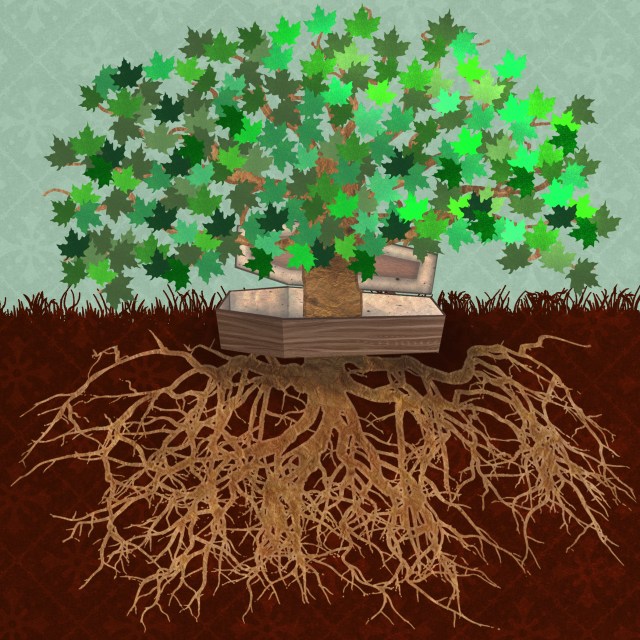
A few weeks ago, my friend Jason came into my office with a challenge. He would be preaching the Easter services at our church, and was thinking about a picture for the bulletin cover. He said:

“Can you make an image of a tree growing out of a coffin?”

Immediately my brain started buzzing with what the tree would look like, and its fabulous theological implications. I already had a full schedule of things I needed to get done that day, but Jason knows that when a new idea for art takes a hold of me, everything else fades into the background. For me, it is always a joy to create something new. I love taking an abstract vision in my head and forcing it into concrete reality.

But this image felt particularly poignant to me, as Jason had recently returned to work at Aldersgate. This time last year, he was in the midst of intensive chemotherapy, fighting what he called “stage serious” Mantle Cell Lymphoma. Frankly, we weren’t sure that he would make it back.

When a friend who has gone through that kind of hell-on-earth asks for an image of life emerging out of death… well… you just have to take that seriously.

By the next morning, this Easter image was born.

Easter

As I worked on it, I prayed for Jason’s continuing health and for his family. But I also thought about those followers of Jesus who, disillusioned and terrified, had scattered when Jesus was arrested. Those disciples who heard the news of his crucifixion, and whose blood seemed to stop in their veins as they grieved the death of the one in whom they had put all their hope. Those friends of Jesus who stood helplessly by as his body was laid in the tomb… and as the air rang with the noise of that great stone dropping into place in front of the tomb’s entrance.

Fear.
Grief.
Loss.
Finality.

They didn’t know that in the dark of that grave,
the seeds of Easter were already sending forth shoots.

Easter is coming!

Posted in Lent, Pondering Scripture | Tagged , , , , , , , , , , , , , , , , , , , | Leave a comment

Free Leadership Study!

Three

I’m SOOOOO happy! The Love. Understand. Serve. study guide is now up & available at www.loveunderstandserve.org/leadership.

It’s a 3-week study guide exploring leadership in the church & in the world… & it’s free!

Written for you with love & great hope for the future!

Posted in Wired to Lead | Tagged , , , , , , | 1 Comment