
Legacy

Great Aunt Janet

Janet Garnsey Hall
November 6, 1917 – September 16, 2014

Yesterday my Great Aunt Janet passed away, just two months shy of her ninety-seventh birthday. She was one of the most amazing people I’ve ever known.

In the 1960s, Janet was the only woman licensed as a captain in the state of Florida — she received her license way back in 1934. She and her husband Wendall (my Grampa Doc’s little brother) started a fishing business in Boynton Beach, Florida, which is now run by her grandchildren. (Here’s an article published a few months ago about the Sea Mist.) She took engineering classes at a time when that was not considered to be an “appropriate” venture for young ladies. She was comfortable in her own skin, not worried about what people thought of her. She had an excellent sense of humor and a great laugh. In her eighties and nineties, an age when many folks start to relax and kick back, Aunt Janet learned how to use a computer (she had several) and launched an online bookstore. She had an unquenchable curiosity and a deep love of life.

She completely adored her seven kids, her grandkids, and her great-grandkids. She thought they were all brilliant and gorgeous. (And she was right!) But even surrounded by her brood, her heart was big enough to hold love for various nieces, nephews, cousins, and friends “adopted” into our very large family. She had the wonderful ability to make every person feel special as she spoke with each of us.

I hope I can be as feisty and strong and fabulous as Janet when I grow up. And I hope that you have had someone like her in your life!
Posted in Personal | 4 Comments

Plumb Lines

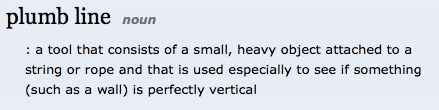
definition by Merriam-Webster

definition by Merriam-Webster

Amos 7:7-8 (New International Version)
This is what he showed me: The Lord was standing by a wall that had been built true to plumb, with a plumb line in his hand. And the Lord asked me, “What do you see, Amos?” I replied, “A plumb line.” The the Lord said, “Look, I am setting a plumb line among my people Israel; I will spare them no longer.”

My Grampa Doc was a beloved physician, a prize-winning sailor, skillful hunter, brilliant storyteller, gifted harmonica player, and undefeated arm-wrestler. He was also a master carpenter. I spent many, many hours watching him lovingly create works of art — furniture, toys, whatever was needed — in his jam-packed garage workshop.

If you can imagine a tool, Grampa probably had it somewhere. He had large machines for planing wood, circular saws for quickly ripping long sections, jigsaws and scroll saws for more intricate cutting work. He also had tiny tools: miniature screwdrivers to fix eyeglasses, drill bits so delicate they could be snapped in two if you weren’t careful enough. But the simplest tool in Grampa’s workshop was a pointed weight tied to a long string: a plumb line.

He would use the plumb line to ensure that a piece of furniture was standing perfectly straight. Holding the string, he would allow the weight to fall close to the ground. He would wait until the weight stopped swaying at the bottom of the string — until it was completely still. Then he would compare the perfectly straight string to the furniture. If there was a gap, he would know that his handiwork was not what he had originally intended; there was an imperfection to fix before it would be ready to leave the shop.

In today’s passage, God speaks to the prophet Amos, apprising him of the impending judgment of Israel. God uses the metaphor of a plumb line, telling Amos that God has seen that the people are not “in line” with God’s plan. As painful as it might be — for both created and Creator — a correction would be necessary to help the people return to a healthier path.

Question:
What are the “plumb lines” you use in your life?

Posted in Pondering Scripture | Tagged , , , , , , | 1 Comment

High Places

2 Kings 12:1-3 (New International Version)
In the seventh year of Jehu, Joash became king, and he reigned in Jerusalem forty years. His mother’s name was Zibiah; she was from Beersheba. Joash did what was right in the eyes of the Lord all the years Jehoiada the priest instructed him. The high places, however, were not removed; the people continued to offer sacrifices and burn incense there.

Joash was king for forty years, but the record of his reign takes up only 21 verses in 2 Kings. Most of that space is used to describe the repairs to the Temple in Jerusalem. He directs the Temple priests to get the finances in order — from taxes to voluntary offerings — and to get started on the renovations. Everything seems to be heading in the right direction. Or was it?

“Joash did what was right in the eyes of the Lord… but the high places were not removed…”

Even though Joash was working to restore the Temple — the center of worship for the God of Israel — he doesn’t get rid of the places where other gods were worshipped. Why is this? Jerusalem had been set apart as the city of God, and God’s will had been made very clear: “You shall have other gods before me. You shall not make for yourself an image in the form of anything in heaven above or on the earth beneath or in the waters below. You shall not bow down to them or worship them; for I, the Lord your God, am a jealous God…” (Exodus 20:4-5)

Pretty unambiguous, eh? But Joash doesn’t teach his people about the futility and danger of worshipping other gods. He doesn’t tear down the other shrines and demonstrate the joy of worshipping God alone. We don’t know exactly why Joash avoided doing this, but here are some guesses. It may have been easier to go along with the crowd — not to upset the people who had been offering sacrifices at the shrines. Or maybe Joash thought that it wasn’t really a big deal. After all, who would be hurt? Or perhaps he was so focused on the rebuilding project that he didn’t have time to deal with what he viewed as smaller issues.

We know what that’s like, don’t we? There are places in our lives that receive a “back-burner” treatment: we figure we’ll get around to addressing them when our lives are less hectic, or when we are in a healthier spiritual place. The problem is that when we hold back, when we refuse to allow God into those areas of our lives, we are missing out. We miss out on the full gift of God’s provision and care. That’s why God calls us to be all in, holding nothing back. The consequences of that decision are nothing short of life-transforming: I pray that out of his glorious riches he may strengthen you with power through his Spirit in your inner being, so that Christ may dwell in your hearts through faith. And I pray that you, being rooted and established in love, may have power, together with all the Lord’s holy people, to grasp how wide and long and high and deep is the love of Christ, and to know this love that surpasses knowledge — that you may be filled to the measure of all the fullness of God” (Ephesians 3:16-19).

I think it would be mightily awesome to be filled to the measure of all the fullness of God”… or, as The Message translates it: “Live full lives, full in the fullness of God.” I don’t know about you, but that sounds seriously good to me.

Question:
When you think about the parts of your life that you haven’t given fully over to God, what are your reasons?

Posted in Pondering Scripture | Tagged , , , , , , | Leave a comment

The End?

Jonah Throws a Tantrum
Jonah 4:10-11 (The Message)
God said, “What’s this? How is it that you can change your feelings from pleasure to anger overnight about a mere shade tree that you did nothing to get? You neither planted nor watered it. It grew up one night and died the next night. So, why can’t I likewise change what I feel about Nineveh from anger to pleasure, this big city of more than 120,000 childlike people who don’t yet know right from wrong, to say nothing of all the innocent animals?”

God now turns a mirror to Jonah, asking him how he can be so upset about the demise of a tree, but not rejoice in the rescue of over a hundred thousand people in Nineveh. God poses this question to Jonah, and then…

… that’s where the story abruptly ends! This would have to be one of the biggest cliff-hangers ever. The story feels unfinished, incomplete, like there should be something more after verse 11. But there is nothing. That’s it. End of story.

[Go ahead and double-check your own Bible. If you find any additional verses, please let me know immediately!!]

Cliff-hangers are meant to draw the action out beyond the end of the story. They’re meant to leave you hungry for more, and to have you yearning for what comes next. We are meant to continue thinking about God’s forgiveness and grace, about Jonah’s reluctance, about the Ninevite’s restoration… and about where we see ourselves in this amazing story.

Questions:
What would you imagine could have happened next in Jonah’s story? What would you like to have happen between God and Jonah? If you were able to sit next to Jonah on the ground that day as he considered the challenges God had put to him, what advice would you give?

Extra:
For an adorable, highly-editorialized version of Jonah’s story, as told by a curly-headed 6-year-old, click here. It’s totally worth it.

Posted in Jonah, Pondering Scripture | Tagged , , , , , , , , | 1 Comment

Drama Queen

Jonah Throws a Tantrum
Jonah 4:7-9 (The Message)
But then God sent a worm. By dawn of the next day, the worm had bored into the shade tree and it withered away. The sun came up and God sent a hot, blistering wind from the east. The sun beat down on Jonah’s head and he started to faint. He prayed to die: “I’m better off dead!”  Then God said to Jonah, “What right do you have to get angry about this shade tree?” Jonah said, “Plenty of right. It’s made me angry enough to die!”

God uses two unlikely characters in this story. The first was a really big fish. The second is a little tiny worm. But it is apparently a very hungry worm! It eats into the tree, killing it from the inside out.

Worms are used in Old Testament imagery to illustrate the fragility and smallness of human beings, as in Psalm 22:7: “But I am a worm and not a man, scorned by everyone, despised by the people.” God uses this little creature to turn the shade tree into a lesson for Jonah. God wants to save Jonah from his own destructive nature.

We saw that he had been happy to have the tree over him, but, now that it is gone, Jonah has a surprising depth of attachment to the greenery that shaded him for only a few hours. “I’m better off dead!” he declares.

[Aaaaaaand, the Drama Queen award goes to: ………. The Prophet Jonah!!!]

Yes, the plant that provided relief from the sun is gone. But was there no other shade to be had? Of course not! There was an entire city within walking distance of Jonah’s location. But Jonah wants to sit and wallow and complain. It’s easy to picture him sulking next to the withered tree, arms crossed, and a big pout on his face.

God looks at this reluctant, obstinate prophet, and asks him:
“Do you think it is right for you to be angry about this?”

For most of us, if we were to hear this question coming out of the air, directly from God, we would think very, very, very carefully about our answer.

“Well, God… seeing as you’ve asked it in that way… let me think about it. Is it right for me to be angry about this? I guess… ummmmm… No?”

The Hebrew word for angry used here is hara, which can mean “to burn.” It refers to the “kindling” of anger, like the kindling of a fire that, once started, is hard to put out. Jonah boldly proclaims that, yes!, his burning anger is entirely appropriate. It’s such an ironic statement, given what Jonah had proclaimed about God in verse 4:2: “I knew that you are a God who is kind and shows mercy. You don’t become angry quickly, and you have great love.” In verse 1:9, Jonah had confessed to the sailors that he was a follower of this slow-to-anger God.

God has shown Jonah kindness, mercy, and love. God has not punished Jonah for his blatant rebellion. God did not give in to anger at Jonah’s sulky, resentful acceptance of God’s call to go to Nineveh.

And yet, Jonah cannot reciprocate.

Question:
When have you had a difficult time letting go of anger or bitterness?

Posted in Jonah, Pondering Scripture | Tagged , , , , , | Leave a comment

Ungrateful

Jonah Throws a Tantrum
Jonah 4:5-6 (New International Version)
Then Jonah went out to the east side of the city and made a shelter to sit under as he waited to see what would happen to the city. And the Lord God arranged for a leafy plant to grow there, and soon it spread its broad leaves over Jonah’s head, shading him from the sun. This eased his discomfort, and Jonah was very grateful for the plant.

There’s a similar passage in the story of the prophet Elijah, who lived about a century before Jonah: “Then he went on alone into the wilderness, traveling all day. He sat down under a solitary broom tree and prayed that he might die. ‘I have had enough, Lord,’ he said. ‘Take my life, for I am no better than my ancestors who have already died'” (1 Kings 19:4).

But here’s the big difference in the stories: Elijah was despondent because he was being physically threatened by the corrupt leaders of the land, whereas Jonah is miserable because the leaders have repented. One prophet wanted desperately for God’s will to be done, but the other is deeply annoyed that it has been done.

Yet, even in the midst of Jonah’s continuing rebellion, God reaches out in compassion, quickly growing a large plant to provide shade from the blistering sun.

Such an interesting little phrase: “Jonah was very grateful for the plant.” While Jonah is grateful for the shade the plant provides, there is no word of gratitude to the God who gave him the plant. He is too stuck in his anger.

Question:
How often do you consciously stop to consider the ways God has provided for you each day?

Posted in Jonah, Pondering Scripture | Tagged , , , , | Leave a comment

Temper Tantrum

Jonah Throws a Tantrum
Jonah 4:1-4 (New International Version)
But to Jonah this seemed very wrong, and he became angry. He prayed to the Lord, “Isn’t this what I said, Lord, when I was still at home? That is what I tried to forestall by fleeing to Tarshish. I knew that you are a gracious and compassionate God, slow to anger and abounding in love, a God who relents from sending calamity. Now, Lord, take away my life, for it is better for me to die than to live.” But the Lord replied, “Is it right for you to be angry?”

When Jonah was being carried inside the fish, he had praised God for sparing his life in such a miraculous way. But now, just a few days later, he is ready to throw it all away again. “It is better for me to die than to live.” Wow! That is quite a desperate sentiment!

So what brought on this dramatic outburst? Jonah finally admits why he tried to run away to Tarshish. This is the first time we hear the reason for his abrupt rebellion. As soon as he heard God’s voice back in chapter one, Jonah knew it was possible that his compassionate and gracious God would forgive the Ninevites — and Jonah wanted no part of that!

According to The New Interpreter’s Bible: “Whereas some prophets shrank from preaching because they saw no hope, Jonah refuses because he knows there is hope. Whereas some prophets complained about the wrath of God, Jonah protests the love of God.”

So ironic. Because it is exactly God’s forgiving and compassionate nature that has kept Jonah alive, even in his disobedience.

Question:

When have you been upset by witnessing the good fortune of someone you didn’t particularly like?

Posted in Jonah, Pondering Scripture | Tagged , , , , , | Leave a comment

A Big Turn-Around

Jonah Takes a Do-Over
Jonah 3:9-10 (New International Version)
“Who knows? God may yet relent and with compassion turn from his fierce anger so that we will not perish.” When God saw what they did and how they turned from their evil ways, he relented and did not bring on them the destruction he had threatened.

Verse 3:9 opens with the words mi-yod’a: “Who knows?” The king of Nineveh admits that he doesn’t know for certain if God will be affected by the repentance of the people, but he is sure that it is more than worth the effort if there is even the slightest chance that God will spare Nineveh.

There are five places in Jonah’s story where the author uses the word shub: “to turn back.” The first is in 1:13 when the sailors try to turn the ship to the shore. The other three occur rapid-fire in 3:8-10. In verse 8, the king decrees acts of repentance (“turning around”). Then, in 9, the king expresses hope that God will see their actions and “turn back” to compassion and “turn from” anger.

And then, in verse 10, God witnesses the people “turn from” their evil ways. When God sees this, God relented and did not bring on them the destruction he had threatened.

God relented!

The Message translates it as “changed his mind,” and the King James Version as “repented.” But neither of these really does justice to the beauty of the Hebrew word used here: naham. When God sees the depth of the Ninevites’ regret, God is “moved to compassion.”*

God is not changeable, flighty, or capricious. God always wants us to choose what is right and good and healthy, and will give us every opportunity to do so. And God is moved to compassion when we get it right. God rejoices for us. God rejoices with us.

Question:
What does it mean to you that we worship a God who responds to our decisions?

* Brown-Driver-Briggs Hebrew and English Lexicon.


Posted in Jonah, Pondering Scripture | Tagged , , , , | Leave a comment

Taking No Chances

Jonah Takes a Do-OverJonah 3:7-8 (Today’s New International Version)
Then the king issued a proclamation in Nineveh: “By the decree of the king and his nobles: Do not let people or animals, herds or flocks, taste anything; do not let them eat or drink. But let people and animals be covered with sackcloth. Let everyone call urgently on God. Let them give up their evil ways and their violence.”

In spite of Jonah’s half-hearted, unenthusiastic proclamation, the people of Nineveh respond powerfully. They believe that God can do — and will do — what Jonah has said.

When the news reaches the king of Nineveh, he jumps into action. He orders that every person in the kingdom, including himself, demonstrate their repentance by putting on mourning clothes, fasting, and ceasing the behaviors they know are evil. They take no chances — even their animals are put on a forced fast and covered in sackcloth!

Hundreds of years later, Jesus will use Nineveh as an example of the importance of repentance: “The people of Nineveh will also stand up against this generation on judgment day and condemn it, for they repented of their sins at the preaching of Jonah. Now someone greater than Jonah is here — but you refuse to repent” (Luke 11:32).

The Ninevites’ response to hearing God’s word proclaimed should also be our response, regret for our mistakes and sins, a decision to change our lives for the better, and a trusting reliance on God’s forgiveness.

Question:
What convinced you of your need for God’s grace?

Posted in Jonah, Pondering Scripture | Tagged , , , , , , | Leave a comment

The Definition of Recalcitrant

Jonah Takes a Do-Over
Jonah 3:4-6 (New International Version)
Jonah began by going a day’s journey into the city, proclaiming, “Forty more days and Nineveh will be overthrown.” The Ninevites believed God. A fast was proclaimed, and all of them, from the greatest to the least, put on sackcloth. When Jonah’s warning reached the king of Nineveh, he rose from his throne, took off his royal robes, covered himself with sackcloth and sat down in the dust.

Imagine being in the crowd that day. You have heard that a prophet has arrived to deliver an important message. You wait in the heat, and you finally catch a glimpse of the man. He clears his throat… and says: “Forty more days and Nineveh will be overthrown.” 

Then he steps down and walks away.

That’s it?

Is this really the message that Jonah fought so hard with God about having to deliver? It’s just five short words in Hebrew! It couldn’t have taken ten seconds to shout out that message. According to The New Interpreter’s Bible, “Jonah’s response is at best ‘giving in,’ resignation to the inevitable. At worst it is another way of resisting: to oppose through external obedience; to say yes but mean ‘no.’”

Even though Jonah has technically done what God commanded, he has done the absolute minimum necessary to cross it off his “to do” list.

Get up? Check!! Go to Nineveh? Check!

Proclaim? Oh… well… ummm. Check.

Question:
When have you resigned yourself to doing something you didn’t really want to do? What was that like for you?

Extra:
Jonah has been given a second chance to be obedient to God’s command. But he responds like a stubborn child, dragging himself along to do a required task without haste, enthusiasm,  or eagerness. Have you ever witnessed a child perform a chore with this attitude? Have you ever felt that way yourself?

Posted in Jonah, Pondering Scripture | Tagged , , | Leave a comment