Wired to Lead: The Root of the Matter

Wired To LeadWIRED TO LEAD: RECAPTURING JOY-FILLED LEADERSHIP

One of the scribes came near and heard them disputing with one another, and seeing that he answered them well, he asked Jesus, “Which commandment is the first of all?” Jesus answered, “The first is, ‘Hear, O Israel: the Lord our God, the Lord is one; you shall love the Lord your God with all your heart, and with all your soul, and with all your mind, and with all your strength.’”
— Mark 12:28-30

If we are to live — and lead — by loving God, then the next section of Mark 12 tells us how we are to do so: with all our heart, with all our soul, with all our mind, and with all our strength. We use those words pretty frequently, and know what they mean when we do, so it’s easy for us to glaze over this verse.

“Yep, heart & soul & mind & strength. Got it. Check!”

But what do each of those words actually mean?

… with all your heart…

The Greek used for heart here in Mark 12, and in the corresponding verse in Matthew 22:37, is kardía. In contemporary English parlance, the “heart” emblematizes emotion and feeling.

I Heart NYIf we see someone on the street wearing a t-shirt that states “I ♥ NY,” then we know that person loves New York. While the Greek kardía does have an aspect of emotion, it is broader than that, also speaking to our rationality. And just as kardía is broader, it is deeper than the English “heart.” Kardía is used figuratively in Matthew 12:40 to describe physical depth: “For just as Jonah was three days and three nights in the belly of the sea monster, so for three days and three nights the Son of Man will be in the heart of the earth.” It means the center, our innermost self. It is the core of who we are. It is our root.

In this section of Mark 12, Jesus is quoting from Deuteronomy 6:5: “You shall love the Lord your God with all your heart and with all your soul and with all your might.” The Hebrew word used for “heart” in this Old Testament passage is lebab, which has a similar meaning to kardía: heart, understanding, as well as reflecting the inner self, the central part.

If we are to “love God with all our heart,” then our leadership starts here: with who we are at our core. Our true identity. There has been debate in recent years over whether — or to what degree — character matters in our political and institutional leadership. But this debate is moot in terms of what God desires from leaders. 1 Samuel 16:7 tells us: “But the Lord said to Samuel, ‘Do not look on his appearance or on the height of his stature, because I have rejected him; for the Lord does not see as mortals see; they look on the outward appearance, but the Lord looks on the heart.’”

Tree BW Top“The Lord looks on the heart” — lebab. As leaders, our love for God must be an intrinsic, deeply-seated part of who we are. If our leadership is effective on the surface but weak in the core, the truth will out. Just as a tree requires strong roots to remain healthy, it is only through a strong relationship with God that we can hope to lead in the full and life-transforming way God desires for us.

Next up… love with all your soul.

Question:
How healthy do your “roots” feel right now? How strong is your connection with the God who created you and loves you?

Posted in Wired to Lead | Leave a comment

Wired to Lead: Love God (video)

Now that we’ve finished week one of Wired to Lead and covered the material for “Love God,” here’s the accompanying video. Hope you’re enjoying this as much as I am!
Next up… “Understand Yourself”!

Posted in Wired to Lead | 1 Comment

Wired to Lead: Relationship

Wired To LeadWIRED TO LEAD: RECAPTURING JOY-FILLED LEADERSHIP

“Christ is the visible image of the invisible God.”

Colossians 1:15 is one of my favorite verses in the Bible. Christ — our king, our leader — is the visible image of the invisible God. But that begs the question: how do people experience the visible image of God in Christ, when Christ is no longer walking the earth in physical form? The simple, overwhelming answer is this: people experience the image of Christ in us. Their experience of God’s grace, love, patience, understanding, forgiveness, wisdom — all this and more happens through interactions with the followers of Christ.

The visible image. The word translated as “image” in Colossians 1:15 is eikon. One of my seminary professors, Dr. Robert Martin, says this about this word: “… over the centuries icon came to signify not only ‘image’ generically conceived, but more. Icon has come to mean the incarnational and sacramental quality of God’s reflection in disciples of Christ.”

This has profound implications for our understanding of leadership. If we are called to lead — and live — iconically, it is imperative that we first understand who it is that we are called to reflect.

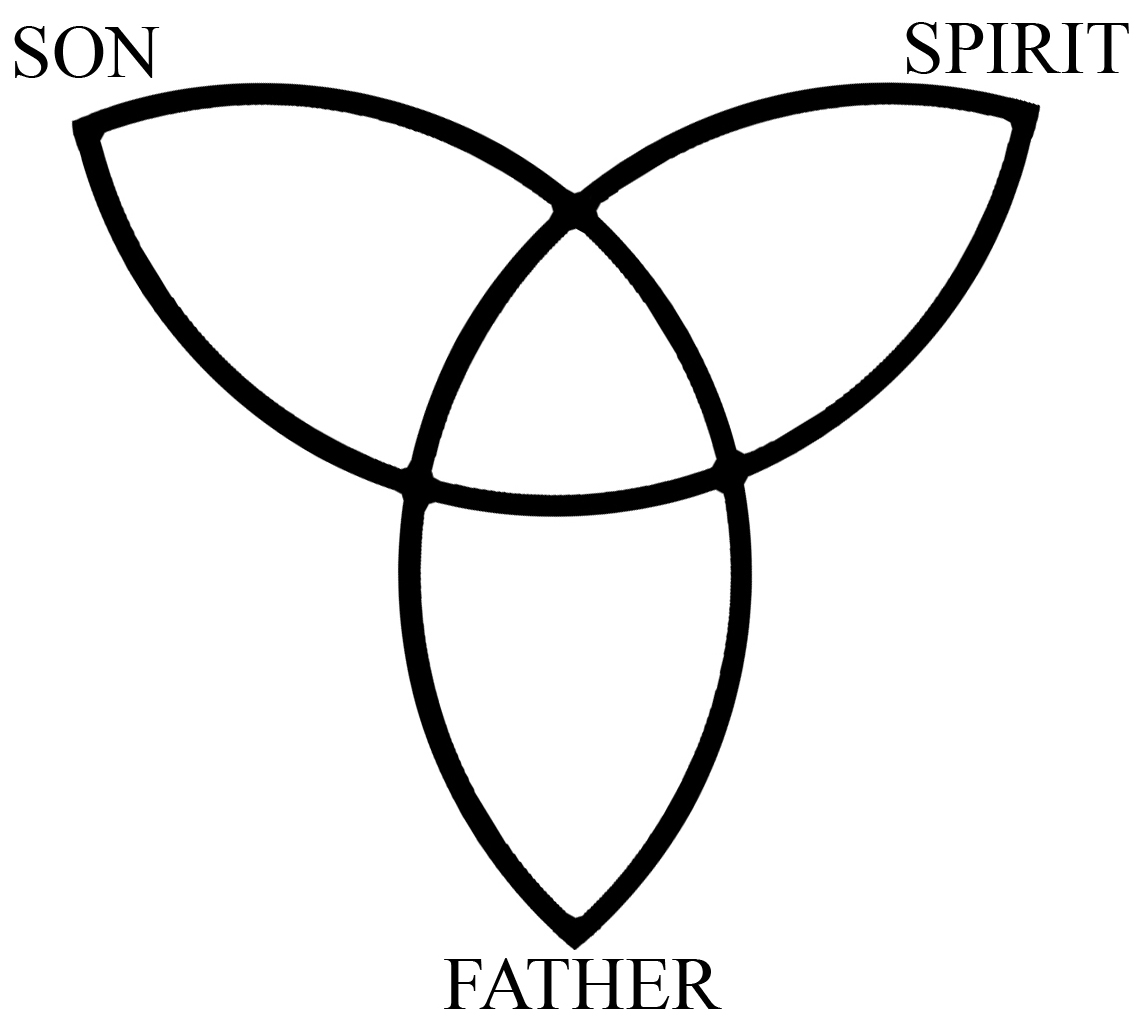
We understand God as “Triune,” meaning three in one. Father, Son, and Holy Spirit. But this can be a very difficult concept to understand. If there are three separate “persons” in the Trinity, how do they relate to one another? How can three be one?

Trinity

The theological term “perichoresis” describes how these unique persons relate. In Greek, the prefix peri means enclosing, surrounding, and the verb choreo means to make room for or to contain. The three are constantly moving in and through each other, and are perpetually indivisible. This movement is sometimes described as an “eternal dance” within the persons of the Trinity.

Trinity Knot w names

This relationship between Father, Son, and Spirit is, quite simply, perfect. The Trinity is a full, vibrant community in and of itself. Humanity was not needed in order to fill a vacancy in their spiritual communion. We are not needed to fill a function or to mitigate loneliness. The Trinity created us for relationship out of love and joy. Bishop Kallistos Ware puts it this way: “The world is not necessary to God; yet at the same time it is no way peripheral to his being or incidental, for it expresses the self-diffusive love that is precisely at the very heart of the living God.”

Through his life on earth, Jesus powerfully and inextricably linked the divine with the mortal. We have been invited to participate in the divine relationship, partnering with God in healing and transforming the world.

Trinity Knot w Us

How amazing it is to realize that God’s love for us is so great, that the same God who created the universe has invited us — small, flawed, wayward us — into loving relationship.

We are called to live iconically, leading with grace, humility, and joy because by doing so we are participating in the relationship of the Trinity, which has its foundation in that self-diffusive, self-giving love.

Next up: we’ll look at where we begin our quest to live and lead this way.

Question:
What does it mean to you that you have been invited to participate in the loving relationship of the Trinity?

Posted in Wired to Lead | Leave a comment

Wired to Lead: Agape

Wired To LeadWIRED TO LEAD: RECAPTURING JOY-FILLED LEADERSHIP

The definitions of leadership we looked at yesterday from Hebrew and Greek are based primarily on a human understanding of leadership. But are any of these THE style of leadership we should adopt? It makes sense at this point to look at how Jesus’s leadership jibes with — or does not jibe with — these styles.

Dictionary:

The idea of a leader as the one who is first, the highest, the one to be most honored was shattered by Jesus. Although Jesus was eventually understood to be the “head” of the church (ro’sh and kephalēn), during his lifetime he would say, “Foxes have dens and birds have nests, but the Son of Man has no place to lay his head” (Luke 9:58). His was not a place of honor among the elite of the land. As the Son of God Jesus was certainly the first (prōtos) among the creation to which he had come, but he was not recognized for his power or glory. The family chosen to raise the baby until he became a man was not influential or worldly, but impoverished and humble.

Then we have the concept of a leader as being the one “lifted up” (nasi’ and nagid) to be admired. Jesus said, “when I am lifted up from the earth, will draw all people to myself” (John 12:32). Instead of being honored as a leader to emulate, he was forcibly lifted up with his hands and feet nailed to a criminal’s cross. Although he possessed limitless power (dynatos), he did not use that power for himself, but only to heal and to demonstrate God’s power. He did not seek positional authority (melek, king, or sar, prince), but refused outright to be named as a worldly leader: “Jesus, knowing that they intended to come and make him king by force, withdrew again to a mountain by himself” (John 6:15). Jesus’s authority for leadership was not bestowed upon him, but was a part of his very nature. Nearing the time of his execution, he proclaimed: “My kingdom is  not of this world. If it were, my servants would fight to prevent my arrest by the Jewish leaders. But now my kingdom is from another place” (John 18:36).

Over and over again Jesus takes our temporal ideas of what a leader looks like, and turns them inside out.

So… where do we start?

I believe we start here: Mark’s gospel, chapter 12, verses 28 through 31. Jesus is asked to summarize the entire Jewish scriptures by telling the crowd which of all the commandments was the most important. Jesus did not hesitate or equivocate in his answer:
One of the scribes came near and heard them disputing with one another, and seeing that he answered them well, he asked him, “Which commandment is the first of all?” Jesus answered, “The first is, ‘Hear, O Israel: the Lord our God, the Lord is one; you shall love the Lord your God with all your heart, and with all your soul, and with all your mind, and with all your strength.’ The second is this, ‘You shall love your neighbor as yourself.’ There is no other commandment greater than these.”

All too often we begin our discussion of leadership with the leader: strengths, weaknesses, experiences, and opportunities. Or with the outward actions of leading: presenting with authority, creating teams, networking, the “how to” of leadership. These are important, of course, and we’ll be looking at leadership from these angles over the course of this series. But starting with the leader or the leader’s actions is not the right — or even best — place to start! We need to start exactly where Jesus tells us to: “Love the Lord your God.”

If we start anywhere else, we will be easily sidetracked. We can forget why we are in leadership, and who it is that we represent in our leadership. Love of God. That’s where we begin, both literally and figuratively.

The Greek verb we translate as “to love” — agapaó — is completely fascinating. The English version simply does not do it justice: (1) to feel great affection, (2) to feel romantic love for someone, (3) to like or desire, to take pleasure in. Agapaó is a much more powerful verb. It is love “based on evaluation or choice, a matter of will and action.”

Tomorrow we’ll look deeply into the implications of this type of love for our leadership… and for our lives.

Question:
When was the last time you felt truly joyful about leading?

Posted in Wired to Lead | Leave a comment

Wired to Lead: A Tale of Two Leaders

Wired To LeadWIRED TO LEAD:
RECAPTURING JOY-FILLED LEADERSHIP

For both personal and pastoral reasons, I tend to steer clear of political comments in my blog, Facebook posts, tweets, sermons, conversations. This has proved to be significantly more challenging living in the DC Metro than it was in South Florida!

But… that said…

Last Wednesday I was on the bike at the gym, and the news channel was toggling between Donald Trump and Pope Francis. They discussed at length Trump’s presidential campaign. Then moved to the Pope’s plans for the day in DC. Then back to Trump. Then to footage of the Pope stepping out of the Popemobile to kiss and bless a disabled child. Back and forth. And back and forth again.

DonaldAndFrancis

Regardless of what you think of Donald Trump and Pope Francis, it would be difficult to deny the wide disparity in their leadership styles. Both are famous leaders, and both have a large following. With such varying examples, it’s not surprising that we struggle to define leadership!

Trying to get to the bottom of it all and curious to see what the Bible had to say about leadership, several months ago I booted up my BibleWorks app and did a word search on “leader.” I learned that there are several Hebrew and Greek words used in the Bible to express different aspects of leadership. Many words in both of these ancient languages are interestingly nuanced, and it is telling that the catch-all English “leader” is represented by all the varied words below. So today let’s race through a few of these words…

[*nerd alert*] You ready?

The Hebrew word nasi’ has the meaning of “one who is lifted up.” This resonates with our image as the leader as the one in the spotlight, the person on the pedestal, the figurehead. Nasi’ is similar to another word translated as leader: nagid. Like nasi’, the root of nagid also indicates being lifted up, but here specifically being “placed high, conspicuous before a person.” The nagid leader is one who is held up before the people as an example.

The Hebrew ro’sh and Greek kephale are translated leader, but their literal meaning is “head.” This does overlap with nasi’ and nagid, as the head is the top, the “lifted up part” of the body. The understanding of the “head” as the one in charge is reflected in the English language, as well (e.g., department head, headquarters). Variations of ro’sh and kephale are also used in other contexts to speak of people and things that are the first, the highest, the best.

The Greek word prōtos means first in a series. In terms of leadership it denotes prominence, influence, and importance. As such, it has similarities with the Hebrew ro’sh and kephale, indicating first or best. This word can be seen in English words such as prototype or protocapitalism. Prōtos also has similarities with the Greek archon. This word for leader shares its root with the Greek arche used to begin the Gospel of John: “In the beginning was the Word.” In the beginning: en archē. Like prōtos, archon indicates primacy: a high official, important leader.

Mashal means to rule, have dominion, to govern. This word, used in Genesis 45:26 to refer to Joseph’s governance of the land of Egypt, is also used in the description of the fourth day of creation: “God set them [the sun and moon] in the dome of the sky to give light upon the earth, to rule over the day and over the night…” The flavor of this word is of organization, administration, direction.

The Greek word from which we get our English “hegemony” is hegéomai. The definition of hegemony is (1) preponderant influence or authority over others, (2) the social, cultural, ideological, or economic influence exerted by a dominant group. Interestingly, the Greek root has a very different overtone. It does mean to lead, or to have authority, but it is associated with wisdom resulting from deep consideration. Hegéomai refers to leadership through guidance as a culmination of deliberation of facts and context.

Another interesting, but rare, word for leadership is kathegetes. This word appears only twice, both in Matthew 23:10: “Do not be called leaders; for One is your Leader, that is, Christ” (NASB). Most English translations render kathegetes as “instructor,” “teacher,” or “master.” However, “leader” is a possible translation. If this word is to be included in our understanding of leadership, it would most closely resemble hegéomai, as a wise guide.

Contrast this with the term dynatos, which, in many ways, mirrors the modern cultural idea of a leader as someone who possesses power and influence. Dynatos is linguistically connected to the Greek word for power and strength, dynamis. This is leadership created and maintained through strength and influence. Dynatos speaks to the ability — the capacity — to lead.

There are other “leadership” words in the New Testament — such as archisynagogos (ruler of a synagogue), krinó (to rule over people), basileus (to rule as a king with complete authority), or exousiazó (to rule or reign by exercising authority) — but the above terms give a good, quick overview of the available Hebrew and Greek words which we translate wholesale as “leader.”

Tomorrow we’ll look at how Jesus lived out each of these leadership styles!

Question:
Which of the above styles most appeals to you, and why?

Donald Trump picture from Wikiquote. Pope Francis picture from WUSA9.

Posted in Wired to Lead | 2 Comments

Wired to Lead … Day One! :)

Wired To LeadWIRED TO LEAD:
RECAPTURING JOY-FILLED LEADERSHIP

I’ve been fascinated by leadership since the mid-90s, when my fabulous then-boss Bonnie Maraia gave me a book on how women lead in the workplace. I still have that book, along with shelves full of other books on leadership. I love to attend leadership conferences, both secular and Christian. I’m working on the last steps of a doctorate in leadership at Wesley Theological Seminary. I wake up in the middle of the night thinking about leadership, how to encourage leaders, how to grow my own leadership skills. Basically, I am a big, annoying leadership nerd.

But if you asked me to give you a quick, no-more-than-30-seconds description of exactly what leadership is, I still might struggle to find the words.

“Leadership” tends to be a rather amorphous term, thrown around indiscriminately. Depending on the context, it can reference radically different concepts: persuasive influence, authoritative arm-twisting, organizational activity. It can be defined as  being vested in a particular individual, being shared within a group, or toggling between individual and group. Leadership can be symbolic or concrete, structured or loose, forceful or gentle. It can be a relationship or a role, goal-oriented or process-centered. In his book Leadership for the Twenty-First Century, Joseph Rost asserted that “leadership is a word that has come to mean all things to all people.” Like Supreme Court Justice Potter Stewart’s explanation of pornography, when it comes to leadership, “we know it when we see it.”

In an attempt to simplify things, I went back to the basics: a plain old-fashioned dictionary, albeit the modern online version thereof. This is the definition of “leadership” that popped up: (1) the office or position of a leader, (2) the capacity to lead, and (3) an act or instance of leading.

Even such a simple definition has its issues, in addition to problematically using forms of the term “lead” within the definition of leadership. Definition (1) tells us that the only people in leadership are those with the official position of leader, something that you could print on a business card. And if leadership is defined by the ability to lead (definition 2), that necessarily implies that not everyone possesses the ability to lead. Finally (3) if you are not actively engaged in an officially sanctioned leadership position, then you are not actually a leader.

I did not find those definitions terribly helpful or illuminating. So, next I searched the dictionary for the definition of “leader.” A leader is … are you ready for it? … “a person or thing that leads.”

[Yep. Thanks for that clarification.]

Is leadership really that vague, context-specific, and difficult to define? Together we’re going to find out! Over the next few days and weeks, we’ll be taking a deep look at leadership: what it means. Who leads, and how. And most importantly: why.

I hope you’ll be along for the ride!

Question:
What definition of leadership have you heard or read that made the most sense to you?

Posted in Wired to Lead | 2 Comments

Wired to Lead

Wired To LeadOver the next few weeks, I’ll begin posting here about the “Wired to Lead” series and study. This project is my final work for a doctorate in ministry at Wesley Theological Seminary. It has been a great journey, and I’m looking forward to this part of it! I hope you’ll join me for the adventure!

Posted in Wired to Lead | 11 Comments

Remembering

Gramps

John 15:12-13 (New Living Translation)
This is my commandment: Love each other in the same way I have loved you. There is no greater love than to lay down one’s life for one’s friends.

I grew up hearing stories about my paternal Grandfather’s experiences in the Navy during World War II. My “Grampa Doc” — Dr. William Wallace Hall, Jr. — was a master storyteller, and even the most frightening episodes had an air of humor and suspense. One story that stands out in my memory is of his first solo surgery: a “routine” appendectomy.

The very young Dr. Bill Hall was brought onto his ship just out of medical school as an assistant physician. But when his senior officer was transferred to another ship, he suddenly found himself the head doctor in charge. One evening, a young man was brought into the infirmary with nausea and an intense pain in his side. Grampa immediately diagnosed it as acute appendicitis, and he knew what needed to happen. Only problem? This young doc had never performed the surgery by himself before!

He contacted the captain and suggested that the ship return to port, so that the sick man could receive treatment in more experienced hands. Grampa was told, in no uncertain terms, that this was not even remotely possible, and that the captain considered him to be more than capable of doing what was necessary.

Continue reading

Posted in Random Thoughts | Tagged , , , , , , , , , , | 2 Comments

Never Gives Up

Hosea 11:1-4 (New Living Translation)
When Israel was a child, I loved him, and I called my son out of Egypt. But the more I called to him, the farther he moved from me, offering sacrifices to the images of Baal and burning incense to idols. I myself taught Israel how to walk, leading him along by the hand. But he doesn’t know or even care that it was I who took care of him. I led Israel along with my ropes of kindness and love. I lifted the yoke from his neck, and I myself stooped to feed him.

ErinEddieChaseEarlier this month we greeted the newest member of our family: Chase Edward Coffin. All six pounds, nine ounces of him. We drove to Massachusetts to visit with his parents — but mostly just to coo over this precious new guy.

It was amazing to see Erin and Eddie transformed into loving parents. Chuck and I don’t have kids of our own, but we’re blessed with thirteen nieces and nephews… and Erin. When she was born (almost three decades ago now), I held her little four pound, four ounce body in my hand, and immediately fell in love. That moment, frankly, seems about five minutes ago. But now she and her husband of one year are “Mom and Dad,” and are loving it! Erin and Eddie will be great parents. They have so much love to give Chase, so many things to teach him. And I have no doubt that they will love him unconditionally and deeply every day of their lives.

The truth is that no matter what kind of love we have received (or, tragically, not received) from our earthly parents, God’s love is infinitely deeper and wider. God’s love is greater than anything we have ever experienced or could ever imagine. What an amazing picture of God we receive in today’s passage from the prophet Hosea. We see a God who created, nurtured, and cared for the people. A God who dreamed big dreams for his children, who hoped big hopes. And who then watched his children walk away from him, forgetting all that he had done for them.

But, like a truly loving parent, God never gives up!

Continue reading

Posted in Pondering Scripture | Leave a comment

Someone Ought To Do Something

Hands
Micah 3:9-11 (New Living Translation)
Listen to me, you leaders of Israel! You hate justice and twist all that is right. You are building Jerusalem on a foundation of murder and corruption. You rulers make decisions based on bribes; you priests teach God’s laws only for a price; you prophets won’t prophesy unless you are paid. Yet all of you claim to depend on the Lord. “No harm can come to us,” you say, “for the Lord is here among us.”

It often happens that we look at injustice and think to ourselves, “Someone really ought to DO something about that!” There is so much out of order in the world: poverty, violence, famine, homelessness, pollution, slave labor, addiction, elder abuse… the list could go on and on and on. It can be incredibly overwhelming to consider the need in our world — and the need right in our communities and families, as well.

The prophet Micah looked at the society in which he lived, and he felt God’s disgust for the abuses of power he witnessed. Fraud and vice in the leadership of both the government and the religious community. God’s heart was breaking for the people. In the midst of this corruption, Micah boldly proclaims: “But as for me, I am filled with power — with the Spirit of the Lord. I am filled with justice and strength to boldly declare Israel’s sin and rebellion” (3:8).

Micah did not allow the sheer volume of need to silence his voice. He relied on God’s power and strength to make the message known. And we can do the same! Because often when we have that strong feeling that “someone ought to do something,” God answers quietly to us, “Someone ought to do something? Perhaps that person… is you.”

Question:
What injustice have you observed — in person or in the media — that made your blood boil?

Posted in Pondering Scripture | Tagged , , , , | Leave a comment